DIRECCIÓN
No 1, Yd Road, distrito de Huishan, ciudad de Wuxi, Jiangsu. 214183
Horario laboral
De lunes a viernes: de 9:00 a 17:00
Sábado: 9:00 - 16:00
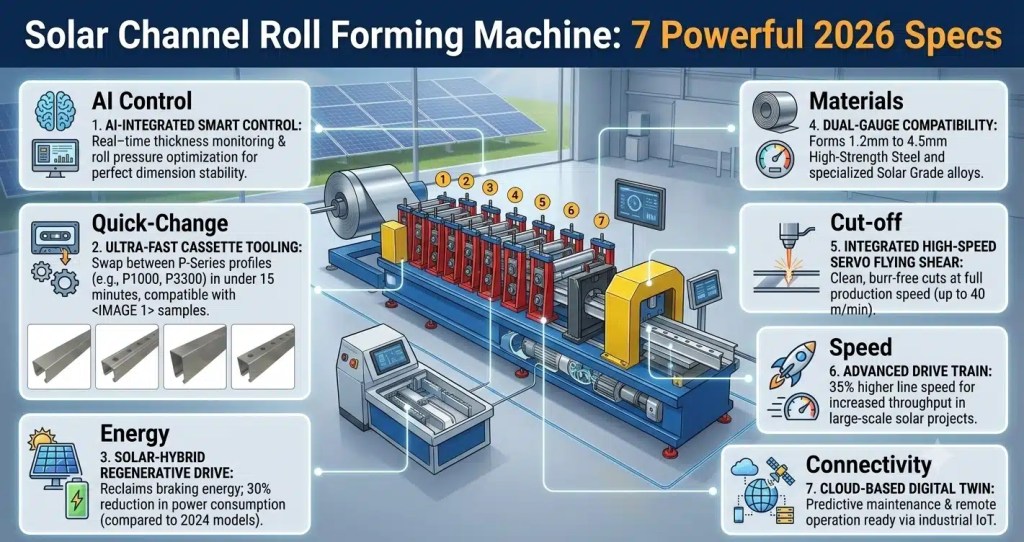
A Máquina perfiladora de canalones solares is a production line that turns galvanized steel coil into strut channel profiles used for solar panel mounting rails. Every PV array needs structural rails. Those rails are roll-formed channels with punched holes for clamps and brackets. The machine runs flat strip through decoil, level, punch, form, cut, and stack in one continuous pass, following the same layout as a standard máquina para fabricar paneles de techo de metal but with punching dies designed for solar clamp patterns.
Believe Industry Company has built solar channel roll forming machines for customers in 20+ countries over 15 years. This guide lists the P series strut channel types used in solar, the roll forming machines the solar industry relies on, and the specs that separate a good solar channel machine from a bad one.
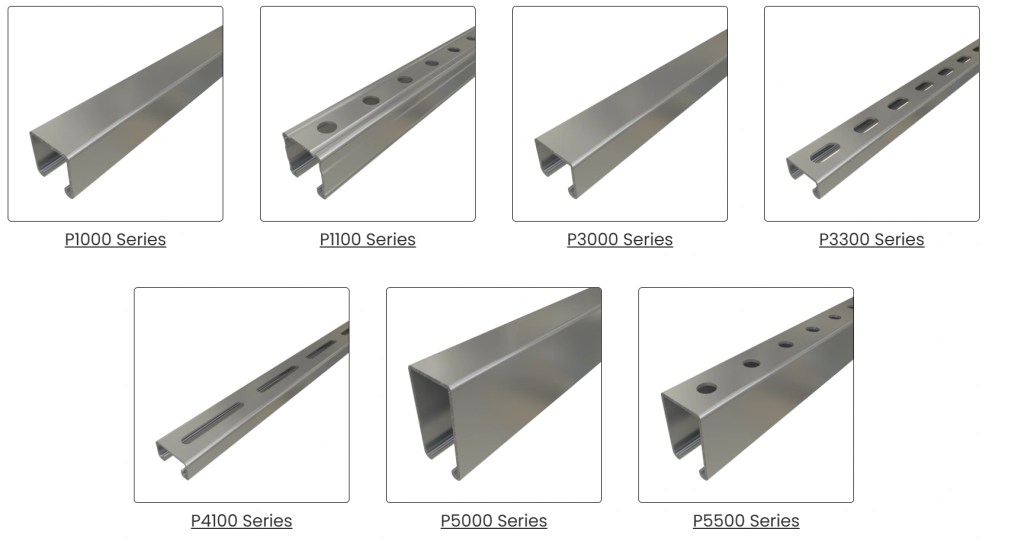
The P series is the standard profile family for strut channel production. In solar mounting, four series dominate.
P1000 is the backbone of solar racking. The 41 x 41 mm square profile and 2.7 mm wall thickness handle the bending loads that ground-mount and rooftop arrays demand. Solar installers use P1000 variants based on clamp and fitting requirements.
A Máquina perfiladora de perfiles para perfiles solares configured for P1000 solar rails runs 2.7 mm galvanized steel at 20-50 m/min. The pre-punching unit is critical because hole position accuracy determines whether clamps slide and lock correctly.
P1100 shares the same 41 x 41 mm profile as P1000 but uses 1.9 mm material. Lighter loads, lower cost. Some rooftop solar systems specify P1100 when structural calculations allow thinner material. A Máquina perfiladora de canales Uni Strut sized for P1000 thickness also runs P1100 by adjusting roll gaps. The máquina perfiladora de estanterías para palets uses the same quick-change approach for thick and thin profiles.
P300 is the shallow-profile option. Half the depth of P1000. Used in wall-mounted solar installations and low-load racking where a full 41 mm depth channel is not needed. The Máquina formadora de perfiles de canal ranurado produces P300 with fewer forming stations (14-16 vs 18-22 for P1000) because the bend depth is shallower.
P5000 combines slots and round holes in the same channel length. Solar racking designers use P5000 when the rail needs to accept adjustable clamps (slots) and fixed brackets (round holes) simultaneously. The punching die for P5000 is the most complex in the P series.
| P Series | Profile (mm) | Espesor (mm) | Patrón de agujeros | Solar Application |
|---|---|---|---|---|
| P1000 | 41 x 41 | 2.7 | Slotted/solid | Ground-mount, rooftop rails |
| P1100 | 41 x 41 | 1.9 | Solid | Light-duty rooftop rails |
| P300 | 41 x 21 | 2.7 | Ranurado | Wall-mount, shallow racking |
| P5000 | 41 x 41 | 2.7 | Slots + round holes | Mixed clamp/bracket rails |
Solar mounting systems need more than just strut channel rails. Here are the five roll forming machine types that produce the structural components for PV installations.
The core machine. Produces P1000, P1100, P300, and P5000 profile rails with punched holes for solar clamps. This is the machine covered in detail on the C strut roll forming machine page. Line speed ranges from 20 m/min for standard punching to 60 m/min for high-volume production with flying punch systems.
Produces the C-shape, Z-shape, and hat-shape brackets that connect rails to posts or roof anchors. These brackets are 100-300 mm long with punched bolt holes. The machine uses servo feeding and stop-cut for short, precise pieces.
A wider-profile machine for brand-specific solar rails. Unlike standard strut channel, solar rails have custom cross-sections designed by the racking manufacturer. The upright rack máquina perfiladora de rodillos shares the same decoil-to-stack layout with different roll tooling for wider profiles.
Produces the vertical support posts for ground-mount solar arrays. Posts are typically C-shape or H-shape profiles in heavier material (3.0-4.5 mm). The machine uses a heavier frame, larger shaft diameter (90-120 mm), and more drive torque compared to a standard solar channel machine.
Cable management runs alongside every solar array. The máquina formadora de rollos para bandejas portacables produces ladder tray, perforated tray, and channel tray that carry DC and AC cabling between inverters and panels. For solar farms, perforated cable tray in 1.5-2.0 mm galvanized steel is the standard choice.
| Tipo de máquina | Profile Output | Material (mm) | Solar Use |
|---|---|---|---|
| Solar strut channel roll former | P1000/P1100/P300/P5000 | 1.9-2.7 | Rails and clamps |
| Solar bracket machine | C, Z, hat shapes | 1.5-3.0 | Rail-to-post connectors |
| Solar rail machine | Custom wide profiles | 1.5-2.5 | Brand-specific rails |
| Solar post machine | C, H heavy profiles | 3.0-4.5 | Ground-mount verticals |
| Cable tray machine | Ladder, perforated | 1.0-2.5 | DC/AC cable routing |
Not every strut channel machine works well for solar. Here are the seven specifications that matter.
Solar rails require precise hole patterns. Pre-punching puts holes into the flat strip before forming. This avoids hole deformation on the curved channel surface. Servo-driven hydraulic punching positions each hole within ±0.5 mm along the strip length. That accuracy is what makes standard solar clamps slide and lock correctly.
A solar channel roll former with flying punch capability runs at 30-50 m/min without stopping for each hole sequence. For lower volume, a stop-punch system works but limits practical speed to 15-20 m/min.
| Nivel de velocidad | m/min | 8-hr Output (3m rails) | Ideal para |
|---|---|---|---|
| Estándar | 20-30 | 3,200-4,800 pcs | New solar manufacturers |
| High speed | 40-50 | 6,400-8,000 pcs | Established solar racking suppliers |
| Ultra high | 60+ | 9,600+ pcs | Large-volume exporters |
Solar channels run in galvanized steel (GI) and pre-galvanized steel (PG). The machine must handle both without surface marking. Hard-chrome-plated rolls prevent zinc coating damage during forming. For stainless solar rails (marine and coastal installations), PU-coated rolls are the right choice. The same surface protection principle applies to the máquina formadora de rollos de láminas onduladas when running pre-coated material.
The roll set determines the final profile shape. Believe Industry designs and machines all roll sets in-house to the buyer’s exact P series drawing. No generic tooling. This matters for solar because the lip geometry and return flange dimensions affect how clamps grip the rail.
Solar rails are cut to specific lengths that match array row spacing. A flying hydraulic cutter with encoder feedback delivers ±1 mm cut accuracy. Stop-cut systems achieve ±2 mm but interrupt line speed.
Solar racking manufacturers often supply rails to multiple brands. Each brand has a different hole pattern. A Máquina perfiladora de canalones solares with replaceable punch inserts allows pattern changes without replacing the entire die set. Changeover time drops from 4-8 hours to 30-60 minutes. The same quick-change principle applies to the máquina formadora de rodillos de doble capa when switching between profiles.
Store punching patterns, cut lengths, and line speeds as recipes in the PLC. Switch between P1000T solar rails and P1100 standard rails with one button. No manual adjustments. Siemens PLC with touch screen is the standard control package from Believe Industry.
Antes de solicitar un presupuesto, confirme estos parámetros:
Believe Industry reviews all seven parameters and returns a line layout drawing with floor space, utility requirements, and output estimates. For multi-profile lines, the proposal includes changeover time between P series variants.
P1000 is the most common choice. The 41 x 41 mm profile at 2.7 mm thickness meets structural requirements for most ground-mount and rooftop solar projects. P1000T (slotted) is the specific variant most solar racking designers specify because slots allow clamp position adjustment.
Yes, if the machine is built for the thickest material. A P1000 machine at 2.7 mm can also run P1100 at 1.9 mm by adjusting roll gaps. For P300 or P5000, you need separate roll sets and punching dies. Quick-change tooling reduces swap time to 30-60 minutes.
Pre-punching with servo hydraulic positioning. Solar rails need precise hole patterns for clamp compatibility. Pre-punching on the flat strip avoids hole deformation. Servo positioning holds hole accuracy to ±0.5 mm. Flying punch systems maintain line speed during punching.
Standard lines run 20-30 m/min. High-speed lines with flying punch and gearbox transmission reach 40-60 m/min. At 30 m/min, an 8-hour shift produces approximately 4,800 three-meter rails. At 50 m/min, output doubles to 8,000 rails per shift.
Galvanized steel (1.5-3.0 mm), pre-galvanized steel (1.5-2.5 mm), stainless steel 304/316 (1.5-2.5 mm), and aluminum (1.5-3.0 mm). Most solar rails use hot-dip galvanized steel at 2.0-2.7 mm. Marine and coastal installations may require stainless or aluminum.
A single-profile machine takes 45-60 days. A multi-profile machine with quick-change tooling takes 60-75 days. Believe Industry supplies interchangeability drawings before production starts.
Last updated: July 2026
Believe Industry Company: Roll forming machine manufacturer and exporter, over 15 years of experience. Shipped to 20+ countries.
External References:
Introducción Un sistema de estanterías para palets no es un solo producto. Es...
Leer másUna máquina perfiladora de canales solares es una línea de producción que transforma...
Leer másUna máquina perfiladora de láminas para techos no es una compra que se adapte a todas las necesidades.
Leer másLa máquina para paneles de techo PBR no es solo otra máquina...
Leer másSuscríbete ahora para seguir leyendo y obtener acceso al archivo completo.