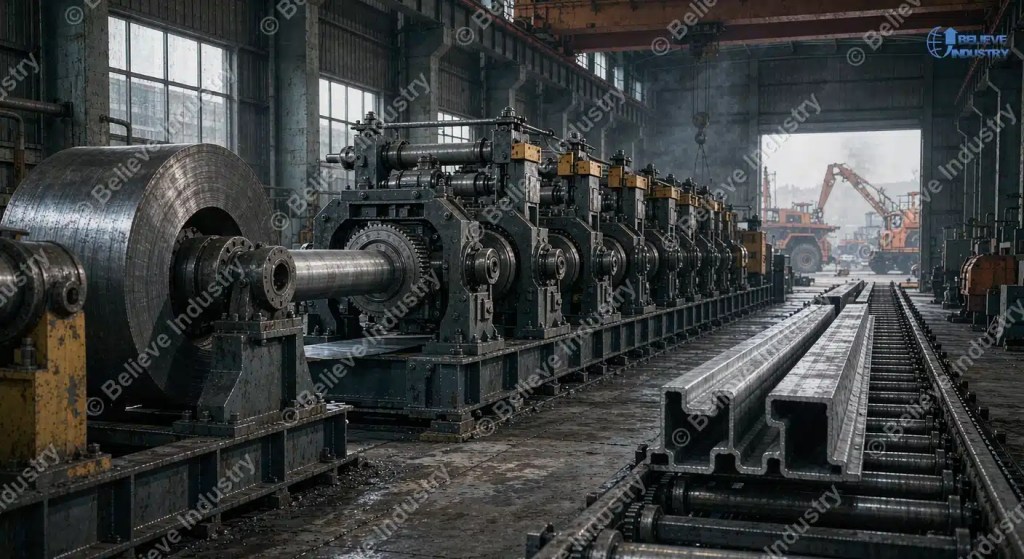
Uma máquina de conformação por enrolamento para mineração é uma linha de conformação de serviço pesado construída para bobina espessa, normalmente de 2,0 a 6,0 mm de aço de alta resistência. Ela conforma armações de roletes de transportadora, canais de longarina, secções estruturais em C e Z, tubagens de ventilação e bandejas de cabos para instalações de mina. Este guia mostra como adequar o laminador ao trabalho.
Resposta curta: Uma máquina de conformação por enrolamento para mineração é uma linha de serviço pesado classificada para bobina de 2,0 a 6,0 mm e aço de alta resistência. Produz armações de roletes de transportadora, canais de longarina, secções estruturais, tubagens de ventilação e bandejas de cabos. Classifique o laminador para a sua bobina mais espessa, e não para a média, porque é isso que protege a tolerância e a produção num contrato de mineração.
Porque é que os fabricantes perto de instalações de mina compram a sua própria linha
As instalações de mina ficam longe do centro de serviços de aço mais próximo. Um suporte de substituição pode demorar seis semanas a chegar por estrada ou barcaça. Um fabricante a um dia de viagem de um distrito mineiro transforma essa espera numa entrega na mesma semana, e uma máquina de conformação por enrolamento para mineração no local retira a estrada e a barcaça da equação.
Os números fazem o caso. Uma campanha de substituição de transportadora pode consumir 100,000 metros de canal de longarina num trimestre. Os perfis conformados por enrolamento expedem-se como feixes encaixados, o que reduz o volume de frete em 30 a 50 por cento.
Uma linha de máquina de conformação por enrolamento classificada para bobina espessa transforma essa procura em trabalho local. A máquina de conformação por enrolamento para mineração certa transforma a fraqueza de um local remoto numa vantagem do fabricante.
A gama de espessura da bobina determina tudo
Uma máquina de conformação por enrolamento para mineração vive ou morre pela sua gama de bobina. As estruturas de transportadora de superfície usam aço de alta resistência de 3,0 a 6,0 mm. Os suportes de roletes e as bandejas ficam mais baixos, entre 2,0 e 3,0 mm. Especificar a linha para a sua bobina mais espessa, e não para a média, protege a tolerância em todos os perfis que corre. Uma máquina de conformação por enrolamento para mineração classificada para 6,0 mm lida com trabalho de 3,0 mm sem esforço, enquanto uma linha de 3,0 mm nunca o fará.
Os graus de baixa temperatura e alta resistência com um limite de escoamento mínimo garantido de 350 a 550 MPa são a norma para longarinas. A ASTM International publica as normas de grau de aço e de método de ensaio a que os certificados de laminador se referem. O certificado tem de corresponder à norma de projeto estrutural do concurso.
O nosso guia sobre como selecionar bobina de aço para conformação por enrolamento cobre em detalhe os graus de limite de escoamento e os certificados de laminador. A bobina espessa altera também o cálculo da largura do desenvolver, que o nosso guia de cálculo da largura da bobina analisa para trabalho de espessura elevada.
Estrutura do laminador: veios, estações e acionamento
Conformar aço de alta resistência de 6 mm exige um binário que um laminador de espessura ligeira não consegue fornecer. Linhas de mineração de serviço pesado usam veios de 60 a 90 mm e estações acionadas por engrenagens em vez de correntes. As estações vão de 16 a 26, porque a bobina espessa precisa de dobras graduais. Uma máquina de conformação por enrolamento para mineração construída nesta estrutura mantém o passo dos furos e a forma do perfil estáveis ao longo de um turno longo.
As estações acionadas por engrenagens mantêm o binário durante toda a sequência de passagens. Uma transmissão por corrente escorrega sob bobina de 6 mm. O comprador de uma máquina de conformação por enrolamento para mineração que especifica um conjunto de engrenagens evita o desvio no passo dos furos que aparece centenas de suportes depois.
A produção de puncionamento é o verdadeiro estrangulamento
Os suportes de roletes têm um padrão de furos a cada poucos centímetros. O puncionamento servo em linha segue a chapa em movimento sem a parar, razão pela qual determina a produção real no trabalho de suportes. Uma prensa lenta estrangula um laminador rápido, e a falta esconde-se na estação de puncionamento até a produção subir. Especificar bem a estação de puncionamento é onde a maioria dos compradores de máquinas de conformação por enrolamento para mineração ganha ou perde produção.
Os laminadores de suportes com puncionamento em linha correm a 20 a 30 m/min com furos de montagem puncionados em linha, pelo que cada suporte se aparafusa sem retrabalho. O ferramental de puncionamento muda em minutos quando uma norma da mina difere da do contrato anterior.
Os compradores que avaliam a produção devem ler metros por turno contra valor por metro. O nosso guia de conformação por enrolamento de grande volume explica essa compensação para linhas de espessura elevada.
Nivelador e corte para bobina espessa
A curvatura residual da bobina transmite-se para desalinhamento dos suportes e torção das longarinas se não for eliminada antes da conformação. Todas as linhas pesadas devem incluir um nivelador-motor classificado para a espessura máxima. Omiti-lo é um erro comum e caro. Uma máquina de conformação por enrolamento para mineração sem nivelador deita fora a tolerância que toda a linha foi comprar para manter.
A bobina espessa precisa de um cisalhamento hidráulico de serviço pesado com um ângulo de corte limpo. As arestas sem rebarba importam para a soldagem e para a segurança dos instaladores junto a arestas de 6 mm. Uma máquina de conformação por enrolamento para bandejas de cabos construída para a mesma gama de serviço partilha esta lógica de ferramental.
Sistema de revestimento: ponha-o no contrato
Os ambientes de mineração estão entre as piores condições de serviço do aço. A ferrugem na aresta de corte de bobina galvanizada simples numa mina subterrânea ácida aparece dentro de dois anos. A bobina de zinco-magnésio resiste muito melhor ao progresso da corrosão na aresta de corte. O comprador de uma máquina de conformação por enrolamento para mineração que escreve o revestimento no contrato evita as disputas de garantia que se seguem à ferrugem da aresta de corte.
A galvanização a quente após a fabricação protege melhor as arestas puncionadas do que a bobina pré-galvanizada isoladamente. Os sistemas duplex acrescentam uma camada de topo para as secções mais severas. Ponha a especificação do revestimento no contrato, porque os concursos de mineração citam a vida em serviço.
Adequar a linha ao perfil
| Perfil | Espessura da bobina | Velocidade típica de linha | Tipo de máquina |
|---|
| Armações e suportes de roletes | 2.0 to 4.0 mm | 20 to 30 m/min | Laminador de suportes com puncionamento servo em linha |
| Canais de longarina de transportadora | 3.0 to 6.0 mm | 12 to 20 m/min | Laminador estrutural pesado, acionado por engrenagens |
| Secções estruturais em C e Z | 2.0 to 4.0 mm | 15 to 25 m/min | Laminador de purlins CZ com troca rápida de medida |
| Painéis e tubagens de ventilação | 2.0 to 4.0 mm | 12 to 20 m/min | Laminador de painéis largos com formação de nervuras |
| Escada e bandeja de cabos | 2.0 to 3.0 mm | 15 to 25 m/min | Laminador de bandejas com puncionamento de serviço pesado |
Uma linha de máquina de conformação por enrolamento de purlins cobre a procura de C e Z. Uma máquina de conformação por enrolamento de perfis de canal no mesmo laminador cassete serve os perfis de suporte da série P que as plantas de mina usam juntamente com as bandejas. Escolher uma máquina de conformação por enrolamento para mineração para a mistura certa de perfis é a diferença entre uma linha que se paga e uma que fica parada.
Custo e retorno
Uma linha de espessura elevada de perfil único arranca perto de 70,000 USD. Uma linha multiperfil que cubra suportes, longarinas, purlins e bandejas corre de 120,000 a 220,000 USD consoante a automatização. Linhas totalmente automatizadas com puncionamento servo e amarração em pilha ultrapassam 250,000 USD. Essa gama reflete o que uma máquina de conformação por enrolamento para mineração pode render, e não apenas o que custa.
O caso de retorno assenta em três coisas: frete poupado em feixes encaixados, tempo de paragem evitado com stock local e utilização mantida alta entre campanhas de mineração. Fabricantes que já produzem secções estruturais para sistemas de estantagem para paletes encontram os perfis de mineração como uma extensão natural, porque os graus de bobina e as capacidades de máquina se sobrepõem.
Cinco erros de compra
Estes cinco erros aparecem em quase todas as compras de máquinas de conformação por enrolamento para mineração, e cada um é evitável.
Especificar o laminador para a sua bobina média, e não para a mais espessa. Uma linha que trata bem 4 mm mas encrava aos 6 mm falha no instante em que cai uma encomenda de longarinas. Classifique o laminador para a bobina mais espessa que vai correr.
Confiar no número de velocidade máxima do fornecedor. Esse valor assume bobina fina e ausência de puncionamento. Peça a produção no seu perfil e padrão de furos reais, porque a densidade de puncionamento determina a velocidade real dos suportes.
Pedir galvanizado simples para poços húmidos. A ferrugem na aresta de corte de bobina Z275 numa mina subterrânea ácida aparece dentro de dois anos. Zinco-magnésio ou sistemas duplex custam mais por tonelada e muito menos por ano de vida em serviço.
Omitir o nivelador. A curvatura da bobina espessa transforma-se em torção das longarinas e desalinhamento dos suportes. Instale um nivelador-motor classificado para a espessura máxima em todas as linhas pesadas.
Tratar as normas da mina como opcionais. A AS/NZS 4600 e a família AISI S100 aparecem nos concursos de mineração por uma razão. Um perfil que falha a revisão de projeto atrasa todo o conjunto, e não apenas essa linha. Os contextos europeus de equipamento também referenciam a orientação da FEM sobre armazenamento de aço e estruturas.
Fatores de especificação regionais
| Região | Foco mineiro | Fatores de especificação | Perfis comuns |
|---|
| Austrália | Minério de ferro, carvão | AS/NZS 4600, vento ciclónico, controlo de qualidade rigoroso | Longarinas, purlins, tubagens |
| Chile e Peru | Cobre | UV de alta altitude, sísmico, normas NCh | Estruturas de transportadora, edifícios |
| África do Sul | Platina, ouro, fundições profundas | Normas SANS, ventilação profunda | Tubagens, contraventamento em arco, bandejas |
| Indonésia | Níquel, carvão | Humidade alta, sísmico, logística de exportação | Purlins, bandejas, suportes de roletes |
| Golfo e África do Norte | Pólos industriais | Padrões NEMA, calor extremo | Bandejas, montantes, secções estruturais |
Os fabricantes que entram nestes mercados devem esperar um pacote de documentação, e não apenas um produto. Uma máquina de conformação por enrolamento para mineração vendida nestas regiões vive ou morre dessa documentação, e não da velocidade do catálogo.
A máquina de conformação por enrolamento para mineração certa é uma ferramenta de margem, e não uma despesa de capital. Adeque-a à sua bobina mais espessa, especifique o puncionamento, escreva o revestimento no contrato, e a linha ganha o seu lugar no parque.





 English
  Español
 Português
 Русский
 العربية
 Bahasa Melayu
 Türkçe
 ไทย
ไทย
 Bahasa Indonesia