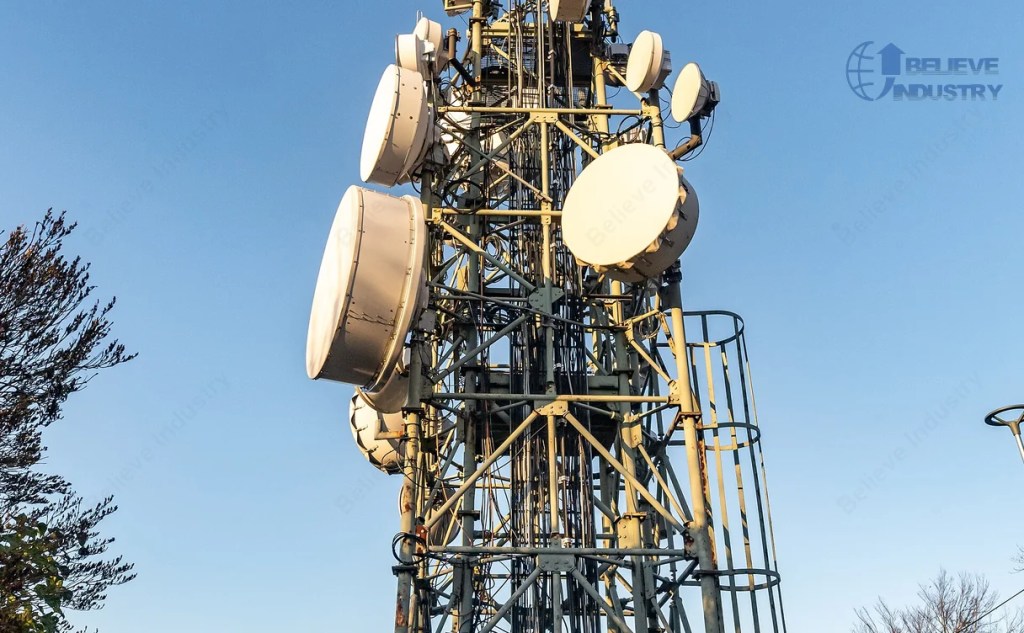
telecom roll forming machine

Telecom Roll Forming Machines: 4 Tower Component Profiles for 5G Builds

Need a Roll Forming Machine for Your Project?
Obtenha um orçamento gratuito da Believe Industry — mais de 15 anos de fabricação de máquinas de conformação sob medida.
Solicite um orçamento Download Catalogue

Telecom Roll Forming Machines: 4 Tower Component Profiles for 5G Builds

A telecom roll forming machine turns steel coil into the tower members, antenna mount channels, cable ladders, and equipment shelter frames that every 5G site is built from. One line can serve a lattice tower fabricator, a monopole producer, and a small cell structure supplier from the same coil stock. Roll forming machine lines with cassette tooling make that spread possible.
Resposta curta: A telecom roll forming machine is a roll forming line configured for wireless infrastructure profiles: lattice tower leg angles and bracing, antenna mount channels and boom rails, tower cable ladder and trough, and equipment shelter frames. These lines run 1.5 to 6.0 mm coil at 10 to 30 m/min, punch hole patterns in line, and cut to length for bolted site assembly.

Why Telecom Fabricators Bring Forming In House

Wireless build has changed shape. Small cell densification means more sites, smaller structures, and shorter lead times. A macro tower order in 2015 might justify buying fabricated sections. A 2026 small cell programme needs forty mounts in six weeks. Three numbers explain why in house forming wins now:
  1. Order size. Small cell work breaks into batches of 20 to 60 units, each with different lengths and hole positions. A service centre prices every variation separately.
  2. Galvanizing economics. Hot dip galvanizing charges by weight and by dip cycle. Pre galvanized coil skips the dip on non structural brackets.
  3. Site tolerance. Tower and mount parts bolt together with slotted holes. A supplier tolerance gap turns into a rework crew on a tower crane day.
The equipment is the bottleneck, not the steel. Forming capacity is cheap relative to tower crane time.
telecommunication tower antenna mount roll forming profiles

Four Telecom Profile Families

1. Lattice Tower Leg Angles and Bracing

Lattice towers are built from equal angle and channel sections bolted at the corner. The leg angle carries compression and buckling load over a 3 to 6 m length. Bracing angles take wind shear across each bay.
Roll forming handles angle sections continuously from 1.8 to 6.0 mm coil. Two details decide certification. First, leg length tolerance, usually within plus or minus 3 mm because bolted connections depend on it. Second, hole concentricity through the leg.
The line that suits this work runs a servo punch at the cutoff end, so holes and length share one encoder reference.
antenna mount channel on a lattice mast

2. Antenna Mount Channels and Boom Rails

Antenna mount channel is the backbone of rooftop and tower mounting. The standard section is a U shaped channel with fixing holes on pitch, usually 50.8 mm centres. Panel antennas clamp to the channel face, and booms bolt through the web.
The volume product in 5G work is the small cell mount frame: a short length of mount channel with a bent mounting plate. Roll forming handles the channel; a press brake handles the plate.
Hole pitch is the commercial spec. Most mount channels run 50.8 mm pitch to match standard antenna bracket hardware. Tighter pitch gives more fixing points but costs more punching cycles.
lattice tower leg angle and bracing members

3. Tower Cable Ladder and Trough

Cable ladder runs up the inside of a lattice tower or along a monopole, carrying coax feeder and fibre. It is a lighter duty cousin of industrial cable tray: two side rails and formed rungs, with a bottom option for shielded installs.
A cable ladder roll forming machine runs 1.5 to 2.5 mm pre galvanized coil. Rung pitch decides how much cable the ladder carries, and tighter rungs reduce the effective bundle size.
Galvanizing matters more here than on any other telecom profile. Coax and fibre in a wet tower hold water after the first storm. ASTM A653 coating weights decide service life, and a ladder with thin coating fails first at the rung ends where the cut edge exposes bare steel.
cellular antenna cluster on a telecom tower

4. Equipment Shelter Frames and Platforms

Site shelters and enclosures use C and U channel frames, plus flat bar and angle for platforms and handrails. Channel frame from 2.0 to 3.0 mm coil covers most of it.
Platform handrail is a common roll formed section: two channel rails joined by formed posts. Galvanized platform sections go onto rooftops and rural hutches where site painting is never done. Shelter frames also need holes for door hardware, gland plates, and cable entry, which inline punching handles without a downstream drilling operation.

Matching the Line to the Profile

PerfilEspessura da bobinaVelocidade da linhaKey in line featureCommon pitfall
Tower leg angle3.0 to 6.0 mm10 to 20 m/minServo punch plus precision cutoffHole concentricity through the leg
Bracing angle1.8 to 4.0 mm15 a 25 m/minShort cut length controlLength drift over a 4 m run
Antenna mount channel2,0 a 3,0 mm20 to 30 m/min50.8 mm pitch punchingPitch drift without encoder feedback
Small cell mount frame2,0 a 3,0 mm20 to 30 m/minPunch plus plate feed stationTwo stage setup cycle time
Tower cable ladder1.5 to 2.5 mm15 to 30 m/minRung forming in the millRung end coating failure
Shelter C channel2,0 a 3,0 mm20 to 35 m/minInline punch for gland platesOver punching at the cutoff
Speed numbers describe the mill, not the finished part. A 3 m channel at 50.8 mm pitch needs about 59 punches. Add a servo press cycle of 0.25 s per stroke and the practical ceiling sits well below the 30 m/min headline. How to reduce coil changeover time covers recoverable setup time.

Steel Grades and Coatings

AplicativoNota típicaGrossuraRevestimentoNotas
Tower leg angleASTM A36 or A572 Gr 504.0 to 6.0 mmHot dip galvanised to ISO 1461Structural, fully dipped
Tower bracingASTM A362,5 a 4,0 mmHot dip galvanisedBolted splice faces
Antenna mount channelASTM A653 Gr 502,0 a 3,0 mmPre galvanised G90Skips the dip entirely
Cable ladderASTM A6531.5 to 2.5 mmPre galvanised G90 minimumRung ends are the weak point
Shelter frameASTM A6532,0 a 3,0 mmPre galvanised G90Door hardware holes
Platform handrailASTM A362.0 to 2.5 mmPre galvanised G90Rooftop exposure
Grade 50 becomes the default once wind load pushes section sizes down. Higher yield means less steel per tower, but bolt hole elongation governs. A punched hole in Grade 50 elongates more under load than mild steel, so edge distance rules still apply. The coil width and thickness calculation guide maps coil limits to profile geometry.
For galvanizing, ISO 1461 governs coating thickness across most export markets. North American buyers often specify ASTM A123 instead. The two are close but not identical, so confirm which one applies before writing coating weights into the order.
telecom monopole tower with mounted equipment

Tooling Strategy and Common Failures

A telecom fabricator rarely runs one profile. A typical week mixes tower leg angle, mount channel, ladder, and shelter channel. A multi spec cassette mill swaps cassettes between families in 2 to 3 hours. Four failures account for most service calls:
  • Twisted tower angle. Uneven roll gap across the width, or coil with cross bow. Check coil flatness first.
  • Hole drift along a long run. A punch cam slipping or an encoder that lost count. Fit the cam tight and log encoder resets.
  • Rusted rung ends. The cut edge exposes bare steel. Heavier coating is cheaper than galvanizing finished ladder at volume.
  • Seam leak on shelter channel. Most channel is rolled, not welded. Specify an interlocking seam where sealed.
Prove one piece per profile before the run, and check the flower pattern on a flat blank first.

How Buyers Specify the Line

Three numbers define most roll forming machine enquiries. First, coil width, since tower angle and mount channel rarely share coil. Second, monthly tonnage, which sets whether one mid size mill suffices. Third, punch duty, since 50.8 mm pitch channels are far heavier on the press than bracing.
Buyers who arrive with a profile drawing and a monthly volume get the fastest quote. How to select steel coil helps prepare it.

Perguntas frequentes

Q: What profiles can a telecom roll forming machine produce?

A: The four core families are lattice tower leg angles and bracing, antenna mount channels and boom rails, tower cable ladder and trough, and equipment shelter frames including platform handrail. Cassette tooling switches between families in 2 to 3 hours.

Q: How fast does a telecom roll forming machine run?

A: Antenna mount channel and shelter frame run 20 to 30 m/min. Tower leg angle and bracing run 10 to 25 m/min because of heavier gauge and higher punch duty. Punching density decides real output, not mill speed.

Q: What steel grade is used for telecom tower members?

A: ASTM A36 for bracing and mild sections, with ASTM A572 Grade 50 used where wind load drives section sizing down. Antenna mount channel usually runs ASTM A653 Grade 50. Bolt hole elongation governs the final decision.

Q: Are telecom profiles hot dip galvanized or pre galvanized?

A: Structural tower sections are hot dip galvanized to ISO 1461 or ASTM A123. Mount channels, ladder, and shelter frames run pre galvanized coil, commonly G90, because they either skip the dip or batch with other work.

Q: How many punches per part affect output?

A: A 3 m antenna mount channel at 50.8 mm pitch needs about 59 holes. With a servo press cycle near 0.25 s per stroke, punching sets the output ceiling well below the mill headline speed. Size the press before the rolls.

Q: Which standards apply to telecom steel supply?

A: ASTM A36 and A572 cover structural grades. ASTM A653 covers pre galvanized sheet. ISO 1461 or ASTM A123 governs hot dip coating. EN 10025 covers European mill certificates.

Principais conclusões

  • A telecom roll forming machine serves four profile families: tower angle and bracing, antenna mount channel, tower cable ladder, and shelter frames.
  • Small cell volume is the reason in house forming now wins. Small batches and fast lead times break service centre economics.
  • Punching duty sets real output. Size the servo press for the hole pitch before sizing the mill for speed.
  • Coating decides field life more than grade. Ladder rung ends and cut edges fail first on thin coating.
  • Cassette tooling pays off above four profile families, which is normal for tower plus 5G work.

Related reading

Registo de alterações do artigo

Originally published: September 30, 2026
Última atualização: 2026-09-30
Registro de alterações:
  • 2026-09-30: First publish. Built around four telecom profile families with a line matching table, steel grade table, tooling and failure section, six FAQ, and an answer block. Added ASTM, ISO 1461 and internal links with the pillar page.
Next Review Triggers:** A tower structural code revision, a 20 percent shift in small cell mount channel search interest, an ASTM A653 coating availability change for 2.0 to 3.0 mm coil, or a new servo punch speed class.

Índice

Novas atualizações

Descubra mais sobre Believe Industry Company| Roll Forming Machine Manufacturer, Supplier & Exporter

Assine agora para continuar lendo e ter acesso ao arquivo completo.

Continue lendo