Home / Roll Forming Machine / Metal Sheet Roll Forming Machine / Monterey V1100 Tile Roll Forming Machine

Monterey V1100 Tile Roll Forming Machine

One Profile, One Pass: What the Line Produces

A Monterey V1100 tile roll forming machine turns prepainted steel coil into the metal tile sheet that Russian and CIS roofers call Monterrey: 350 mm tile step, 39 mm profile height, 1,100 mm of usable cover. Believe Industry has built this line since 2005, and each unit is assembled to the buyer’s profile drawing rather than to a catalogue shape.

Short answer: a Monterey V1100 tile roll forming machine runs 0.3 to 0.8 mm prepainted steel from a 1,250 mm coil, forms the tile through 16 stands, punches and cuts in one hydraulic stroke, and delivers 3 to 4 m/min of finished sheet. A 5 t coil yields about 1,020 running metres, or 1,120 m² of finished roof.

The Monterey Profile in Numbers

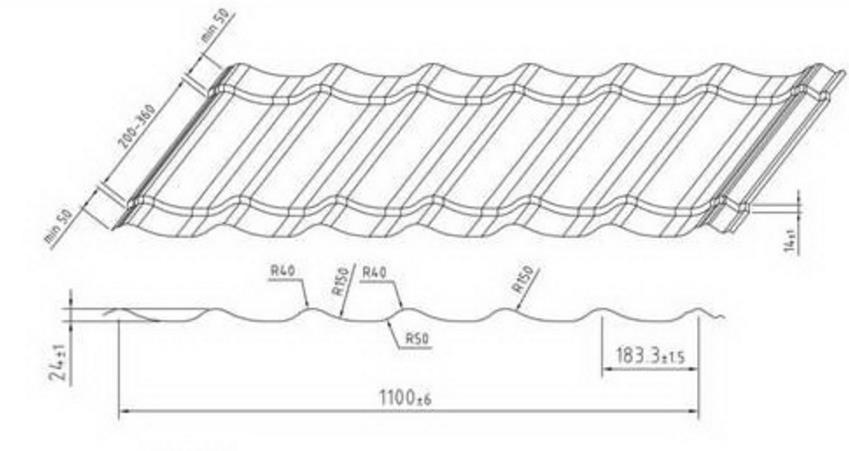
Monterey is the most widely installed metal tile profile in Russia, and every Monterey V1100 tile roll forming machine is tooled around that same geometry, standardised enough for a buyer to compare suppliers line by line. The standard module is 350 mm, with 300 mm and 400 mm variants produced for regional tastes. Two capillary grooves run along the overlap, and they separate a real Monterey sheet from a plain stamped tile: they break the water path wind pushes under the lap.

Monterey V1100 roof tile

The same name covers two profiles, which is the first thing to settle before tooling is cut. The CIS version is tall and pronounced. The North American version is much shallower. Both need different rolls.

Profile dataCIS Monterrey, TS39 typeNorth American Monterey
Profile height39 mm15 mm
Tile step350 mm, with 300 and 400 mm variants350 mm
Effective width1,100 mm1,100 mm
Total sheet width1,180 mm1,200 mm
Steel thickness0.4 to 0.5 mm typical, 0.3 to 0.8 mm on request0.4 to 0.6 mm
Weight at 0.5 mm4.7 kg/m²5.0 kg/m²
Minimum roof pitch8 to 14 degrees, check local code18 degrees

Ruukki lists the TS39-350-1100 module as 39 mm high, 350 mm stepped and 1,100 mm effective, which is the reference most Russian tenders quote.

From Coil to Stacked Sheet: Line Configuration

On a Monterey V1100 tile roll forming machine the flow is simple, because a tile line earns money on uptime. Coil loads on a manual uncoiler, the strip is guided into 16 forming stands, the punch and cut unit works in one hydraulic stroke, and sheets leave on a collection table. A film unit sits before the mill when the sheet is bound for sea freight.

Monterey V1100 Tile Roll Forming Machine

Sixteen stands is the number that matters on a Monterey V1100 tile roll forming machine. A shallow profile can hold tolerance with twelve. A 39 mm tile with a capillary groove cannot. Each stand carries rolls in ASTM 1045, quenched and tempered, then chrome plated to 0.05 mm so the prepainted face is not marked.

ItemSpecification
Coil thickness0.3 to 0.8 mm
Coil width1,250 mm maximum
Coil weight5 t, manual uncoiler with tension brake
Coil inner diameter480 to 520 mm
Coil outer diameter1,350 mm maximum
Forming stands16
Roll materialASTM 1045, quenched and tempered, hard chrome 0.05 mm
ShaftASTM 1045, 80 mm diameter
Forming motor7.5 kW
Forming speed12 m/min
Line speed3 to 4 m/min including punch and cut
Hydraulic station11 kW, 12 to 16 MPa
Punch and cut mouldCR12, quenched to HRC 58 to 62, one body
ControlPanasonic PLC, Yaskawa inverter, Omron encoder, MCGS touch screen, 20 recipes
Power supply380 V, 50 Hz, 3 phase, overload protected
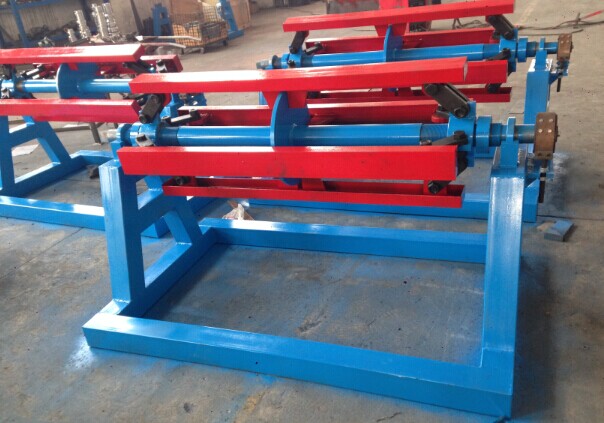
Manual Uncoiler

Line Speed, Cycle Time and Real Shift Output

The mill on this Monterey V1100 tile roll forming machine turns at 12 m/min. The line does not. Every sheet stops for the punch and the cut, so the number that belongs in a business plan is the 3 to 4 m/min line speed. Quoting it loses credibility with a buyer who already runs a tile line.

At 70 percent uptime, which allows one coil change and normal handling, one shift produces the tonnage below. Heavier coil is slower in the mill and needs a longer cut cycle.

Coil thicknessLine speedMetres per 8 h shiftCovered area per shift3.5 m sheets
0.4 mm4.0 m/min1,344 m1,478 m²384
0.5 mm3.5 m/min1,176 m1,294 m²336
0.6 mm3.0 m/min1,008 m1,109 m²288
0.8 mm2.5 m/min840 m924 m²240

Planning figures, not a guarantee. Hand stacking loses 10 to 15 percent against an automatic stacker, and week one always runs slower than week three.

Punch, Cut and the Polymer Film Unit

On the Monterey V1100 tile roll forming machine, fastening holes, ridge fixing holes and the end cut all happen in one hydraulic station. The punch and the blade share a single body, so the sheet cannot shift between the two operations. That is why the cut edge stays square on a 39 mm profile, and why hole spacing repeats within a millimetre.

Tile Roll Forming Machine Mould

The mould is CR12 tool steel, hardened to HRC 58 to 62. On two shifts the blade is reground about once a year, and a spare insert set is worth ordering with the machine rather than after the first dull cut.

The film unit on this Monterey V1100 tile roll forming machine is not cosmetic. A prepainted sheet that spends six weeks in a container can arrive with scuffed paint along the lap, and the customer sees that scuff before they see the profile. A 50 micron film applied before forming removes the argument at roughly two percent on coil cost.

Coil Width, Cover Width and Material Yield

Cover width is where a Monterey V1100 tile roll forming machine makes or loses money, and the arithmetic is easy to check. A 1,250 mm coil feeding a 1,180 mm sheet leaves 35 mm of trim each edge, so 5.6 percent of the steel leaves as scrap. A 1,180 mm coil removes the trim but leaves no room for guiding error.

At 0.5 mm, one square metre of steel weighs 3.93 kg, so a 1,250 mm strip weighs 4.91 kg per running metre. A 5 t coil gives 1,019 running metres, which covers 1,121 m² at 1,100 mm effective width. Put that number in front of any buyer comparing a 1,100 mm line with a 1,130 mm competitor.

The same sheet in 0.45 mm gives 1,131 running metres per coil, so thickness moves output on a Monterey V1100 tile roll forming machine by about 11 percent.

Options That Change the Quote

A base Monterey V1100 tile roll forming machine forms, punches, cuts and stacks by hand. Most buyers add two or three, each with a clear trigger.

OptionWhat it changesAdd it when
Hydraulic uncoiler with coil carCoil change drops from 20 minutes to 5More than three coil changes per shift
Automatic stackerRemoves one operator, 15 to 25 sheets per minuteShift output above 900 m²
Servo feederLength tolerance within plus or minus 0.5 mmPanels are pre-cut for a fixed module
Quick change cassetteProfile swap in 2 to 3 hoursYou sell 300, 350 and 400 mm steps
Polymer film unitProtects paint through sea freightExport shipments over 30 days
Remote diagnosticsEngineer access without a visaLine sits outside your service region

How to Specify Your Line

Five checks settle the specification of a Monterey V1100 tile roll forming machine before a quotation is written. Skip one and the machine arrives with the wrong rolls.

One, the drawing. Send it with step, height and cover width marked. A photo is not a drawing, because the groove depth is invisible.

Two, the coil supply. Confirm 1,180 or 1,250 mm, and the inner diameter. A 508 mm coil does not fit a 480 mm mandrel.

Three, the thickness range. A line tooled for 0.4 to 0.6 mm will run 0.3 mm sheet, but the profile springs back differently. State the real range.

Four, the pitch and the code. Monterey is rated from 8 degrees in some markets and 14 in others. That number sets the overlap and the sheet length list.

Five, the power supply. 380 V at 50 Hz is standard here, and 415 V or 440 V at 60 Hz is a build option, not a field conversion.

Buyers who also sell flashings pair this line with a roof ridge cap roll forming machine so the roof package ships complete. If the mix is broader than tiles, compare a metal roof tile roll forming machine and a glazed tile roll forming machine before fixing the profile.

Delivery, Commissioning and Support

A Monterey V1100 tile roll forming machine is normally ready in 45 to 60 days from drawing approval, packs into two containers, and commissions in 7 to 10 days with operator training. Spare rolls, punch inserts and a wiring diagram travel with the unit.

Believe Industry has shipped Monterey V1100 tile roll forming machines since 2005 to 50+ countries, with 500+ machines completed and 80+ engineers and technicians on design and commissioning. The works hold ISO 9001, and machines carry CE marking.

The profile is the one part of the purchase that cannot be fixed later without new tooling. Compare width options against a roofing sheet roll forming machine if you also supply trapezoidal panels, and read the steel tile profile roll forming machine page when profile height stays under 30 mm.

Coating and corrosion data for prepainted steel are published by the American Galvanizers Association, the TS39 module is documented by Ruukki, and steel recycling rates sit with worldsteel.

Send the profile drawing and coil data through the contact page, and the quotation for your Monterey V1100 tile roll forming machine returns with the roll set, cassette option and container plan.

Frequently Asked Questions of Monterey V1100 Tile Roll Forming Machine

What is a Monterey V1100 tile roll forming machine?

A line that produces the Monterey metal tile sheet, 1,180 mm wide with 1,100 mm of effective cover, a 350 mm step and a 39 mm profile height. It forms, punches, cuts and stacks in one pass at 3 to 4 m/min.

What coil width does it need?

1,250 mm is the standard maximum, which leaves 35 mm of trim each side and absorbs guiding error. A 1,180 mm coil saves 5.6 percent of steel but leaves no margin.

Can one Monterey V1100 tile roll forming machine run 300, 350 and 400 mm steps?

Not with a single roll set. The step is cut into the rolls, so each module needs its own tooling, or a cassette that swaps in 2 to 3 hours. Buyers who sell all three modules order the cassette frame with the first line.

What steel thickness can it form?

This Monterey V1100 tile roll forming machine forms 0.3 to 0.8 mm, with 0.45 to 0.5 mm the sweet spot. At 0.8 mm the line runs near 2.5 m/min and cut tonnage rises, so confirm the hydraulic specification when heavy gauge is a regular product.

How much does a Monterey V1100 tile roll forming machine produce per shift?

At 0.5 mm and 3.5 m/min, one 8 hour shift produces about 1,176 running metres, equal to 1,294 m² of roof or 336 sheets at 3.5 m. Output scales with line speed until the stacking crew becomes the bottleneck.

What is the difference between Monterey and glazed tile?

Monterey uses a stepped wave with two capillary grooves and a 39 mm rise. Glazed tile profiles are deeper and rounder, often 55 mm, and imitate a ceramic barrel tile. Both run on the same line architecture, but rolls and sheet width are not interchangeable.

Last updated: 2026-11-02
Article Changelog
2026-11-02: Full rewrite with profile and machine tables, shift output data, six FAQs and current internal links.
Next Review Triggers
Coil supply or profile drawing changes for the Monterey module
New step module or coating option is released
Roof pitch rules change in a target market

Quick Inquiry

Send us your requirement — we'll reply within 24 hours.

Click or drag files here
PDF, DWG, DXF, STEP, PNG, JPG — Max 20MB

Inquiry Sent Successfully!

Thank you for your interest in Believe Industry.
Our engineering team will get back to you within 24 hours.

Need urgent response? Email enquiry@believeindustry.com

Table of Contents

Latest Posts Believe Industry

Buying Guider & Machinery Technology & Maintainence Tips