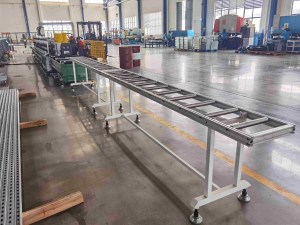
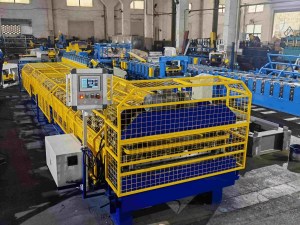
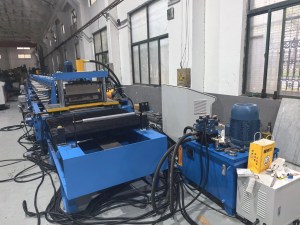
Roll forming is a cost-effective, continuous process where flat sheet metal coils are progressively bent into complex cross-sections. This is achieved by passing the metal through sets of contoured roller dies mounted on successive stands. The gradual, sequential bending minimizes stress on the material while ensuring exceptional consistency over extremely long lengths.
To get a complete overview of how this technology integrates into different industries, we encourage you to read our comprehensive article: The Complete Guide to Roll Forming Technology.
1. Key Advantage: Unmatched Dimensional Precision
One of the foremost advantages of roll forming machine is its ability to maintain extremely tight dimensional tolerances along the entire length of the profile. This consistency is difficult, if not impossible, to achieve with traditional press-brake forming for components exceeding a few feet in length.
Achieving Superior Accuracy
The precision stems from two core elements: the sequential nature of the dies and the durability of the tooling. Each roller station performs a minor, controlled bend. By the time the metal reaches the final station, the desired shape is achieved incrementally, eliminating spring-back issues and ensuring identical cross-sections, whether the profile is 10 feet or 10,000 feet long. This accuracy is crucial for interlocking components and structural applications.
If you want to understand the material science behind dimensional control, particularly when the process is performed at room temperature, review our previous discussion: Amazing Benefits: Unlocking 5 Cold Roll Forming Secrets.
2. Key Advantage: Material Versatility and Structural Integrity
The second set of advantages of roll forming machine relates directly to the types of materials it can handle and how it improves their inherent structural properties. Unlike processes limited to softer metals, roll forming can efficiently process high-strength, low-alloy (HSLA) steels, stainless steel, aluminum, and copper.
Enhanced Strength and Surface Quality
As the metal passes through the rollers, the process induces work hardening, particularly in cold roll forming. This means the finished component is often stronger than the parent material, ideal for critical structural applications. Furthermore, the smooth, hardened tool steel rollers impart a superior surface finish, which is often a final finish, eliminating costly secondary operations like grinding or polishing. This focus on material optimization makes roll forming environmentally and financially attractive.
For further reading on the latest advancements in processing ultra-high-strength steel using specialized roll forming techniques, check out this external industry resource: Advanced Roll Forming Materials Guide.
3. Key Advantage: Unbeatable Scalability and Cost Efficiency
The final, and perhaps most impactful, of the advantages of roll forming machine is its unmatched economic performance at scale. When high-volume output is required, the per-unit cost drops dramatically, making it superior to machining, welding, or extrusion.
Low Operating Costs and High Speeds
The process is highly automated and continuous, meaning a single machine can run for hours with minimal operator oversight, drastically reducing labor costs. Production speeds typically range from 30 to over 300 feet per minute, enabling massive daily output. The high-speed capability is particularly valuable for long-run components like metal decking, purlins, and industrial racking.