The entire production cycle is a continuous, integrated chain. Each of the following seven stages is dependent on the flawless execution of the preceding one. Any interruption or error at an early stage can propagate throughout the entire line, underscoring the need for precision machinery and diligent oversight.
1. Coil Handling and Staging (The Uncoiler)
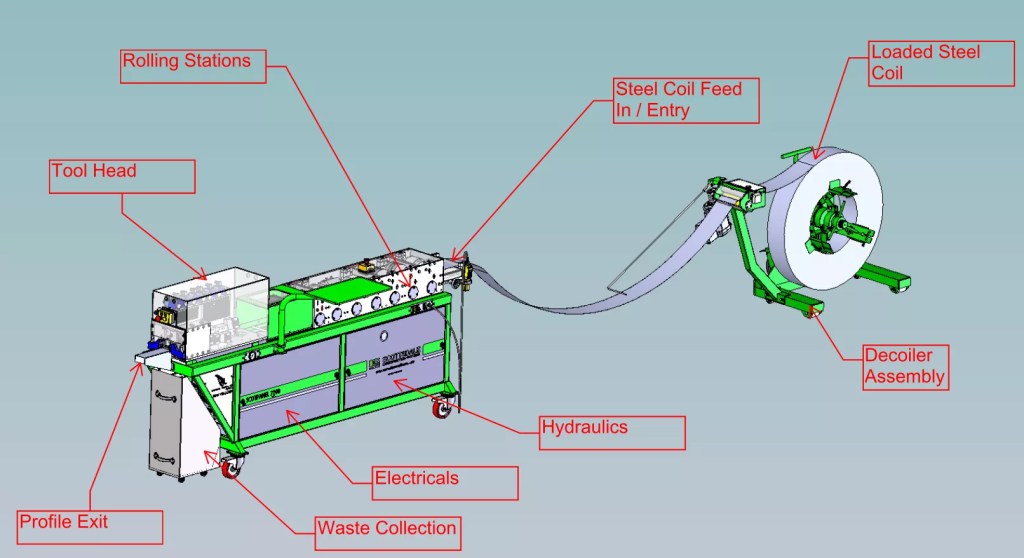
The Roll Forming Process begins long before the metal enters the machine. The first step involves selecting the correct coil and loading it onto the uncoiler or decoiler. This piece of equipment holds the heavy metal coil and allows the strip to feed into the line. The tension and speed must be precisely controlled here to prevent sudden jerks or slack, which could damage the strip or the subsequent equipment.
2. Strip Entry and Preparation
Once unwound, the metal strip passes through the entry guide and often a leveler or flattener. This is a crucial preparatory stage of the Roll Forming Process. The entry guide ensures the strip is perfectly centered before engaging the rollers. The leveler removes any residual curvature or camber from the coil, ensuring the material is perfectly flat and ready for the demanding work of forming. Without proper leveling, dimensional accuracy throughout the profile will be compromised.
3. The Core Forming Stations
This is the heart of the 7 Steps of the Roll Forming Process. The strip passes sequentially through a series of roll stands, each equipped with custom-designed roller dies. Each stand imparts a gradual change in the cross-section. Instead of making one sharp bend, the metal undergoes multiple small bends, minimizing stress and eliminating spring-back. The number of stations depends on the complexity of the final profile (simple profiles might use 8 stations; complex ones up to 30 or more).
4. Component Integration (Punching, Notching, & Cutting)
For many applications, holes, slots, or notches need to be added to the profile. This step typically occurs either before the forming stations (pre-punching) for simpler profiles or after the forming stations (post-punching) for complex profiles. The mechanism must be synchronized precisely with the line speed to ensure every feature is placed accurately according to the profile length.
5. Cut-Off/Separation
The fifth step involves cutting the continuous profile to the final specified length. High-speed flying shears or saws are commonly used. These cutters move at the same speed as the forming profile at the moment of the cut, ensuring a clean, precise, and square end without interrupting the continuous flow of the Roll Forming Process. This high-speed synchronization is a major engineering achievement in modern machinery.
6. Outfeed and Handling
After the profile is cut, it exits the machine onto an outfeed table or conveyor. This stage must handle the newly cut piece gently and quickly to prevent scratches, bending, or piling up, especially when producing long, lightweight, or easily damaged profiles. Automation here, such as automated grippers or magnetic conveyors, is key to maintaining quality.
7. Stacking and Packaging
The final of the 7 Steps of the Roll Forming Process is organizing the finished profiles for shipment or further processing. Automated stackers arrange the profiles into neat, counted bundles. Proper packaging ensures the profiles are protected from damage during transit to the job site or customer warehouse. High-quality packaging reflects the professionalism of the manufacturer.





 English
  Español
 Português
 Русский
 العربية
 Bahasa Melayu
 Türkçe
 ไทย
ไทย
 Bahasa Indonesia