Address
No 1, Yd Road, Huishan District, Wuxi City, Jiangsu. 214183
Work Hours
Monday to Friday: 9AM - 5PM
Saturday: 9AM - 4PM
Address
No 1, Yd Road, Huishan District, Wuxi City, Jiangsu. 214183
Work Hours
Monday to Friday: 9AM - 5PM
Saturday: 9AM - 4PM
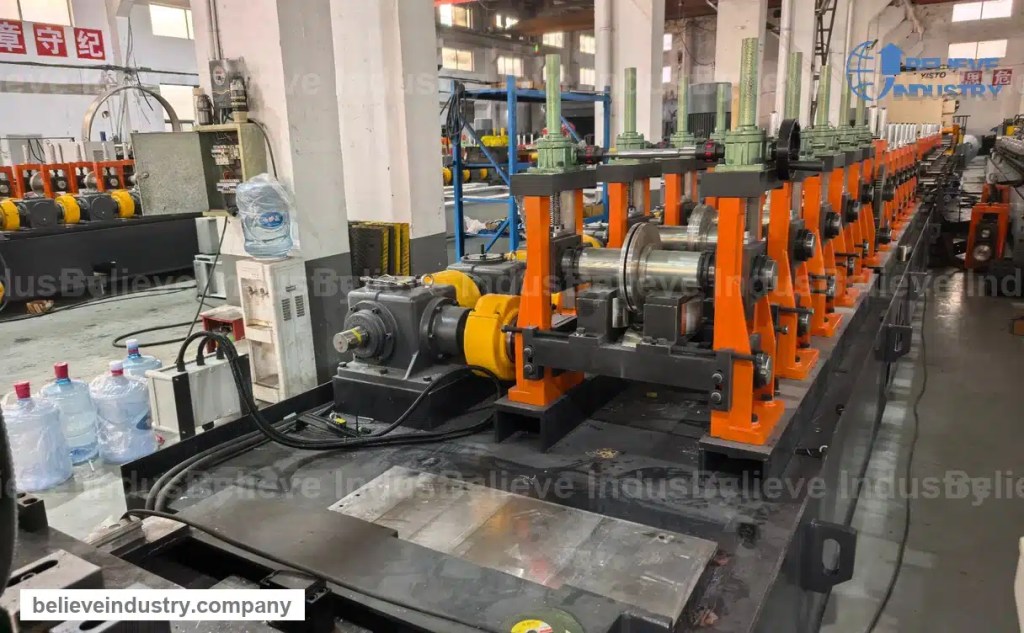
Short answer: A strut channel roll forming machine cost runs from about $28,000 for a 2 to 4 m/min hydraulic line to about $150,000 for a 25 to 30 m/min servo-feed line or a 40+ m/min rotary-punch line. Frame type, profile size, and optional add-ons move the total.
A strut channel roll forming machine cost depends first on how fast the line must run. Speed decides the punching method, the machine frame, and most of the budget. If you are new to the product, read what is a strut channel first, then return to price. This guide breaks the market into four speed tiers, shows what each tier includes, and lists the add-ons that change the final number.
The table below maps line speed to the punching method, the frame you should expect, and a realistic price band. Speeds appear in both metric and feet per minute so buyers in the US and metric markets read the same line.
| Line speed | Speed (fpm) | Punching method | Typical frame | Price (USD) |
|---|---|---|---|---|
| 2 to 4 m/min | 6.6 to 13 fpm | Hydraulic punch and cutoff (stop to punch) | Wall-plate chain | about $28,000 |
| 15 to 20 m/min | 49 to 66 fpm | Servo tracking punch, non-stop cutoff | Wall-plate chain | about $100,000 |
| 25 to 30 m/min | 82 to 98 fpm | Servo feed with high-speed punch press | Cast-iron gearbox | about $150,000 |
| 40+ m/min | 131+ fpm | Rotary punch (continuous) | Cast-iron gearbox | about $150,000 |
These bands cover a standard P1000 or slotted strut profile in mild steel up to 2.5 mm. Thicker coil, wider channels, or extra hole patterns raise the strut channel roll forming machine cost inside each tier.

A 2 to 4 m/min line is the entry build. It uses a hydraulic punch that stops the strip, punches the holes, then a hydraulic shear cuts to length. The frame is usually wall-plate chain construction. This strut channel roll forming machine cost lands at about $28,000 and suits shops with low to medium daily volume.
A 15 to 20 m/min line adds a servo tracking punch. The press follows the moving strip and punches without stopping it, so the cutoff is also non-stop. Output climbs several times over the entry tier. Expect about $100,000 for a line of this class, the kind often shipped to regional suppliers covered by our Mexico market guide.
A 25 to 30 m/min line moves to a servo feed with a high-speed punch press. The heavier duty needs a cast-iron housing gearbox frame for rigidity. This strut channel roll forming machine cost runs about $150,000 and fits continuous shift production.
A 40+ m/min line uses a rotary punch that stamps holes while the strip flows through continuously. Few suppliers build this reliably. The price of about $150,000 reflects the precision tooling and the cast-iron gearbox base it requires, the same economics behind high-volume roll forming lines.
The punching method is the largest single cost driver after speed. Four methods appear in the market:
Each step up in punching method comes with a stronger frame and drive, which is why the tiers rise from $28,000 to $150,000. Buyers often over-spec the punch and pay for speed they never use. Match the method to your real daily footage, and review our punching die installation guide before committing to a hole pattern.


Two frame styles dominate, and they are not interchangeable on size. Wall-plate chain (also called cantilever or wall-board) uses plates bolted to a base with chain drive. It is light, easy to service, and economical. Its limit is profile size: it handles channels up to 1-5/8 x 1-5/8 inches (41 x 41 mm), the standard single strut.
The cast-iron housing gearbox uses a rigid iron frame with a geared drive train. It holds tolerances at high speed, absorbs punch reaction without deflection, and handles wider channels up to 1-5/8 x 3-1/4 inches (41 x 82 mm), including the deep strut used in racking and solar.
The frame choice adds about $60,000 when you move from wall-plate chain to cast-iron gearbox. A wall-plate chain line suits a single 41 x 41 mm profile at low to medium speed. Above 20 m/min, or whenever the channel exceeds 1-5/8 x 1-5/8, the gearbox is required. A strut channel roll forming machine cost quote that mixes a gearbox frame with a low-speed punch is usually misconfigured.
Beyond speed, the profile itself moves the number. A plain P1000 channel is cheaper to tool than a slotted section, because slotting needs an extra punch station with tight pitch control. Coil thickness from 1.5 to 2.5 mm runs on standard rolls; 3.0 mm and above needs heavier stands and a stronger frame, which adds $5,000 to $15,000.
A heavier or slotted profile raises the strut channel roll forming machine cost by $5,000 to $15,000 before any speed upgrade. Steel grade matters too. Many export jobs specify electro galvanized or pre galvanized coil, which runs fine through the line. Coating choice affects storage and corrosion resistance, not the machine price, but it changes the delivered cost per meter.
Channels are built to dimensional standards such as NEMA VE-1 in North America, while international projects align with IEC and EN references for cable support systems.
Most quotes start with the base line and add modules. The common ones:
| Option | What it does | Added cost |
|---|---|---|
| Coil end shearing and butt welder | Joins coil ends so the line runs without stopping for changeover | about $6,500 |
| Auto stacker | Stacks finished channels and counts them automatically | about $25,000 |
A coil end shearing and butt welder matters most on high-speed lines where stopping to swap coils wastes minutes every hour, and it costs about $6,500. An auto stacker cuts labor on any tier and costs about $25,000. Neither is required, but both raise the strut channel roll forming machine cost in exchange for lower running cost. Other options such as extra punch stations are quoted per project. A proper coil slitting setup upstream also reduces scrap.


Three real-world builds show how the numbers land:
These scenarios show why a single price quote is misleading. The strut channel roll forming machine cost is really a configuration question, and a multi-profile line can spread the investment across several product families.
Start from your required daily footage, not from a budget number. A line running 8 hours at 3 m/min makes roughly 1.4 km of channel a day. The same hours at 30 m/min make over 14 km. If you need under 2 km per day, the entry tier is correct and saves $40,000 plus. If you ship containers weekly, the 25 to 30 m/min tier protects delivery promises.
The right strut channel roll forming machine cost is the one matched to footage, not the cheapest quote on paper. Believe Industry has built custom roll forming lines since 2005, with 80+ engineers and 500+ projects delivered to 50+ countries under ISO 9001 and CE. We size the punching method and frame to your actual profile and volume, so the strut channel roll forming machine cost reflects production need rather than a catalog default.
The US market guide covers import and compliance steps for North American buyers.
Q: What is the lowest strut channel roll forming machine cost for a working line?
A basic 2 to 4 m/min line with hydraulic punching and a wall-plate chain frame starts around $28,000. Add freight and tooling for your profile, and most buyers land near $32,000. An auto stacker adds about $25,000 more.
Q: Why does a high-speed line cost about $150,000?
Both the 25 to 30 m/min servo-feed line and the 40+ m/min rotary-punch line land around $150,000. The rotary-punch tier needs continuous tooling and a cast-iron housing gearbox to hold tolerance at speed, and wider or multi-strand builds go higher. The tooling and frame precision are the cost drivers, not the roll stands.
Q: Is a cast-iron gearbox frame worth the extra money?
It adds about $60,000 over a wall-plate chain frame, and it is the only frame that handles channels up to 1-5/8 x 3-1/4 inches (41 x 82 mm). The wall-plate chain frame tops out at 1-5/8 x 1-5/8 inches (41 x 41 mm). For lines above 20 m/min, or any channel wider than 41 x 41 mm, the gearbox is required. Below 20 m/min on a single 41 x 41 mm profile, wall-plate chain is enough and lowers the strut channel roll forming machine cost.
Q: Does a coil end shearing and butt welder pay back?
On high-speed lines it does, because it removes the stop to change coils. At about $6,500 it is a modest add-on that pays back fastest on 25 to 30 m/min and 40+ m/min lines. On a 3 m/min line the savings are small, so the cost is hard to recover.
Q: How much does an auto stacker add?
An auto stacker adds about $25,000. It removes one manual handling step and is worthwhile on any line running more than a single shift.
Q: Can one line make both P1000 and slotted strut?
Yes, with quick-change or cassette tooling. The multi-profile setup adds cost but lets a single strut channel roll forming machine cost cover several product lines.
*Last updated: 2026-10-24*
*Article Changelog: 2026-10-16: Initial publication. 2026-10-24: Revised all price points to current tiers (about $28,000 / $100,000 / $150,000 / $150,000), added frame price gap (about $60,000) and profile-size limits (wall-plate chain 1-5/8 x 1-5/8 vs gearbox 1-5/8 x 3-1/4), updated add-on prices (butt welder about $6,500, auto stacker about $25,000), and added machine photos.*
*Next Review Triggers: Steel coil price moves beyond 15 percent; a major buyer requests a 50+ m/min tier; frame price gap shifts.*


3 Strut Channel Roll Forming Machines Ready to Ship to...
Read More

Scaffold Sheet Machine Ready to Ship to a United States...
Read More
How Much Does a Strut Channel Roll Forming Machine Cost?...
Read More
Marine Roll Forming Machines: 5 Shipbuilding Profiles A marine roll...
Read More English English
 Español
 Português
 Русский
 العربية
 Bahasa Melayu
 Türkçe
 ไทย
 Bahasa Indonesia