Address
No 1, Yd Road, Huishan District, Wuxi City, Jiangsu. 214183
Work Hours
Monday to Friday: 9AM - 5PM
Saturday: 9AM - 4PM
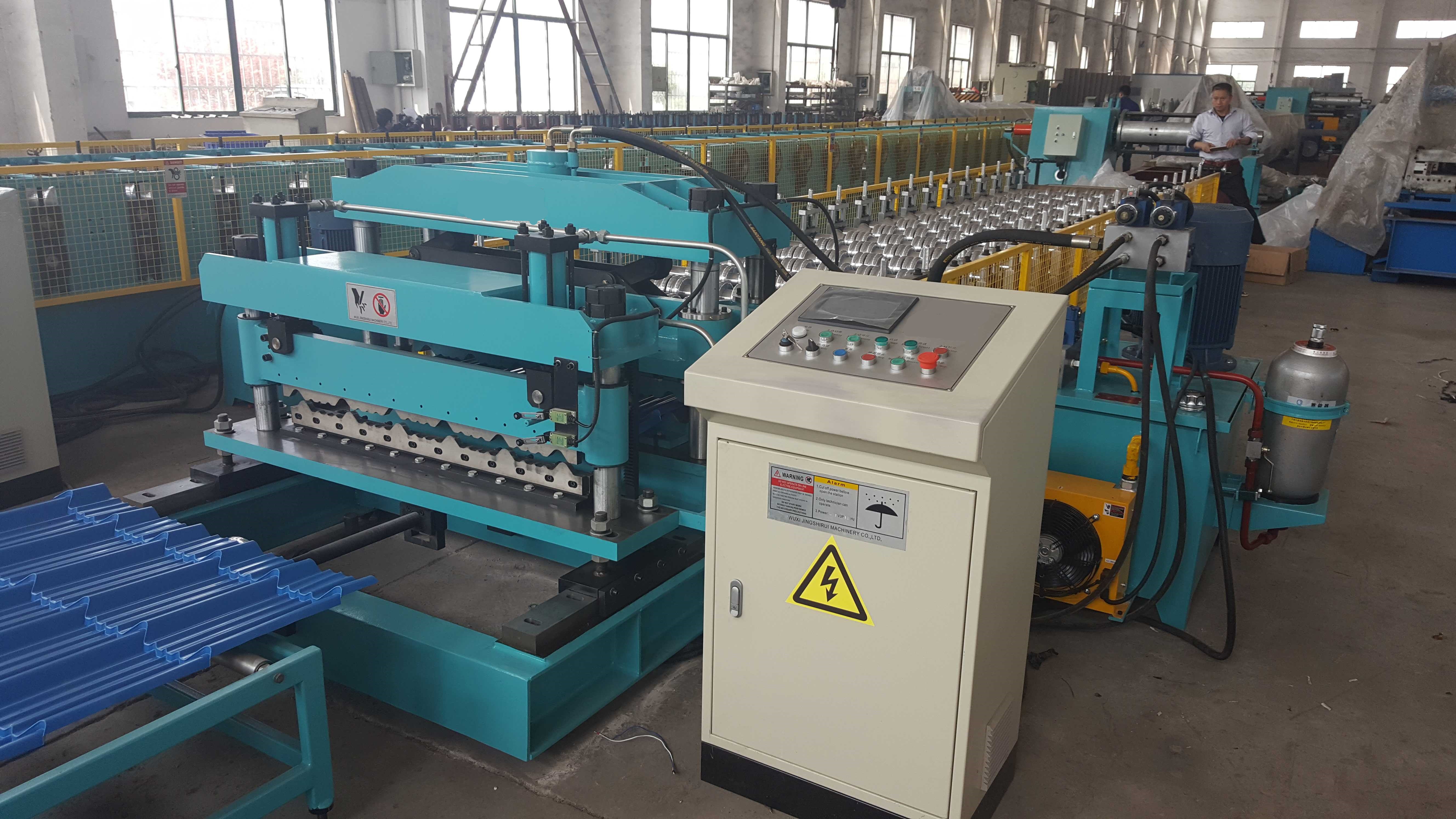
A glazed tile roll forming machine turns flat coated coil into steel roof tiles that read as fired clay from the street. The profile is a step tile, closed by a hydraulic die into repeating courses. The finish is a high gloss paint that imitates ceramic glaze, which is where the name comes from.
Short answer: a glazed tile roll forming machine forms 0.30 to 0.80 mm prepainted or Al-Zn coated steel into tiles with a 250 to 350 mm step and 900 to 1150 mm cover, at 4 to 8 m/min. A standard build uses 16 forming stations, a 7.5 kW main motor and a four post punch and cut unit, and makes about 2,300 m of tile per eight hour shift.
Two numbers decide the build, and neither is in the roof photo a buyer usually sends. The step length sets the die, the cover width sets the coil. This page works through both, then the coil, the coating and the site work.
Output from a glazed tile roll forming machine looks like a row of clay tiles. Each course is a raised step with a rounded nose. Ribs between courses cover the side lap, and the bottom edge of one sheet sits over the top edge of the sheet below it, so the step hides the joint.
A common build makes a 320 mm step across a 1000 mm cover. At 0.45 mm steel that sheet weighs about 3.8 kg per square metre. One square metre takes 3.1 tile courses, and one linear metre covers one square metre of roof. Those ratios decide cost per square metre, not tonnage.
Glazed is a finish claim, not a shape claim. A step tile with matte polyester is sold as step tile. The same profile with a 40 gloss clear top coat is sold as glazed. Buyers in Nigeria, Kenya, the Philippines and Indonesia ask for glazed because the shine sells the roof. Buyers in Russia and Eastern Europe ask for step tile because the section matters more. Both come off the same tooling, and the difference sits in the coil order.
Eight modules make up a glazed tile roll forming machine. Coil goes in at one end, stacked tiles come out at the other, and nothing is handled by hand once the batch is set.
The step press separates a glazed tile roll forming machine from a plain roofing line. Rolls bend a rib, but they cannot close a 14 mm step with a rounded nose in one pass. A hydraulic die does it in one hit while the strip is stationary. That pause is why the line is quoted at 4 to 8 m/min, against 15 m/min for trapezoidal sheet.
Floor sequence runs uncoiling, feeding, forming, step pressing, punching, cutting, collecting. Length is 18 to 22 m.
Four step tile families cover most orders for a glazed tile roll forming machine. The family decides the die, the coil width decides the cover.
| Profile family | Step length | Cover width | Minimum pitch | Where it sells |
|---|---|---|---|---|
| Classic step tile | 320 mm | 1000 mm | 15 degrees | Nigeria, Ghana, Kenya, Philippines |
| Narrow step tile | 300 mm | 900 mm | 15 degrees | Indonesia, Malaysia, Vietnam |
| Spanish S tile | 300 to 350 mm | 1050 to 1150 mm | 14 degrees | Middle East, North Africa |
| Deep step tile | 350 mm | 1000 mm | 12 degrees | Russia, Kazakhstan, Eastern Europe |
Cover width is always smaller than coil width, because the side rib and lap eat the difference. A 1250 mm coil feeding a 1000 mm cover loses 20 percent. That number belongs in a price comparison, since a cheap glazed tile roll forming machine with a wide loss is expensive per square metre.
| Coil width | Typical cover width | Material loss | Tiles per square metre at 320 mm step |
|---|---|---|---|
| 1000 mm | 820 mm | 18 percent | 3.8 |
| 1200 mm | 1000 mm | 17 percent | 3.1 |
| 1250 mm | 1050 mm | 16 percent | 3.0 |
| 1250 mm | 1150 mm | 8 percent | 2.7 |
Tiles per square metre: divide one square metre by cover width times step length in metres. At 1.05 m cover and 0.32 m step that gives 2.98.
The table is a standard export build for a 1000 mm cover glazed tile roll forming machine. Every row has an option, and the final drawing governs.
| Item | Standard build | Option |
|---|---|---|
| Coil width | 1000 to 1250 mm | Up to 1300 mm |
| Steel thickness | 0.30 to 0.80 mm | 0.25 mm for trim work |
| Yield strength | 235 to 450 MPa | 550 MPa with reduced step |
| Step length | 320 mm | 250, 300 or 350 mm die set |
| Step height | 14 mm | 12 to 18 mm |
| Forming stations | 16 | 14 to 20 |
| Shaft diameter | 76 mm | 90 mm above 1250 mm coil |
| Roller material | 45 forged steel, hard chrome 0.03 to 0.05 mm | GCr15 for abrasive coil |
| Main motor | 7.5 kW | 11 kW for 8 m/min |
| Line speed | 4 to 8 m/min | Servo feed for short batches |
| Hydraulic station | 11 kW, 16 MPa, with accumulator | 5.5 kW on light builds |
| Punch and cut die | Cr12MoV, quenched to HRC 58 to 62 | Cr12 for spares |
| Length tolerance | plus or minus 1.5 mm at 3000 mm | plus or minus 1.0 mm with servo |
| Control system | Panasonic PLC, touch screen, Yaskawa inverter, Omron encoder | Mitsubishi or Siemens |
| Electrical supply | 380 V, 50 Hz, three phase | 415 V or 440 V, 60 Hz |
| Coil weight | 5 t hydraulic decoiler | 3 t manual, 10 t hydraulic |
| Coil bore | 480 to 530 mm | 508 mm standard bore |
| Machine length | 18 to 22 m | Cassette layout |
| Machine weight | 8 to 11 t | Depends on station count |
Two rows matter before an order. Shaft diameter caps strip width and the step depth the mill holds square. Station count sets how gradual the rib forms, and a deep step on thin coil needs the extra stands to avoid stretch marks.
On a glazed tile roll forming machine the coil order decides how long the roof lasts. Three layers matter, and each is worth writing into the order.
Deep steps want ductility. DX51D+AZ and S250GD to S280GD form a 14 mm step without cracking at the nose. G550 resists wind load but cracks at a deep step, so it belongs on trapezoidal and corrugated sheet. When a job needs strength and a deep step together, drop the step to 10 mm and raise thickness instead.
AZ150 is the export default for a glazed tile roll forming machine: 150 g per square metre total, both sides, of a 55 percent aluminium, 43.4 percent zinc, 1.6 percent silicon alloy under EN 10346 and ASTM A792. That alloy keeps a coastal roof alive past 20 years. AZ100 suits inland dry markets. The Galvanizeit corrosion data is the reference we hand to buyers who ask why not plain zinc.
A glazed tile roll forming machine cannot protect a bad edge. A sheared edge on 0.35 mm sheet exposes bare steel, so the cut face is where rust starts. Keep the cut trimmed by the line rather than by hand.
Polyester at 20 to 25 microns is the usual finish on a glazed tile roll forming machine, with a 30 to 40 gloss unit top coat. SMP holds colour better in strong sun. PVDF at 25 to 27 microns suits a 20 year colour warranty and roofs within 1 km of the sea.
One limit catches buyers every month. Stone coated coil cannot be roll formed, because granules crack at the step and shed at the rib. Stone coating is applied after forming by a specialist coater, so the glazed tile roll forming machine supplies bare formed tile and the coater adds the finish. Prepainted and PVDF coil run without change.
Speed on a glazed tile roll forming machine is not a single number. The mill forms at one rate and pauses for the step press, so the quoted figure includes both.
| Line speed | Metres per 8 hour shift | Roof area at 1.05 m cover | Tiles per shift at 320 mm step |
|---|---|---|---|
| 4 m/min | 1,530 | 1,600 sqm | 4,800 |
| 6 m/min | 2,300 | 2,415 sqm | 7,250 |
| 8 m/min | 3,060 | 3,215 sqm | 9,560 |
Those figures assume 80 percent efficiency. A 5 t coil of 1.2 m by 0.45 mm steel runs about 1,180 m, so a 6 m/min glazed tile roll forming machine changes coil twice a shift. Two operators run it.
Short batches change the maths. A 20 sheet order on a glazed tile roll forming machine means 20 step cycles and 20 cuts, so it spends more time indexing than forming. Servo feed helps, and so does a die that swaps without re shimming.
A glazed tile roll forming machine sits at the decorative end of the tile family, and four pages on this site overlap. The difference is the section, not the price.
| Machine | Section | Best for |
|---|---|---|
| Glazed tile machine | Step tile with 250 to 350 mm courses | Residential roofs that must look like clay tile |
| Metal roof tile machine | Shingle and tile look, shallow relief | Reroofing, lightweight structures |
| Steel tile profile machine | Custom profile, up to 30 mm depth | Buyers with their own drawing |
| Monterey V1100 | Russian step tile with condensate grooves | Russia, Kazakhstan, cold climate roofs |
Start with the metal sheet roll forming machine index if the section for a glazed tile roll forming machine is still open. For a shingle look, read the metal roof tile roll forming machine page. For a drawing already in hand, the steel tile profile page covers custom tooling. For the Russian market, go to Monterey V1100.
A glazed tile roll forming machine also pairs with a ridge cap line, because every tile roof needs caps that match the tile colour and pitch. The roof ridge cap roll forming machine page covers that. Buyers running sheets and tiles together sometimes add a double layer roll forming machine for the sheet side and keep the tile line separate.
A tile from a glazed tile roll forming machine still leaks if the detailing is wrong. Minimum pitch is 15 degrees for a 320 mm step and 12 degrees for a deep step. Below that, capillary action pulls water up the lap in driving rain.
Side lap runs one full rib, which the roll set builds in. End lap runs one step plus 100 mm, so the nose of the upper tile sits over the flat of the lower one. Fixings go at the crest of the rib, never in the channel, each with a sealing washer. The NRCA steep slope guidance follows the same rules.
Order caps from the same coil batch. A glazed tile field with a plain galvanized ridge looks unfinished, and a curved roof needs the curving option ordered with the machine.
A 16 station glazed tile roll forming machine with hydraulic decoiler loads into one 40 foot high cube plus one 20 foot container. The mill body ships in two or three bolted sections, with numbered wiring looms and oiled machined faces.
On site the order is fixed. Set the floor pads, level the mill to 0.5 mm over its length, bolt the sections, connect hoses and power. Fill the hydraulic station with 46 grade oil, run the pump unloaded for ten minutes, then check for leaks.
Commissioning takes 7 to 10 days with an engineer on site: first coil run, step depth adjustment, length calibration against a steel tape, and touch screen training. Our engineers have commissioned lines in 50+ countries since 2005, and the machines carry ISO 9001 and CE marking.
Power supply causes most delays on a glazed tile roll forming machine. Confirm site voltage, frequency and phase before release, because a 380 V 50 Hz cabinet does not run on 440 V 60 Hz without a transformer.
Q: What is the difference between a glazed tile and a step tile machine?
Q: What coil width do I need for a 1000 mm cover?
Q: How many tiles are in one square metre?
Q: Can the machine run 0.8 mm steel at full width?
Q: How fast does a glazed tile roll forming machine run?
Q: Can it produce stone coated tiles?
Q: Can I change the step length later?
Q: What is the lead time?
Send the profile drawing, coil width, steel thickness and target market, and we will confirm station count and die size for the glazed tile roll forming machine before quoting. Our team has built custom roll forming lines since 2005, and a glazed tile roll forming machine is one of the simplest builds to get right when coil and section are specified together. Use the contact page to start, or compare the wider range on the metal sheet roll forming machine index.
Last updated: 2026-11-02
Article Changelog
2026-11-02: Full rewrite of page 3148. Replaced the 2018 component list with a buyer guide covering profile families, coil to cover conversion, tiles per square metre, a 19 row specification table, coating selection, shift output maths, machine comparison, roof detailing and eight FAQ entries.
Next Review Triggers
Step tile profile standard revision in a major export market
Al-Zn coil price movement above 15 percent
New step die range or servo feed option released
Thank you for your interest in Believe Industry.
Our engineering team will get back to you within 24 hours.
Buying Guider & Machinery Technology & Maintainence Tips
Two Cable Tray Roll Forming Machines Ready to Ship to...
Read MoreA roll forming machine price ranges from 20,000 for a basic stud and...
Read MoreCable Tray Roll Forming Machine: Ladder vs Perforated Tray Lines...
Read MoreBillboard & Signage Roll Forming: Advertising Structure Profiles Short answer:...
Read More