Why Light Steel Framing Replaced Wood in Partition Walls
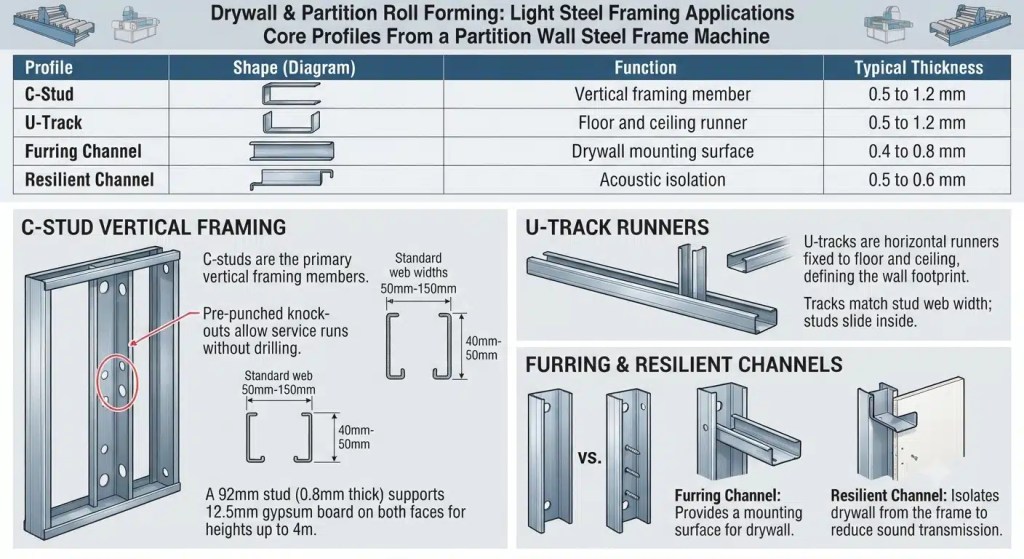
Steel framing gained market share over wood for practical reasons. Steel studs do not rot, warp, or attract termites. They resist fire naturally, which matters in commercial buildings where codes demand non-combustible partition materials. Steel framing maintains dimensional stability across temperature and humidity swings, so walls stay straight over the building lifetime.
A steel stud and track roll forming machine produces these profiles continuously from coil. Per-unit cost drops because there is no cutting waste. The cold roll forming process preserves the steel’s structural properties without thermal distortion.
| Comparison Factor | Light Steel Framing | Wood Framing |
|---|
| Fire Resistance | Non-combustible (ASTM E136) | Combustible, needs treatment |
| Dimensional Stability | No warping or shrinking | Warps with humidity changes |
| Pest Resistance | Termite-proof | Vulnerable to termites |
| Waste Rate | 2-3% coil scrap | 10-15% cut waste |
| Recyclability | 100% recyclable | Limited |
| Installation Speed | Fast (lightweight, pre-cut) | Moderate (heavier, on-site cutting) |
How a Drywall Partition Roll Forming Machine Works
The production flow follows a clear sequence:
- Coil feeding. A decoiler releases galvanized steel coil into the entry guide. Coil widths range from 150mm to 300mm depending on profile size.
- Pre-punching. A hydraulic or servo punch station creates service holes and knockout patterns before forming. Pre-punching is more accurate because the steel is still flat.
- Roll forming. The steel passes through 12 to 18 roller stations. Each station contributes a small incremental bend that preserves material integrity and prevents surface cracking.
- Straightening. A straightening unit removes twist or side bow. Profiles with twist will not assemble properly in the field.
- Cutting. A servo-driven flying saw cuts to programmed length without stopping the line. Cut tolerance is plus or minus 1.5mm for lengths up to 6 meters.
- Stacking. An automatic stacker collects finished profiles for packaging.
A well-built cold formed steel framing machine achieves line speeds of 15 to 30 meters per minute. High-speed servo configurations reach 40 meters per minute. Production lines for construction industry roll forming share many of these operational principles.
Key Technical Specifications
When evaluating a drywall stud roll forming machine, pay attention to these specs:
- Material thickness. 0.4mm to 2.0mm covers standard light steel framing. Thinner material suits residential drywall. Thicker profiles serve load-bearing partitions.
- Material type. Galvanized steel (GI) per ASTM A653 or EN 10346. Galvalume (GL) for corrosive environments. Yield strength of 250 to 550 MPa.
- Profile width. The machine should handle 50mm to 150mm web widths to cover common stud sizes.
- Line speed. 15 to 20 m/min for standard lines. 30 to 40 m/min for high-speed servo lines.
- Cutting tolerance. Plus or minus 1.5mm for lengths up to 6 meters.
- Control system. PLC with touch screen, 50+ profile recipes, switch time under 10 minutes.
The C-strut roll forming machine shares similar forming principles, though strut channels serve structural support rather than drywall framing.
Standard vs High-Speed Production Lines
| Parameter | Standard Line | High-Speed Line |
|---|
| Line Speed | 15-20 m/min | 30-40 m/min |
| Material Thickness | 0.5-1.2 mm | 0.4-1.5 mm |
| Servo Control | Optional | Full servo drive |
| Output per 8hr shift | 3,000-4,000 pcs | 7,000-10,000 pcs |
| Tooling Change Time | 30-45 min | 5-10 min (cassette) |
| Investment Level | Moderate | Higher |
High-speed lines justify their cost when daily output exceeds 5,000 studs. The servo-driven flying cut saw and quick-change cassette system are the two features that most impact throughput. If your market demands fast delivery of mixed profile sizes, the cassette system pays for itself within the first year.
Applications Across Building Types
Residential. Interior partitions, basement finishing, and ceiling framing use 0.5 to 0.8mm light gauge steel framing. Multi-family housing requires fire-rated partition walls between units, making non-combustible steel framing mandatory under most building codes. The residential roofing roll forming machine guide shows how complementary products serve the same projects.
Commercial. Office partition walls, corridor framing, and suspended ceilings are the bread and butter of steel stud framing. Contractors prefer steel because it installs fast and passes fire code inspections without special treatment. A standard office building may need 10,000 to 20,000 lineal meters of steel studs for interior partitions.
Industrial. Warehouse office partitions, clean room enclosures, and equipment screening walls use thicker profiles (1.0 to 2.0mm) for added rigidity. The mezzanine floor roll forming applications guide covers how steel framing integrates with elevated platforms in the same facilities.
Data Centers. Server room partitions require fire-rated and thermally stable framing. Steel does not contribute to fire load, which is critical in facilities where suppression systems demand low-combustible surroundings. Our data center roll forming machines page details these specialized requirements.
Material Standards and Compliance
Light steel framing profiles must meet regional building codes. A reliable light steel framing roll forming machine produces profiles that comply with these standards consistently:
United States. ASTM C645 defines non-structural steel framing members. ASTM C754 covers installation. ASTM A653 specifies the galvanized steel substrate. The ASTM International standards database provides full text access for subscribers.
Europe. EN 14195 defines requirements for metal framing components for drywall systems. EN 10346 covers hot-dip galvanized steel strip. CE marking is mandatory for framing products sold in the EU. The Gypsum Products Association provides complementary guidance on drywall system performance.
Australia. AS/NZS 2735 specifies steel framing for interior and exterior applications. The Building Code of Australia (BCA) governs fire resistance ratings.
Middle East. The Saudi Building Code (SBC) and SASO certification apply. GCC projects often require profiles meeting both local and international standards.
Choosing the Right Machine for Your Production
Selecting a partition wall steel frame machine comes down to five questions:
- Volume. How many studs and tracks per day? Standard lines handle 3,000 to 4,000 pieces per shift. High-speed lines double that.
- Profile variety. Do you need multiple sizes? Quick-change cassette systems switch from a 92mm stud to a 150mm stud in under 10 minutes.
- Material range. What steel thicknesses will you run? Producing both interior drywall studs (0.5mm) and structural studs (2.0mm) requires wider thickness capacity.
- Automation. Do you need automatic stacking, bundling, and packaging? These features add cost but reduce labor from 3 operators to 1.
- Budget. Standard lines cost less. Servo lines deliver faster ROI through higher output.
For manufacturers entering the steel framing market, a standard line is a practical starting point. If your operation already produces pallet racking systems, adding a drywall partition line diversifies your range into interior construction with minimal additional training. The solar channel roll forming machine shows another example of how a new line captures supply chain margin.
In-House Production vs Outsourced Supply
| Factor | In-House Production | Outsourced Supply |
|---|
| Material Cost | Coil price + 5-8% processing | Coil price + 25-40% markup |
| Lead Time | 1-2 days | 2-4 weeks |
| Customization | Unlimited | Limited to supplier catalog |
| Freight | Minimal | Significant |
| Quality Control | Direct, real-time | Indirect, batch-based |
The breakeven point for a standard drywall partition roll forming machine falls between 12 and 18 months for a producer running two shifts. After that, every stud costs only coil price plus a small processing overhead. That margin stays in your business instead of flowing to a framing supplier.
Operational Best Practices
Coil quality. Use clean, properly tensioned coils. Irregular edges cause forming defects and scrap.
Roll alignment. Check weekly. Misaligned rolls produce twisted profiles that fail quality inspections.
Lubrication. Apply sparingly. Too much contaminates the zinc surface and creates drywall compound adhesion problems.
Tooling wear. Inspect roll surfaces monthly. Worn rolls leave score marks that affect painted profile finish quality.
Length calibration. Verify flying saw cut length every shift.
Future Trends
The light steel framing industry is moving toward higher automation:
Digital twin simulation models the process before physical tooling is built, cutting development time from weeks to days. Servo-driven roll stations allow real-time profile adjustment without retooling. BIM integration feeds profile data into Building Information Modeling systems so architects specify exact framing components from the manufacturer’s catalog.
These advances make steel stud and track roll forming machines more productive and flexible. Believe Industry stays current with these trends, helping clients across 20+ countries modernize their lines. The Steel Framing Alliance tracks market data for manufacturers evaluating investment timing.





 English
  Español
 Português
 Русский
 العربية
 Bahasa Melayu
 Türkçe
 ไทย
ไทย
 Bahasa Indonesia