Dirección
No 1, Yd Road, Distrito de Huishan, Ciudad de Wuxi, Jiangsu. 214183
Horario de trabajo
Lunes a viernes: 9AM - 5PM
Sábado: 9AM - 4PM
Dirección
No 1, Yd Road, Distrito de Huishan, Ciudad de Wuxi, Jiangsu. 214183
Horario de trabajo
Lunes a viernes: 9AM - 5PM
Sábado: 9AM - 4PM

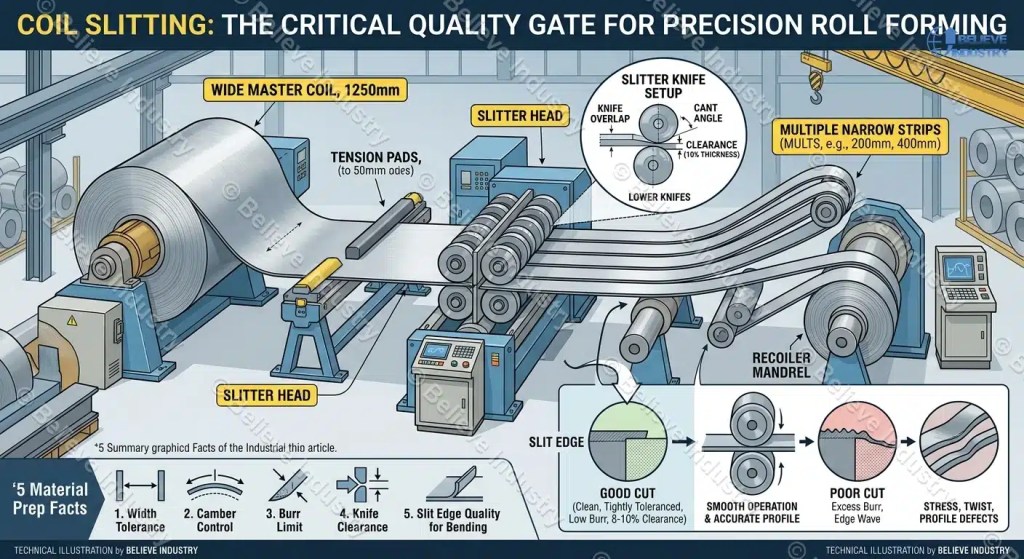
La calidad de cada línea de conformado de perfiles depende de la calidad de la banda que la alimenta. Sin embargo, la mayoría de los defectos de perfil que detectamos en Believe Industry no se originan en la máquina perfiladora, sino en la bobina. Una banda con rebabas, curvatura o variación de ancho dificultará el funcionamiento de la máquina a lo largo de toda la línea de producción.
Ahí es donde entra en juego el corte de bobinas. Es el paso intermedio entre la acería y la máquina perfiladora, y determina si el material sale limpio o si se convierte en chatarra.
Esta guía explica qué es el corte longitudinal de bobinas, cómo funciona una línea de corte longitudinal y los cinco aspectos más importantes de la preparación del material para lograr una precisión óptima en el conformado por rodillos.
El corte longitudinal de bobinas es un proceso de corte de metal que divide una bobina maestra ancha a lo largo en múltiples tiras más estrechas, llamadas mults, utilizando cuchillas de corte rotativas. Las tiras se vuelven a enrollar en bobinas separadas, cada una cortada al ancho exacto que necesita la máquina posterior.
Las acerías producen bobinas maestras en anchos estándar, generalmente de 1000 mm a 2000 mm, con un peso de 10 a 30 toneladas. Casi ninguna máquina perfiladora necesita ese ancho. Máquina formadora de viguetas C Z Puede que se necesite una tira de 200 mm. Una línea de bandejas portacables puede necesitar 400 mm. El corte longitudinal soluciona ese problema.
Una sola pasada por una línea de corte longitudinal puede cortar una bobina maestra de 1250 mm en 20 o más tiras en una sola operación. Ese es el objetivo principal. Se compra acero por tonelada con anchos de fábrica y luego se corta a los anchos precisos que requieren los perfiles. Puede leer la información general del proceso en Página de Wikipedia sobre el corte de rollos.
La preparación de la bobina no es un trabajo secundario. Es el primer control de calidad para todo el proceso. proceso de conformado de rodillos.
Un estándar línea de corte de bobina El acero pasa por seis estaciones en secuencia. Esto es lo que sucede en cada una.
Entrada y desenrollado. La bobina maestra se carga en un mandril, las envolturas exteriores se despegan y se introducen en rodillos de presión. Una bobina bien construida. Desenrollador Mantiene la bobina centrada y libera el material a un ritmo constante. Una desalineación en este punto crea una curvatura en cada tira posterior.
Bucle y alimentación. Un acumulador o un sistema de compensación desacopla la velocidad del desenrollador de la velocidad del cabezal de corte. La tira entra en las cuchillas plana y sin tensión. En las líneas que también corrigen la forma, un nivelador aplana la bobina antes del corte.
La cabeza desbrozadora. Este es el corazón de la máquina. Dos cuchillas circulares, una superior y otra inferior para cada línea de corte, cortan la tira a medida que pasa entre ellas. Unos anillos de goma mantienen la tira plana y separan las tiras terminadas para que no se superpongan.
Bobinado de desecho. Los dos hilos de borde recortados se enrollan en bobinadoras de chatarra. El recorte típico es de 3 mm a 8 mm por lado, dependiendo de los requisitos de calidad del borde y del estado del borde en la fábrica.
Tensión y separación. Un soporte de tensión o almohadilla de arrastre sujeta cada tira para que la máquina de rebobinado la tense. Las cuchillas de corte separan las tiras; la estación de tensión las mantiene separadas.
Retrocediendo. Cada tira se enrolla en su propio mandril, separada por dedos o separadores, lista para su envío o para la línea de conformado de rodillos.
Las líneas modernas de vía estrecha funcionan a una velocidad de entre 150 y 250 metros por minuto. El cabezal de corte no reduce la velocidad para cortar más tiras, sino para materiales más gruesos. Por eso, la clase de calibre es importante al especificar una línea.

El factor más importante en la calidad del corte es la holgura entre la cuchilla superior e inferior. Si es demasiado estrecha, las cuchillas se desgastan rápidamente y pulen el borde en lugar de cortarlo. Si es demasiado amplia, la tira se desgarra en lugar de cortarse, dejando rebabas pronunciadas y un estiramiento excesivo del borde.
La regla general inicial es del 8 al 10 por ciento del espesor del material, dividido entre los dos juegos de cuchillas. Los técnicos de configuración luego ajustan observando la rebaba. Estos valores iniciales funcionan para acero dulce:
| Espesor del material | Espacio libre inicial (por lado) | Rebaba esperada |
|---|---|---|
| 0,3 a 0,5 mm | 0,03 a 0,05 mm | Menos de 0,03 mm |
| 0,6 a 1,0 mm | 0,05 a 0,10 mm | Menos de 0,05 mm |
| 1,1 a 2,0 mm | 0,10 a 0,18 mm | Menos de 0,10 mm |
| 2,1 a 3,0 mm | 0,18 a 0,28 mm | Menos de 0,15 mm |
| 3,1 a 6,0 mm | 0,28 a 0,50 mm | Menos de 0,25 mm |
La configuración de las cuchillas también incluye la superposición y la inclinación. La superposición determina la profundidad a la que se entrelazan verticalmente los círculos de las cuchillas. La inclinación ajusta ligeramente el ángulo de las cuchillas para que el corte se abra detrás de la hoja, reduciendo así la fricción en la tira. Ambos ajustes varían según el grosor y el tipo de material. El acero de alta resistencia y el acero inoxidable requieren valores diferentes a los del acero dulce.
Los materiales más duros necesitan mayor espacio libre. Los materiales más blandos y gomosos, como algunos grados de aluminio, necesitan menos. Cuando una línea corta varios grados, la hoja de configuración para cada grado es tan importante como las cuchillas mismas. Los técnicos de configuración en El fabricante Si desea profundizar más allá de las tablas que se incluyen aquí, publique una guía práctica al respecto.
El conformado por rodillos dobla los bordes de la tira más que cualquier otra parte del perfil. Las patas, los retornos y los bordes doblados comienzan como bordes cortados. Si ese borde tiene rebabas o está endurecido por un mal corte, el perfil lo refleja.
La rebaba es el primer problema. Una rebaba es un fino rollo de metal que se extruye en la línea de corte. En un perfil conformado por laminación, una rebaba gruesa se agrieta cuando el borde se dobla. En bobinas prepintadas, la rebaba se arrastra a través de las herramientas y raya el recubrimiento. La rebaba también se acumula en los huecos de los rodillos y acelera el desgaste de las herramientas en toda la superficie. línea de máquina de conformación de perfiles.
La curvatura es el segundo problema. La curvatura es la curva lateral de una tira medida a lo largo de su longitud. Si la tira ranurada se arquea hacia la izquierda o hacia la derecha, Máquina de conformado por rodillo La estira con fuerza. Esa lucha se manifiesta como una torsión en el perfil final, patas onduladas y alturas inconsistentes a lo largo de la longitud.
La ondulación de borde es la tercera. Las tiras cortadas con un margen excesivo se estiran en el borde en lugar de cortarse limpiamente. El borde estirado es más largo que el centro de la tira, por lo que se ondula. La ondulación de borde alimenta directamente la ondulación de perfil en el lado de salida.
Por eso, los compradores experimentados especifican la calidad del borde en sus pedidos de bobinas cortadas, no solo el ancho y el grosor. Un borde que parece aceptable en forma de bobina puede fallar en la máquina.
La tolerancia de ancho en la tira cortada depende del espesor del material. Los materiales más delgados se cortan con mayor precisión y mantienen tolerancias más ajustadas. Estos valores reflejan el rendimiento que ofrecen en la práctica las líneas de corte bien mantenidas:
| Espesor del material | Tolerancia de ancho | Curvatura (por cada 2 m de franja) | Límite de rebabas |
|---|---|---|---|
| 0,2 a 1,0 mm | más o menos 0,10 mm | 1,0 mm | 5 por ciento de espesor |
| 1,0 a 2,0 mm | más o menos 0,13 mm | 1,5 mm | 5 por ciento de espesor |
| 2,0 a 3,0 mm | más o menos 0,15 mm | 2,0 mm | 8 por ciento de espesor |
| De 3,0 a 6,0 mm | más o menos 0,20 mm | 2,5 mm | 10 por ciento de espesor |
A modo de comparación, los requisitos generales de laminado plano para acero laminado en caliente y en frío se encuentran en ASTM A568/A568M. El conformado de precisión mediante rodillos suele requerir valores más ajustados que los estándar, algo que conviene comentar con el proveedor de corte antes de realizar el pedido.
Compárelo con Línea de corte a medida En el trabajo, la tolerancia de longitud determina las especificaciones. En el corte de bobinas, el ancho, la curvatura y las rebabas son los factores determinantes. Incluya los tres en las especificaciones de compra de bobinas.
Las líneas de corte de bobinas se clasifican según el grosor del material que procesan. Comprar la clase incorrecta para su gama de productos supone un derroche de dinero en ambos sentidos: una línea demasiado ligera se avería, y una demasiado pesada cuesta más de lo necesario.
| Clase de línea | Rango de espesor | Velocidad de línea | Tiras Max | Productos típicos |
|---|---|---|---|---|
| Calibre ligero | 0,1 a 2,0 mm | 150 a 250 m/min | 30+ | Techos, correas, canaletas de puntal, bandeja portacables |
| Calibre medio | 1,5 a 4,0 mm | De 80 a 150 m/min | 20 | Montantes de estantería, correas estructurales |
| Calibre grueso | de 3,0 a 12,0 mm | De 30 a 60 m/min | 10 | Secciones estructurales gruesas, tira de chapa |
A línea de corte de calibre ligero Cubre la mayoría de los materiales de alimentación para el conformado por rodillos, ya que el material para techos, paneles de pared, correas y puntales se encuentra entre 0,3 mm y 3,0 mm. línea de corte de gran calibre Existe para tiras estructurales gruesas que la mayoría de las perfiladoras nunca llegan a utilizar.
Para tiendas pequeñas y volúmenes más bajos, una mini línea de corte Maneja bobinas estrechas y anchos moderados con un tamaño y precio mucho menores. Hemos instalado las tres clases, y el error de especificación más común que vemos entre los compradores primerizos es utilizar una línea del tamaño incorrecto.

La mayoría de las empresas de laminado de pequeño y mediano tamaño compran bobinas cortadas a un procesador externo. Usted envía las especificaciones, ellos cortan la bobina maestra y usted recibe las bobinas listas para usar. Sin inversión inicial, sin personal de montaje, sin inventario de cuchillas.
Las matemáticas cambian a medida que aumenta el volumen. El corte por contrato le cobra por corte, por configuración y por tonelada. Una vez que su tonelaje mensual justifica dos o tres anchos fijos, el retorno de la inversión en su propia línea se acorta rápidamente. Líneas como la Aquí describimos las opciones de desenrollado. Se combina directamente con el corte interno para un control total del material.
El corte interno también ofrece mayor capacidad de respuesta. Cambiar el ancho de una tira en una tarde, en lugar de esperar una semana por un espacio en la procesadora, es fundamental. Para los talleres que utilizan perfiles personalizados de conformado por rodillos con cambios frecuentes de ancho, esta agilidad representa un ahorro considerable.
Nuestro consejo sincero: por debajo de aproximadamente 500 toneladas mensuales de una mezcla de anchos estable, utilice un procesador externo. Por encima de esa cantidad, calcule los números en su propia línea de producción. El punto de inflexión varía según el costo de la mano de obra local y la logística del acero, así que modele su propio caso en lugar de copiar el de otros.

Cuatro factores influyen decisivamente en el coste del corte de bobinas. El número de tiras, ya que a mayor número de cortes, mayor cantidad de cuchillas y tiempos de preparación más prolongados. El calibre del material, puesto que el material grueso se procesa más lentamente y desgasta las cuchillas con mayor rapidez. La especificación de calidad del borde, dado que los límites estrictos de rebaba y curvatura exigen cuchillas de mayor calidad y velocidades más bajas. Y la pérdida de rendimiento, puesto que en cada pedido de corte se pierden los bordes recortados, así como los extremos de la bobina.
Si el diseño de su perfil tolera un recorte ligeramente más ancho, ganará vida útil de la cuchilla y calidad de corte. Si su máquina formadora de rollos de láminas para techos El perfil permite recortar los bordes en la propia formadora de rodillos, lo que permite solicitar bobinas cortadas con mayor tolerancia y reducir costes en ambos extremos.


Máquina formadora de bandejas de andamio lista para enviar a un comprador de los Estados Unidos...
Leer más
Máquinas de Roll Forming marinas: 5 perfiles de construcción naval Una máquina de roll...
Leer más
Máquina de conformación por rodillo para vías: 5 perfiles de infraestructura. Una vía...
Leer más
Puesta en marcha de la máquina de montantes de rack: 12 pasos hasta su primer perfil correcto...
Leer más English English
  Español
 Português
 Русский
 العربية
 Bahasa Melayu
 Türkçe
 ไทย
ไทย
 Bahasa Indonesia