Endereço
Nº 1, Yd Road, distrito de Huishan, cidade de Wuxi, Jiangsu. 214183
Horário de trabalho
De segunda a sexta-feira: das 9h às 17h
Sábado: 9h - 16h
Endereço
Nº 1, Yd Road, distrito de Huishan, cidade de Wuxi, Jiangsu. 214183
Horário de trabalho
De segunda a sexta-feira: das 9h às 17h
Sábado: 9h - 16h

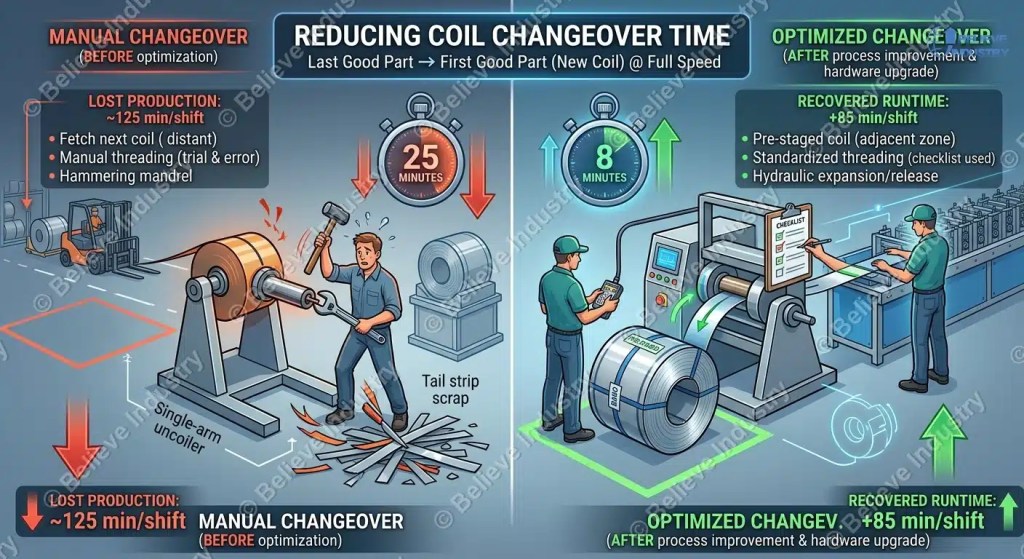
O tempo de troca de bobinas é o tempo em minutos que sua linha de perfilagem fica ociosa entre o término de uma bobina e o início da produção em velocidade máxima da próxima. Isso inclui a ejeção do núcleo da bobina antiga, a liberação da tira de extremidade, o carregamento da nova bobina, a passagem da cabeça de corte e o retorno à velocidade normal. A maioria das empresas nunca mede esse tempo, e é por isso que ele consome silenciosamente de 60 a 120 minutos por turno.
Definição de troca de bobina: O tempo total decorrido desde a última peça boa na bobina de saída até a primeira peça boa na bobina de entrada, na velocidade normal da linha. Se você considerar um tempo menor, estará se enganando sobre o seu tempo de inatividade.
Uma troca manual típica em um desbobinador de braço único leva de 20 a 30 minutos. Uma equipe disciplinada com o equipamento adequado realiza o mesmo trabalho em 8 minutos. Em uma linha que transporta bobinas de 3 toneladas, essa diferença representa milhares de metros de perfil perdidos por mês. Se você é novo no processo de montagem, comece com Como funciona uma máquina de perfilagem de rolos, porque cada etapa de troca ocorre no início dessa linha.
O cálculo é simples. Uma linha de produção de telhas que troca bobinas 5 vezes por turno, a cada 25 minutos, perde 125 minutos de produção diariamente. Com uma velocidade de linha de 15 m/min, isso representa quase 2.800 metros lineares de painel a menos por turno, antes de considerar o refugo por problemas na rosca.
As fábricas respondem comprando uma linha de máquinas de perfilagem mais rápida, o que é a solução errada. A capacidade mais barata em qualquer oficina de perfilagem está escondida no tempo de troca de ferramentas. Estudos de eficácia geral do equipamento A troca de bobinas está entre as três principais perdas planejadas em linhas alimentadas por bobinas.
Antes de melhorar qualquer coisa, registre o que realmente acontece. Aqui está uma referência prática de uma desenroladora manual de braço único alimentando uma linha de perfil C, filmada e cronometrada ao longo de cinco trocas:
| Etapa | Minutos | Desperdiçado por |
|---|---|---|
| Procuro operador de guindaste ou empilhadeira e motorista. | 4 | Sem pré-encenação |
| Cortar e remover a faixa da cauda | 5 | Sem plano B |
| Mandril colapsando, ejetando o núcleo vazio. | 4 | Mandril desgastado, martelagem manual |
| Buscando a próxima bobina no armazenamento. | 5 | Bobina armazenada longe da linha |
| Carregamento, centralização e expansão do mandril | 3 | Alinhamento manual |
| Encaixe a cabeça da tira no nivelador | 4 | Sem auxílio para passar a linha, tentativa e erro. |
Leia aquela tabela novamente. Cerca de 9 dos 25 minutos são gastos caminhando e procurando, não trabalhando com metal. É por isso que a otimização da troca de ferramentas é mais importante do que a velocidade de compra.
Não se pode reduzir o que não se mediu. Filme três trocas de linha com um celular, depois divida-as em etapas e classifique cada etapa como interna (linha parada) ou externa (linha em funcionamento). Esta é a essência de Metodologia SMED, E funciona em desenroladores exatamente da mesma forma que funciona em prensas.
A descoberta mais comum choca os donos de oficinas: 40% de tempo de troca de ferramentas é trabalho que poderia ser feito com a linha de produção ainda em funcionamento. Buscar a próxima bobina, posicionar as máquinas de corte de fita, pré-ajustar a pressão do mandril, imprimir a ordem de serviço. Ao eliminar essas tarefas do cronograma, o tempo interno diminui sem gastar um centavo em equipamentos. Cobertura especializada de produtividade de conformação de rolos relata descobertas semelhantes em diversas oficinas de retrabalho.
O pré-posicionamento da bobina significa que a próxima bobina é colocada em um suporte ou rampa ao lado do desenrolador, com a fita cortada e o olhal alinhado com o mandril, antes que a bobina atual termine. É a otimização de troca mais barata desta lista.
Regras que fazem o pré-encenamento funcionar:
Se feita corretamente, a pré-montagem elimina os 9 minutos de busca e preparação da linha de base mencionada anteriormente. Requer apenas uma marcação no chão e a criação de um hábito disciplinado, nada mais. Isso é especialmente importante em linhas com múltiplos perfis, onde as trocas de bobina são frequentes, como em uma [inserir exemplo aqui]. Máquina de perfilagem de terças CZ Alternando entre as larguras C e Z.
A liberação do mandril é onde as tubulações antigas perdem tempo. Os operadores usam martelos para quebrar os núcleos presos, acionam o mecanismo de expansão repetidamente ou removem a serpentina com uma barra. Cada golpe de martelo representa um risco de danificar o mandril e ferir o trabalhador.
Fixe a liberação do mandril nesta ordem:
Uma pessoa saudável desenrolador Libera um núcleo em menos de 60 segundos. Se o seu leva cinco minutos, o problema está na manutenção, não na mão de obra. Nosso tipos de máquinas desbobinadoras O guia aborda detalhadamente os mecanismos de liberação de cada projeto.
A faixa final corresponde aos últimos metros da bobina de saída, e equipes sem treinamento a transformam em um verdadeiro teatro. Um operador persegue uma faixa instável enquanto outro procura por falhas, e a linha fica parada por cinco minutos.
Anote o procedimento para remover a tinta da cauda e pratique-o:
O manuseio da faixa de cauda, realizado por duas pessoas, leva 90 segundos. Improvisado, leva cinco minutos e, ocasionalmente, envolve o uso dos dedos. Considere-o como um procedimento de segurança e de agilização ao mesmo tempo.
O hardware acaba por limitar a velocidade de uma troca de bobinas. Um desenrolador manual de braço único com expansão por parafuso exige força e tempo para cada bobina. Um desenrolador hidráulico expande e contrai o mandril com o simples toque de um botão e retira o braço do caminho de carregamento automaticamente.
| Tipo de desbobinador | Mudança típica | ação do mandril | Ideal para |
|---|---|---|---|
| Manual de braço único | 20 a 30 minutos | Expansão do parafuso, liberação do martelo | Linhas de baixo volume e baixo custo |
| braço único hidráulico | 10 a 14 minutos | Expansão e liberação hidráulicas | A maioria das linhas de perfilagem |
| Hidráulico com ejetor de núcleo | 8 a 10 minutos | Ejeção automática, desprendimento por empurrão | Alta rotatividade de bobinas |
| Desbobinador de cabeça dupla | 3 a 5 minutos | Segunda cabeça pré-carregada | Tempo de atividade máximo, produção de duas bobinas |
UM desenrolador hidráulico A atualização geralmente se paga em um ano para qualquer linha que troque mais de três bobinas por turno. Para fábricas que não podem tolerar nenhuma parada, uma desenrolador de cabeça dupla A próxima bobina é carregada na segunda cabeça e a troca de bobinas leva o tempo necessário para soldar ou fixar as tiras. Essa diferença se reflete diretamente na faixa de preço de qualquer produto. preço da máquina de perfilagem Portanto, defina as especificações do desenrolador antes de assinar o contrato, não depois.
O último pedaço de tempo perdido se esconde na reinicialização. Cada operador alimenta a cabeça de alimentação da bobina à sua maneira, esbarra na linha, recua e tenta novamente. A solução é simples e eficaz: um padrão de alimentação por escrito e uma lista de verificação de troca plastificada afixada no desbobinador.
A lista de verificação deve abranger a pressão do mandril por largura da bobina, o alinhamento da tira com a escala, o ajuste da folga do nivelador e as etapas de aceleração do perfil. Moderno conformação de rolos servoelétrica Os controles armazenam essas informações como receitas, de modo que as configurações corretas são carregadas em segundos, em vez de serem calculadas novamente a cada bobina. Máquinas projetadas para trocas rápidas de produtos, como a máquina de perfilagem de rolos de troca rápida, estenda a mesma lógica de receita às próprias ferramentas.
A padronização é gratuita e é a etapa que as oficinas pulam por considerá-la burocrática. Filme a sua transição após um mês, utilizando a lista de verificação, e compare os resultados. O vídeo demonstrará a sua eficácia.

Um produtor de perfis metálicos do Oriente Médio, operando em dois turnos, nos solicitou uma solução para otimizar o tempo de troca de bobinas em uma linha manual de braço único. Aplicamos todas as seis dicas em etapas ao longo de oito semanas. Não foi adquirida nenhuma nova linha de máquinas de perfilagem, apenas uma adaptação de desbobinador hidráulico e disciplina de processo.
| Métrica | Antes | Depois | Diferença |
|---|---|---|---|
| Troca média de bobina | 25 minutos | 8 minutos | -68% |
| Trocas de turno por turno | 5 | 5 | 0 |
| Perda de produção por turno | 125 minutos | 40 minutos | Tempo de execução: +85 minutos |
| Produção extra por turno | 0 m | ~1.900 m | A uma média de 22 m/min |
| incidentes na faixa de cauda | 2 por mês | 0 | 12 meses consecutivos |
A sequência de etapas foi crucial. O mapeamento de tempo e o pré-posicionamento vieram primeiro e resultaram em uma redução de 25 para 15 minutos na segunda semana, sem a necessidade de equipamentos adicionais. A manutenção do mandril e as perfurações da tira de cauda levaram o tempo para 12 minutos na quinta semana. A adaptação do desenrolador hidráulico proporcionou a redução final para 8 minutos. Investir primeiro em equipamentos teria mascarado os ganhos de processo.


A mining roll forming machine is a heavy duty roll...
Leia mais

Upright roll forming machine speed is the finished-column line speed...
Leia mais
An electrical roll forming machine turns steel coil into the...
Leia mais
Agricultural roll forming machines turn steel coils into the gutters,...
Leia mais English English
  Español
 Português
 Русский
 العربية
 Bahasa Melayu
 Türkçe
 ไทย
ไทย
 Bahasa Indonesia