


Updated on March 9, 2026. Scheduled for technical review and update in 3 months (June 2026) to reflect the latest in FEA simulation and AI-driven metallurgy.
D M Tweet
What is a Roll Forming Machine?
A roll forming machine is a continuous manufacturing system that transforms metal coils into specific, uniform profiles by passing the material through a series of mated, contoured rollers. Unlike stamping, it utilizes incremental longitudinal bending at room temperature, preserving material thickness while achieving high-speed production of structural components with tolerances as tight as ±0.2mm.
I. The Core Mechanics of the Roll Forming Machine Line
The modern roll forming machine is not merely a collection of rollers; it is a synchronized engineering ecosystem. At its heart, the process relies on the “constant length” principle. Before purchasing equipment, many professionals seek a comprehensive analysis of roll forming machine technology to understand how 2D sheet metal is formed into complex 3D profiles without thinning the cross-section.
1.1 The Kinematics of Bending
In roll forming, the strip is gradually bent in a series of stages. Each stage (or “pass”) brings the cross-section closer to the final shape. According to the Rollforming Handbook (George T. Halmos), the most critical factor is the Longitudinal Strain. If the strain at the edges of the strip exceeds the material’s yield point during the transition between stands, “edge wave” or “oil canning” occurs. Staying updated on a roll forming advancement 5 incredible secrets 2026 can help engineers mitigate these strain-related defects through better pass distribution.
1.2 Flower Pattern Design: The Blueprint of Success
The “Flower Pattern” is the 2D CAD overlay of every bending step.
Neutral Line Calculation: We determine the precise axis where the material neither stretches nor compresses.
Springback Compensation: For high-strength steels (UHSS), the rollers must “over-bend” the profile. Our 2026 designs utilize FEA (Finite Element Analysis) to predict exactly how much the material will “snap back” after exiting the roll forming machine.
Roll Forming Station Calculator
To calculate the number of stations required for a specific profile, engineers generally use the Flower Pattern method, which accounts for the material’s yield strength, thickness, and the complexity of the bends.
Machine Engineering Configurator
II. Advanced Mill Configurations: Choosing the Right Foundation
The rigidity of the roll forming mill determines the quality of the final profile. Machine deflection—the slight opening of the roll gap under pressure—can cause dimensional drift. Selecting the right mill is the first step in metal roll forming machine 5 incredible 2026 advancements that focus on structural rigidity.
2.1 Standard vs. Specialized Mills
-
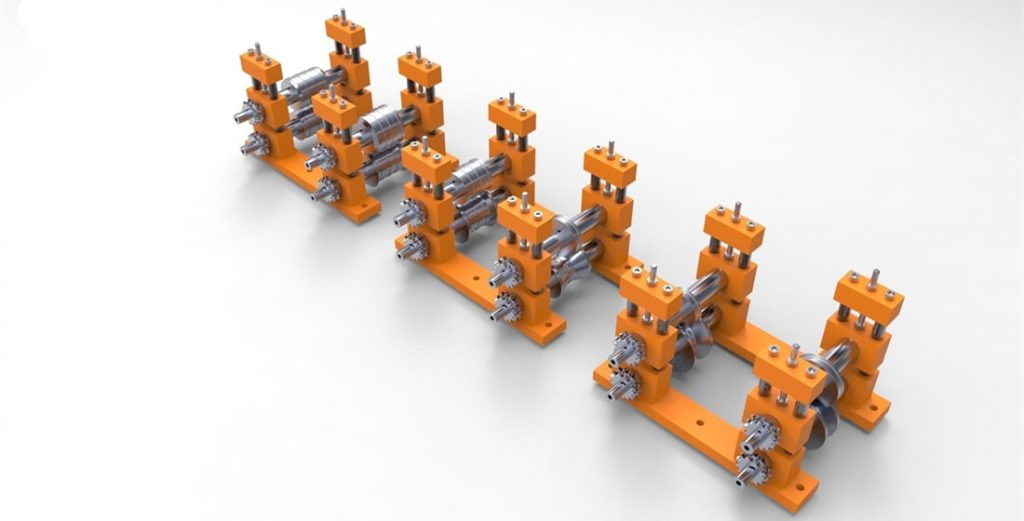
Standard (Conventional) Mill: Features shafts supported at both ends by heavy-duty housings. This is the “workhorse” for thick-gauge structural steel roll forming machine applications.
-
Cantilevered Mill: Only one side of the shaft is supported. This allows for incredibly fast profile changes but is limited to lighter gauges and narrower strips.
-
Rafted (Plated) Mill: In the 2026 manufacturing landscape, Rafted Mills are essential for Just-In-Time (JIT) production. The entire roll set is mounted on a removable “raft,” allowing for a complete profile changeover in under 15 minutes.
-
Double-High (Double Layer) Mill: By stacking two forming lines vertically, factory owners save 50% on floor space. Understanding how to adjust roll forming machine rollers is particularly critical in these compact setups to ensure both levels produce identical quality.
III. What Believe Industry Company Offers: 2026 Solutions
Believe Industry Company (Beli Rollforming) leverages the newest technology to provide customized, turnkey solutions. Every roll forming machine we produce is integrated with Copra RM or Ubeco PROFIL software to ensure optimization before it reaches the factory floor.
3.1 Metal Sheet & Purlin Equipment
-
High-Speed Metal Sheet Roll Forming: Designed for roofing and wall cladding with optimized rib depth for structural integrity.
-
C/Z Purlin Roll Forming Lines: Featuring 10-second automatic size changeovers to maximize production uptime.
3.2 Specialized Industrial Profiles
-
Steel Door & Frame Roll Forming: Achieving furniture-grade finishes and tight corner radii.
-
Gutter & Downspout Formers: Continuous systems for seamless drainage profiles.
-
Pallet Racking & Logistics Systems: A heavy-duty roll forming machine capable of forming high-tensile uprights and beams for warehouse storage.
-
Highway Guardrails & Cable Trays: Engineered for safety and electrical infrastructure compliance.
3.3 Coil Processing Equipment
Beyond the primary roll forming machine, we provide the essential “front-end” and “back-end” of the factory:
-
Slitting Lines: High-precision slitting for high-volume coil distribution.
-
Cut-to-Length & Blanking Lines: Ensuring flat sheet precision for subsequent stamping or bending.
IV. Technical Components & Maintenance: The Anatomy of Precision
4.1 The Drive System and Transmission
Modern lines utilize AC Frequency Variable Drives. Transmission can vary between chain drives for economy and gear box drives for high-torque applications. Proper synchronization in a roll forming machine prevents the strip from buckling between stands.
4.2 Straightening Units (The "Turkish Head")
When a profile exits the mill, internal stresses often cause bow (vertical curvature), camber (horizontal curvature), or twist (axial rotation). Knowing how to fix bow and twist using a 5-axis straightening unit is essential for any roll forming machine operator aiming for “dead straight” products.
V. Cutoff and Secondary Operations: Efficiency in Motion
The efficiency of a roll forming machine line is only as fast as its slowest component. We utilize Flying Cutoff technology to avoid stopping the mill, which can cause marking on the profile.
-
Servo-Driven Tracking: A servo motor synchronizes the speed of the cutoff carriage with the speed of the moving profile.
-
Hydraulic vs. Rotary: Hydraulic shears provide precision for standard shapes, while Rotary Saws are utilized for complex architectural sections.
VI. The Engineering of Tooling and Roll Design
The rolls are the “heart” of any roll forming machine. Their design dictates the success of the profile.
6.1 Material Selection for Rollers
-
Cr12 (D2 Steel): High carbon, high chromium tool steel. Known for exceptional wear resistance.
-
Chromium Plating: To prevent surface scratching on pre-painted or stainless steel, rollers are often hard-chrome plated.
-
Cast Iron Spacers: Used between the rollers on the shaft to provide the correct spacing without the cost of solid steel.
6.2 Handling Material Variations
Steel coils are never perfect. Variations in thickness (gauge) and yield strength can cause the profile to under-form or over-form. A high-quality roll forming machine incorporates adjustable stands that allow operators to fine-tune the “roll gap” to compensate for coil-to-coil variations.
VII. Overcoming Common Defects: A Technical Troubleshooting Guide
| Defect | Cause | 2026 Engineering Solution |
| Edge Wave | Excessive longitudinal strain at the strip edge. | Increase stations in the roll forming machine to reduce per-pass deformation. |
| Flare | Stress concentration at the ends of the cut profile. | Optimize the final “over-bend” pass and check cutoff die alignment. |
| Surface Marring | Friction between the roller and pre-painted coil. | Use Chromium-plated rollers and automated lubrication. |
| Machine Deflection | Insufficient housing rigidity under load. | Upgrade to “Torii” style cast-iron stands with tie-bars. |
VIII. Advanced Simulation and Digital Twins
In 2026, the roll forming machine has entered the era of the “Digital Twin.” By creating a virtual model of the machine, we can:
-
Predict Tool Wear: Estimating when rollers need regrinding.
-
Optimize Energy Consumption: Adjusting drive speeds for maximum efficiency.
-
Validate New Profiles: Testing a profile design in a virtual roll forming machine before manufacturing the expensive physical rollers.
IX. How to?
- How to Customize a Roll Forming Machine for Specific Metal Gauges: 9 Essential Secrets for Perfect Precision
- How to Calibrate a CZ Purlin Roll Forming Machine: 9 Incredible Secrets for Perfect Precision
- How to Compare Different Motor Brands for Your Roll Forming Machine: 7 Powerful Secrets for Maximum Torque
- How to Install a Roll Forming Machine Remotely: 7 Incredible Secrets for Fast Success
- How to Operate a Double Layer Roll Forming Machine: 9 Powerful Secrets to Prevent Material Damage
- How to Adjust Roll Forming Machine Rollers: 11 Incredible Secrets for Perfect Bending
- How to Fix Bow and Twist in Roll Formed Products: 5 Amazing Secrets for Flawless Metal Profiles
- How to Set Up a Roll Forming Machine: 9 Essential Steps for Massive Precision
- How to Operate a Roll Forming Machine: 10 Critical Steps for Flawless Production
X. Comprehensive FAQ: 21 Professional Inquiries
It depends on material thickness and profile depth. A deeper profile requires more stations in the roll forming machine to keep the “forming angle” gradual.
It allows for FEA simulation to detect “red zones” before any rollers are manufactured, as detailed in our roll forming advancement 5 incredible secrets 2026 report.
Yes, by using Duplex Mills or adjustable spacers, the machine can be narrowed or widened.
It reduces tool wear and prevents metal particles from “welding” to the rollers, preserving the surface finish.
A solid stand is fixed. A rafted stand is modular, allowing you to lift out one profile set and drop in another in minutes.
Refer to our expert guide on how to fix bow and twist for step-by-step correction techniques.
It is the CAD overlay of all bending steps, showing the material’s transition from flat to finished.
Yes, though it requires specific roller coatings to prevent material pickup.
High-speed lines can reach 100m/min, though 20-40m/min is standard for complex profiles.
By using side-roll stands or specialized “flare-control” final passes.
With proper maintenance, D2 steel rollers can produce millions of meters of profile.
It is a closed-loop housing design (resembling a Japanese gate) that provides maximum rigidity.
Yes, via flying punching dies or rotary punching wheels.
Higher yield strength requires more forming power and increased springback compensation.
The specific layer in the material that does not change length during bending.
Gear boxes offer superior torque and synchronization for heavy-duty applications.
Regular lubrication of shafts, checking bolt tightness, and inspecting roller surfaces for debris.
Yes, via rafted systems or double-layer mill designs.
The tendency of the metal to partially return to its original shape after being bent.
For long lengths and continuous production, roll forming is significantly more cost-effective.
Conclusion: Future-Proofing Your Production with Beli Rollforming
The evolution of the roll forming machine from a mechanical workhorse to a digitally-optimized precision system represents the largest leap in manufacturing efficiency since the industrial revolution. As we navigate the 2026 landscape, the boundary between “standard” and “superior” production is defined by the integration of FEA simulation, high-rigidity mill architecture, and the mastery of material science.
At Believe Industry Company, we understand that a roll forming machine is a multi-decade investment. By bridging the gap between traditional craftsmanship and AI-driven design, we ensure that your facility is equipped to handle the high-strength materials and complex geometries of tomorrow. Whether you are expanding an existing line or building a smart factory from the ground up, our engineering team provides the technical foundation for your long-term success.
Take the Next Step Toward Industrial Excellence
Don’t settle for “good enough” in an era of precision. Partner with the global leaders in specialized metal forming technology.
-
Custom Consultations: Speak with a senior engineer about your unique profile requirements and material challenges.
-
Technical Analysis: Request a comprehensive analysis of roll forming machine configurations tailored to your factory’s output goals.
-
Live Demos: Schedule a remote or in-person demonstration of our 2026 roll forming machine models, featuring the latest in rapid changeover technology.
Contact Believe Industry Company Today Ready to revolutionize your production? Reach out to our team at Beli Rollforming to receive a detailed quote and a custom engineering roadmap for your next project.


