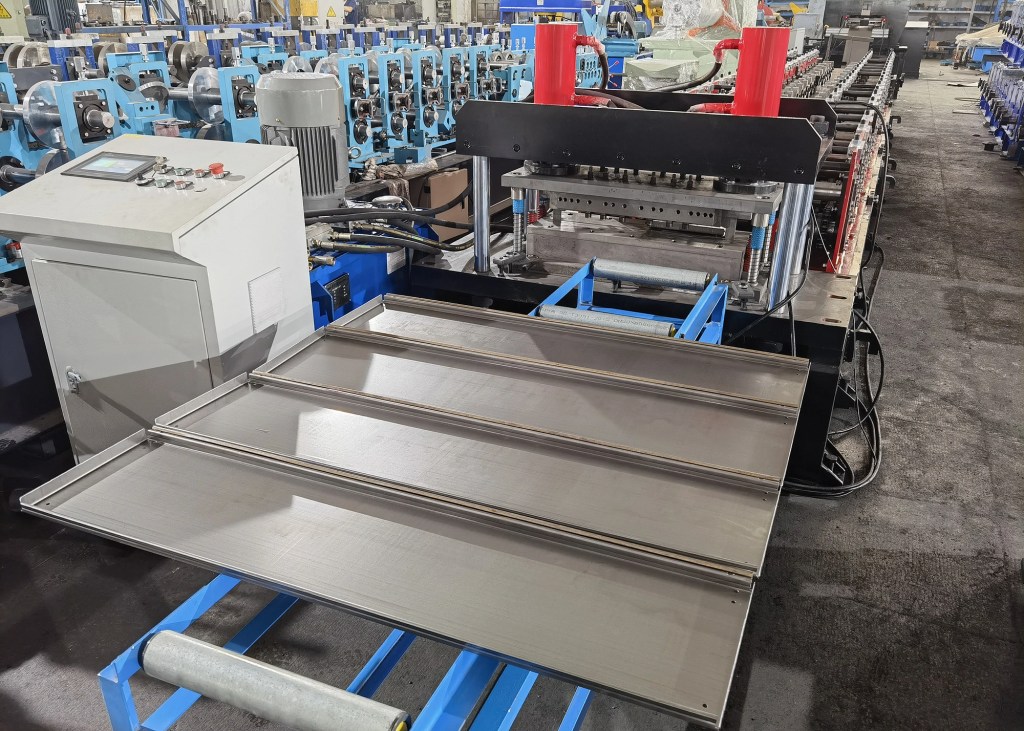
สายการผลิตขึ้นรูปม้วนสำหรับชั้นวางอุตสาหกรรม

Industrial Shelving Roll Forming Line: What It Makes and How to Spec

Need a Roll Forming Machine for Your Project?
รับใบเสนอราคาฟรีจาก Believe Industry — ผู้ผลิตเครื่องม้วนรูปตามสั่งมากกว่า 15 ปี
ขอใบเสนอราคา Download Catalogue

Industrial Shelving Roll Forming Line: What It Makes and How to Spec

An industrial shelving roll forming line builds the parts of a boltless shelf system from steel coil: the deck, the upright post, and the brackets that lock them together. A shelving roll forming line is a family of profiles, not one part, so the line must switch between them without a long stop. This guide covers what the line makes and how to spec one for your volume.
คำตอบสั้น: An industrial shelving roll forming line forms shelf decks, upright posts, and brackets from galvanized coil, punching holes and slots in line. Deck lines run 10 to 20 m/min, upright lines 10 to 15 m/min with press punch and over 30 m/min with servo. Spec the profile range, thickness, and punch library before you buy.

What a shelving roll forming line builds

A shelving system has three formed parts. The deck is the flat or profiled shelf that holds the load. The upright is the vertical post with slots. The bracket hooks the deck to the upright. A complete shelving roll forming line makes all three, and the buyer sizes it to the mix of those parts they ship.
The deck is the highest volume part. It is a shallow pan or a flat strip with return edges, often perforated for weight saving. An industrial shelving roll forming line for decks needs wide rolls and a stable strip path, because a wavy deck rocks the load and fails inspection.

Profiles and how they form

The upright post is a slotted column, similar in idea to a pallet rack upright but lighter. The shelving roll forming line punches the slot pattern, then bends the post. Bracket forming is a small line that bends a hook and a lip from a short strip. Most shops run decks and uprights on one line and brackets on a second.
PartHow it formsKey spec
DeckShallow pan with return edgeFlatness, perforation
ตั้งตรงSlotted post, light gaugeSlot pitch, straightness
BracketHook and lip from short stripHook angle, repeatability
A shelving roll forming line tooled for one deck width is cheap but limited. A line with quick change rolls covers several deck widths from one setup, which suits shops with varied orders.

Line speed and punch

Speed follows the punch method. A shelving roll forming line with a press punch runs 10 to 20 m/min on decks and 10 to 15 m/min on uprights. A servo punch passes 30 m/min on light patterns. Perforated decks need more punch time, so the hole pattern sets the real speed.
Punch methodDeck speedUpright speed
พั้มไฮดรอลิก3 ถึง 4 m/min3 ถึง 4 m/min
Press punch10 to 20 m/min10 ถึง 15 m/min
Servo rotary30+ เมตร/นาที30+ เมตร/นาที
Plan the shelving roll forming line around your hole count. A line rated at 40 m/min that stalls at 12 m/min on a dense deck is still a 12 m/min line for your product.

Material and tolerance

Shelving uses 0.6 to 1.5 mm galvanized or painted steel, lighter than pallet rack. An industrial shelving roll forming line for this range needs fine roll control to avoid oil canning on the wide, thin deck. Heavier stands help, but the roll grind matters more at thin gauge.
Flatness is the test. A deck that waves under load is unsafe, so the shelving roll forming line must hold the strip flat through the bend. Side rolls and a straightener after the last station keep the deck true. For rated load, confirm the flatness tolerance before you accept the sample.

How to spec the line

Start from the deck width, steel grade, and slot pattern. A shelving roll forming line for 0.8 mm decks at 400 to 600 mm width with a standard slot needs 10 to 14 stations and a press punch. Add automatic stacking for decks, since long thin shelves are awkward to handle by hand.
Standards set the floor. Shelving must meet RMI ANSI MH16.1 in the United States, FEM 10.2.02 in Europe, and use แอสทรอส เอ1008 grade steel. A line set to those limits passes buyer audit and avoids rework on the deck and upright.
Coating choice also shapes the line. Pre-galvanized coil is simplest, but buyers needing painted shelving may want post-paint or a pre-painted coil run. A shelving roll forming line that handles coated coil without marking the surface protects the finish through the rolls, which matters for retail and display shelving where scratches show.
For the warehouse context, see our warehouse logistics roll forming guide. เดอะ retail and commercial shelving guide covers the shop-fitting side. Our upright rack buyer guide looks at the heavier upright side.
Punch setup is in our roll forming punching die installation guide. เดอะ coil width and thickness calculator sizes the strip, and the สายการผลิตเครื่องรีดขึ้นรูป overview explains the system. Our pallet rack production speed guide applies the same throughput method to a related line.

Common mistakes when buying a shelving roll forming line

The first mistake is buying a single-width line when orders span several deck sizes. A shelving roll forming line tooled for one width forces you to turn away work or run a second machine. Quick-change rolls cost more up front but pay back fast in a job shop with mixed orders.
The second mistake is ignoring the deck flatness spec. Thin galvanized steel waves easily, and a wavy deck fails load test at the buyer. Ask the builder for a flatness number in millimetres per metre, not just “flat enough”, and check it on the first sample before the line ships.
The third mistake is treating brackets as an afterthought. Brackets are small but high volume, and a poor hook angle makes the whole shelf feel loose. A shelving roll forming line that forms brackets on a dedicated station keeps the hook repeatable across long runs.
The fourth mistake is skipping automatic stacking on decks. Long thin shelves are awkward to handle by hand, and manual stacking caps the line speed you just paid for. Automatic stacking usually recovers more output than a faster former would have.

คำถามที่พบบ่อย

Q: What does an industrial shelving roll forming line make?

A: It forms shelf decks, upright posts, and brackets from coil. The deck is the highest volume part, the upright is the slotted post, and the bracket hooks the deck to the upright. Most shops run decks and uprights on one line.

Q: How fast does a shelving line run?

A: A press punch line runs 10 to 20 m/min on decks and 10 to 15 m/min on uprights. A servo punch passes 30 m/min on light patterns. The hole pattern on perforated decks sets the real speed.

Q: Which steel and gauge should I use?

A: Shelving uses 0.6 to 1.5 mm galvanized or painted steel, lighter than pallet rack. The shelving roll forming line must control oil canning on thin wide decks, so roll grind quality matters more than stand weight.

Q: How many stations does the line need?

A: Most decks need 10 to 14 stations, and uprights similar. More stations bend more gently, which keeps thin steel flat. A line with quick change rolls covers several deck widths from one setup.

Q: Which standards apply to shelving?

A: Shelving should meet RMI ANSI MH16.1 in the US, FEM 10.2.02 in Europe, and ASTM A1008 for steel grade. Confirm the classes your buyer requires before the line is built.

Q: Where should I invest first on the line?

A: Size the line to your deck width and slot pattern, then add automatic stacking for decks. Long thin shelves are slow to handle by hand, so stacking often recovers more speed than a faster former.

บันทึกการเปลี่ยนแปลงของบทความ

Originally published: March 6, 2026
อัปเดตล่าสุด: October 12, 2026
บันทึกการเปลี่ยนแปลง:
  • October 12, 2026: Refreshed for GEO compliance. Removed the clickbait “7 Powerful Secrets” title and the “2026” year stamp, added a direct-answer block, two tables, six FAQ with bold Q, and a spelled-month changelog. Expanded from 996 to about 1,620 words. Added three authority links (RMI, FEM, ASTM) and eight internal links including the pillar page. Kept the industrial shelving angle, which is distinct from the pallet rack and retail shelving posts.
Next Review Triggers:** New RMI or FEM revision, a 20 percent shift in search interest for “industrial shelving roll forming line”, launch of a new servo punch speed class, or a change in shelving load standard.

สารบัญ

อัปเดตใหม่

ค้นพบข้อมูลเพิ่มเติมจาก Believe Industry Company| Roll Forming Machine Manufacturer, Supplier & Exporter

สมัครสมาชิกตอนนี้เพื่ออ่านต่อและเข้าถึงคลังบทความฉบับเต็ม.

อ่านต่อ