Address
No 1, Yd Road, Huishan District, Wuxi City, Jiangsu. 214183
Work Hours
Monday to Friday: 9AM - 5PM
Saturday: 9AM - 4PM

The global cold chain market is on fire. Valued at 210 billion in 2025, it is projected to reach 340 billion by 2030. Frozen food, vaccines, biotech, and fresh produce all depend on temperature controlled storage. Behind every refrigerated warehouse sits a cold storage roll forming machine turning steel coil into the panels and frames that keep cold in and heat out.
Believe Industry Company has built roll forming lines for cold storage applications for over 15 years, shipping to 20+ countries. This guide breaks down the three insulated panel profiles that define cold storage construction and the machines that produce them.
Cold storage construction is not standard building. Walls and roofs must maintain temperature differentials of 40 to 60 degrees C between inside and outside. Moisture condenses on every surface. Steel profiles face corrosion from constant humidity and chemical washdowns.
A cold storage roll forming machine handles these demands through tighter tolerances, specialized coating compatibility, and profiles designed for thermal breaks. Standard roofing and wall lines do not cut it. The Global Cold Chain Alliance reports that cold storage capacity is growing 12% annually, driven by pharmaceutical cold chain requirements and food safety regulations worldwide.
Three profile types form the backbone of cold storage construction. Each requires a dedicated roll forming line.
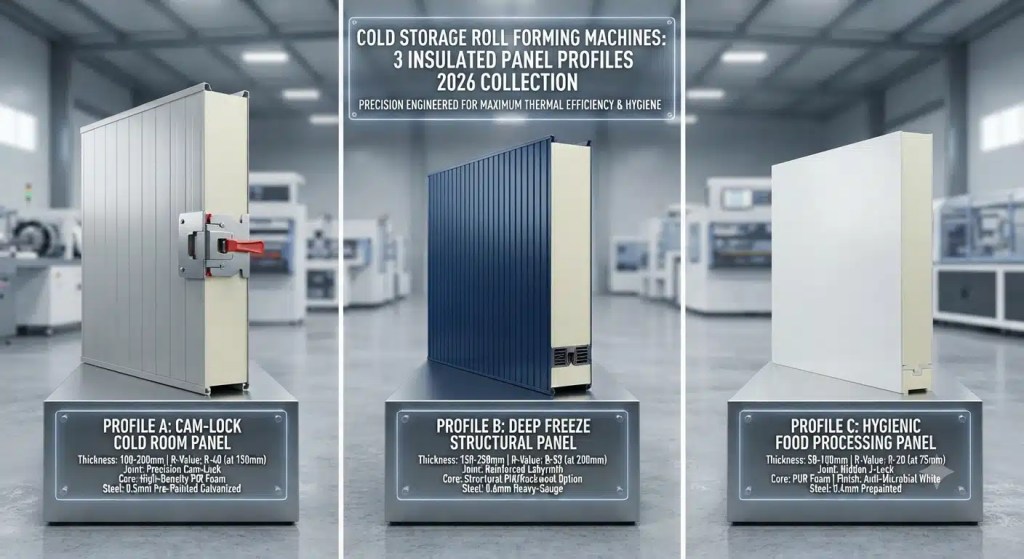
The insulated sandwich panel is the heart of every cold room. Two metal skins bonded to a polyurethane (PU) or polyisocyanurate (PIR) foam core create a panel with thermal insulation values from R-20 to R-40. These panels form the walls, roofs, and ceilings of refrigerated warehouses, blast freezers, and walk-in cold rooms.
A sandwich panel production line is actually two machines in one. The first roll forms the outer metal skin, typically 0.4 to 0.6mm pre-painted galvanized steel or aluminum. The second forms the inner skin. Between them, a foaming station injects PU or PIR chemical mixture that expands and cures as the panel moves through the double-belt conveyor. The result is a continuous insulated panel cut to length by a flying saw.
This is what makes an insulated panel roll former fundamentally different from a standard metal roof panel machine. The foaming station controls everything. Panel widths range from 1000mm to 1200mm. Thickness varies from 50mm for chilled rooms to 200mm for deep freeze applications below -30 degrees C. The International Association of Refrigerated Warehouses specifies minimum insulation values for different temperature zones.
PU panel roll forming lines must maintain foam density consistency of 38 to 42 kg/m3 to meet these standards. A freezer panel machine that produces inconsistent foam density creates panels with cold spots, and cold spots mean condensation, mold, and failed inspections.
Key machine specifications:
The double-layer roll forming machine concept applies here. Some lines produce two panel profiles by switching the roll forming section while the foaming station runs continuously. Believe Industry builds these hybrid lines for factories that serve both cold storage and standard industrial building markets.
Joint design matters as much as the panel itself. Cam-lock joints, tongue-and-groove edges, and hidden fastener systems all get formed into the panel profile during roll forming. A poor joint means thermal leakage, condensation, and mold. A good joint maintains a continuous vapor barrier across the entire cold room envelope.
Every cold room needs doors. Cold room door assemblies are thick insulated units, 75mm to 120mm, that must seal against temperature differentials of 50 degrees C or more. The frames that hold these doors are roll-formed profiles with thermal break features.
A cold room door frame roll forming machine produces U-channels, Z-sections, and custom profiles from 1.5mm to 2.5mm galvanized steel. The critical feature is the thermal break. The profile includes a recess or channel where a PVC or nylon thermal separator sits, preventing heat transfer through the steel frame. Without this break, the frame sweats, ice forms, and the door seal fails.
Cold room door frame profiles come in several configurations. Sliding door frames use a double-track profile that guides insulated sliding doors along the cold room face. The track must be perfectly straight and level. Roll forming tolerance on straightness is 1mm per meter. The c-strut roll forming machine produces compatible structural channels that frame the door opening.
Hinged door frames use a heavier profile with integrated hinge mounting points. Pre-punched holes for hinges, locks, and closures are essential. A servo-driven punch press integrated into the cold room door frame line handles this with 0.2mm positioning accuracy.
Freezer door frames are the most demanding. Operating at -30 degrees C and below, the steel must resist brittle fracture. Low-temperature carbon steel grades like S355J2 or ASTM A572 Gr50 are standard. The roll forming machine needs heavier forming stations because these grades have higher yield strength and more springback.
Production specs for cold room door frame lines:
The food processing equipment market depends on these frames. Every meat processing plant, dairy, and pharma clean room needs cold room door frames that survive daily washdowns with chemical sanitizers. Hot-dip galvanized coatings of 55 microns minimum are standard for corrosion resistance.
Inside the cold storage facility, product sits on racks. Refrigeration racking is pallet racking built for environments from -30 degrees C to +5 degrees C. The profiles are similar to standard warehouse racking, but the steel, coating, and tolerance requirements are stricter.
A refrigeration racking roll forming machine produces upright frames, box beams, and bracing from 1.5mm to 4.0mm steel. The pallet racking roll forming machine platform serves as the base, configured for cold storage specifications.
The critical difference is steel grade. Standard warehouse racking uses S235 or S275. Refrigeration racking requires S355J2 or equivalent low-temperature steel that maintains impact toughness at -30 degrees C. The upright rack roll forming machine handles these harder grades with 20 to 24 forming stations and heavier roller stands.
Coating is the other key factor. Cold storage environments cycle through condensation and freezing. Pre-galvanized strip is the starting point, but many cold storage operators specify post-galvanizing for racking components exposed to washdowns. A minimum 55-micron hot-dip galvanized coating is standard. Some pharmaceutical cold chain facilities require epoxy powder coat over galvanizing for chemical resistance.
Refrigeration racking profiles include uprights at 80mm to 140mm deep in 2.5 to 4.0mm steel, box beams at 80x40mm to 100x50mm in 1.5 to 2.5mm from the racking system box beam line, and C-channel bracing at 40x20mm to 60x30mm in 1.2 to 2.0mm.
Line speed for uprights runs 8 to 15 m/min. Box beams run 15 to 30 m/min. Bracing lines hit 30 to 50 m/min. The speed difference comes from material thickness and profile complexity. For facilities combining cold storage with standard warehousing, the same corrugated sheet roll forming machine logic applies. One line can serve multiple markets with quick-change tooling.
| Parameter | Sandwich Panel Line | Door Frame Machine | Refrigeration Racking |
|---|---|---|---|
| Material Thickness | 0.4-0.6mm (skin) | 1.5-2.5mm | 1.5-4.0mm |
| Line Speed | 4-8 m/min | 12-20 m/min | 8-30 m/min (varies) |
| Roll Stations | 16-22 per skin | 14-20 | 10-24 (varies) |
| Foaming System | Yes (PU/PIR) | No | No |
| Punching | Optional | Servo-driven, multi-die | Servo/hydraulic |
| Key Feature | Thermal insulation core | Thermal break recess | Low-temp steel compatibility |
| Primary Application | Walls, roofs, ceilings | Cold room door openings | Interior shelving |
| Steel Grade | Pre-painted galv/aluminum | S355J2 for freezer | S355J2 or ASTM A572 Gr50 |
| Parameter | Cold Storage Panel | Standard Building Panel |
|---|---|---|
| Insulation | PU/PIR foam, 50-200mm | None or mineral wool |
| Temperature Range | -30C to +5C interior | Ambient |
| Vapor Barrier | Continuous, cam-lock joints | Optional |
| Steel Coating | Heavy galv + paint, 55+ microns | Standard pre-galv |
| Joint Type | Tongue-and-groove, hidden fastener | Overlap, exposed fastener |
| Panel Width | 1000-1200mm | 1000-1250mm |
| Machine Requirement | Foaming station + dual roll formers | Single roll former only |
Cold storage construction falls under multiple regulatory frameworks. In Europe,ย EN 14509ย governs self-supporting double-skin metal faced insulating panels. It defines fire performance, thermal resistance, and dimensional tolerances. Panels carrying the CE mark must pass these tests.
In the United States, theย FDA Food Safety Modernization Actย imposes strict requirements on food storage facilities. Cold storage surfaces must be cleanable, non-toxic, and resistant to corrosion from sanitizing chemicals. Panel coatings and racking finishes must comply.
Pharmaceutical cold chain facilities face even tighter rules.ย WHO Good Distribution Practiceย guidelines for pharmaceutical products require temperature mapping, calibrated monitoring, and validated insulation performance. The roll-formed profiles and panels must meet documentation standards that trace material origin through final installation.
Believe Industry machines ship with full export documentation. Material test reports, dimensional inspection sheets, weld procedure specs, and CE support come standard. For cold chain projects, we add compliance packages for the target market. Everyย cold storage roll forming machineย we build gets configured for the local grid, local standards, and local steel supply before shipping.
A sandwich panel line with foaming station runs $180,000 to $350,000 depending on width, thickness range, and automation level. A cold room door frame machine costs $70,000 to $130,000. Refrigeration racking lines range from $35,000 for a bracing machine to $150,000 for a full upright line with welding.
The economics work because cold storage panels command premium prices. A standard 1000mm x 100mm PU sandwich panel wholesales at $15 to $25 per linear meter. Raw material cost: $6 to $9. Gross margin per meter: $9 to $16. At 6 m/min, that is $54 to $96 per minute in margin. An 8-hour shift generates $25,920 to $46,080 in gross margin.
A cold room door frame at 2.0mm costs $3 to $5 in steel per linear meter. Finished frame sections sell at $8 to $14. Margin: $5 to $9. At 15 m/min, that is $75 to $135 per minute.
Refrigeration racking uprights at 2.7mm: $5 to $7 in steel, $18 to $25 finished. Margin: $11 to $18. At 10 m/min producing 3-meter uprights, that is 3 pieces per minute, $33 to $54 per minute. Theย standing seam roll forming machineย market sees similar margins in roofing, but cold storage profiles carry less competition and higher barriers to entry.
Payback on a sandwich panel line: 8 to 14 months at 70% utilization. Door frame machine: 4 to 7 months. Racking line: 4 to 6 months. Theย roofing sheet roll forming machineย market is more crowded, which makes cold storage a smarter entry point for new manufacturers looking at insulated panel roll former opportunities.
PU (polyurethane) offers better thermal insulation at lower cost. PIR (polyisocyanurate) provides superior fire resistance and is required in many markets for cold storage construction. PIR costs 10 to 15% more but meets stricter fire codes forย temperature controlled storageย facilities.
Yes, but not simultaneously. The foaming station bypasses when running single-skin profiles. Changeover takes 4 to 8 hours. Some factories run insulated panels on day shift and single-skin on night shift to maximize line utilization.
S355J2 for freezer applications below -20 degrees C. S275 or ASTM A36 is acceptable for chilled rooms at 0 to +5 degrees C. Always specify low-temperature impact testing on the mill certificate forย cold room door frameย production.
Hot-dip galvanized zinc builds up on rollers over time. Use zinc-resistant roller coatings, wider roll gaps, and dust extraction at forming stations. Pre-galvanized strip is easier to form but offers thinner coatings.
380V to 480V three-phase, 50Hz or 60Hz. A sandwich panel line with foaming station draws 120 to 200 kW. Door frame machines draw 50 to 80 kW. Racking lines draw 30 to 120 kW. Believe Industry configures everyย cold storage roll forming machineย for the local grid.
2 to 4 weeks for a sandwich panel line. 1 to 2 weeks for a door frame or racking line. Believe Industry sends an engineer. First production parts come off the line by day 3 to day 5.
Yes. The profiles are similar. The difference is steel grade and coating specification. One line handles both if you source the right coil. Quick-change tooling switches between profiles in 15 to 20 minutes.
One machine. Believe Industry builds to order. Typical lead time is 45 to 75 days from deposit to shipment, depending on configuration and customization level.
The cold chain is not slowing down. Food safety regulations tighten every year.ย Pharmaceutical cold chainย logistics demand grows with biotech expansion. Every new refrigerated warehouse needs panels, door frames, and racking produced on roll forming machines.
Three decisions determine your success. First, pick your primary profile. Sandwich panels offer the highest margin but the highest entry cost. Door frames are the fastest payback. Racking lines serve both cold storage and standard warehouse markets. Second, secure your steel supply. Cold storage grades cost 15 to 25% more than standard, and availability varies by region. Third, choose the right partner.
Believe Industry Company has built roll forming machines for over 15 years. We ship to 20+ countries. Our team configures, commissions, and trains. Fromย cable tray roll forming machinesย for cold room electrical to full sandwich panel production lines, we cover the complete cold storage manufacturing ecosystem.
The cold chain market waits for no one. Every degree of temperature control starts with the right steel profile.
Last updated: July 27, 2026
Article Changelog:
Next Review Triggers:
Introduction The global cold chain market is on fire. Valued...
Read MoreIntroduction Interior partition walls used to mean wood studs, sawdust,...
Read MoreGlobal vehicle production reached 90 million units in 2025. Every...
Read MoreAย residential roofing roll forming machineย shapes flat steel coil into finished...
Read MoreSubscribe now to keep reading and get access to the full archive.