Home / Roll Forming Machine / Metal Sheet Roll Forming Machine / Corrugated Sheet Roll Forming Machine

Corrugated Sheet Roll Forming Machine

762 mm Cover From 914 mm Coil: How the Line Is Sized

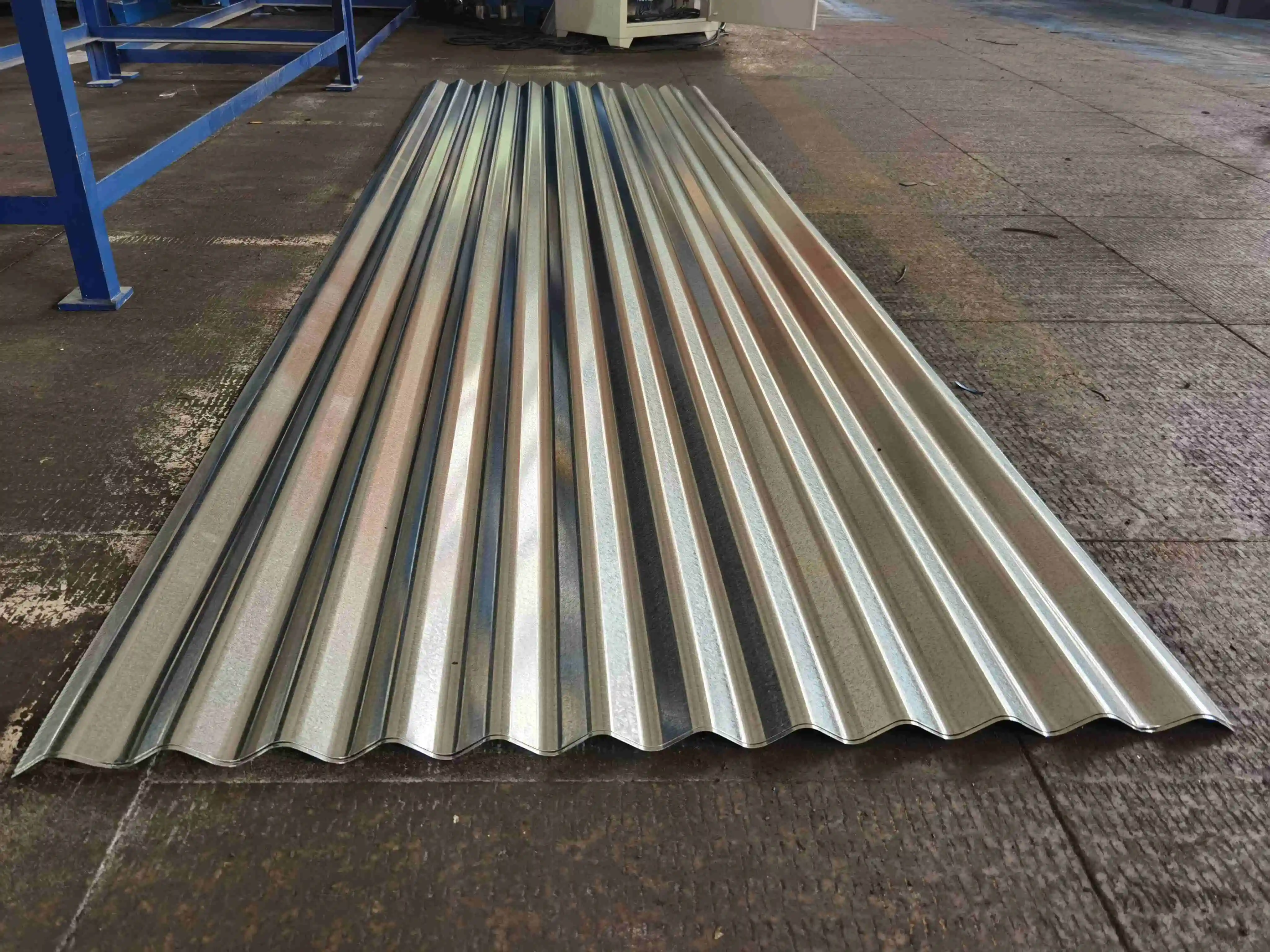
Short answer: A corrugated sheet roll forming machine forms flat steel coil into the round wavy roof and wall profile. The standard tool set runs a 76.2 mm pitch and 18 mm wave depth, takes 914 mm coil, and delivers 762 mm cover at 10 to 15 m/min across 24 forming stations.
Most buyers arrive with two numbers: a coil width and a cover width. Those two numbers decide the roll set, the edge guide, and the cutter stroke. A corrugated sheet roll forming machine built on the wrong pair still runs, but the sheets will not lap cleanly on site. This page covers the profile geometry, the coil to cover conversion, the machine modules, and the checks worth running before you sign a purchase order. If you are still comparing profile families, read the parent guide on metal sheet roll forming machines first.
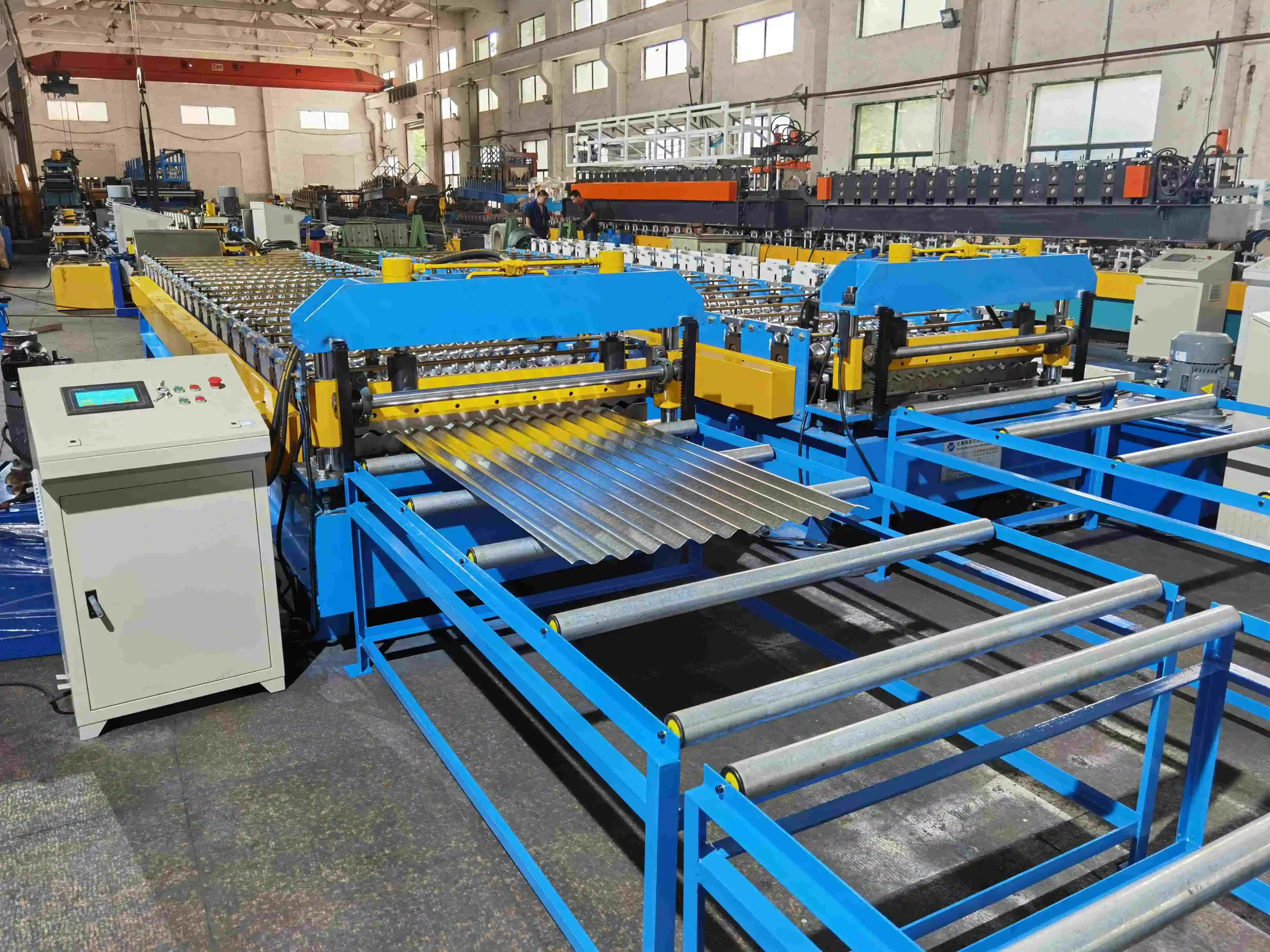
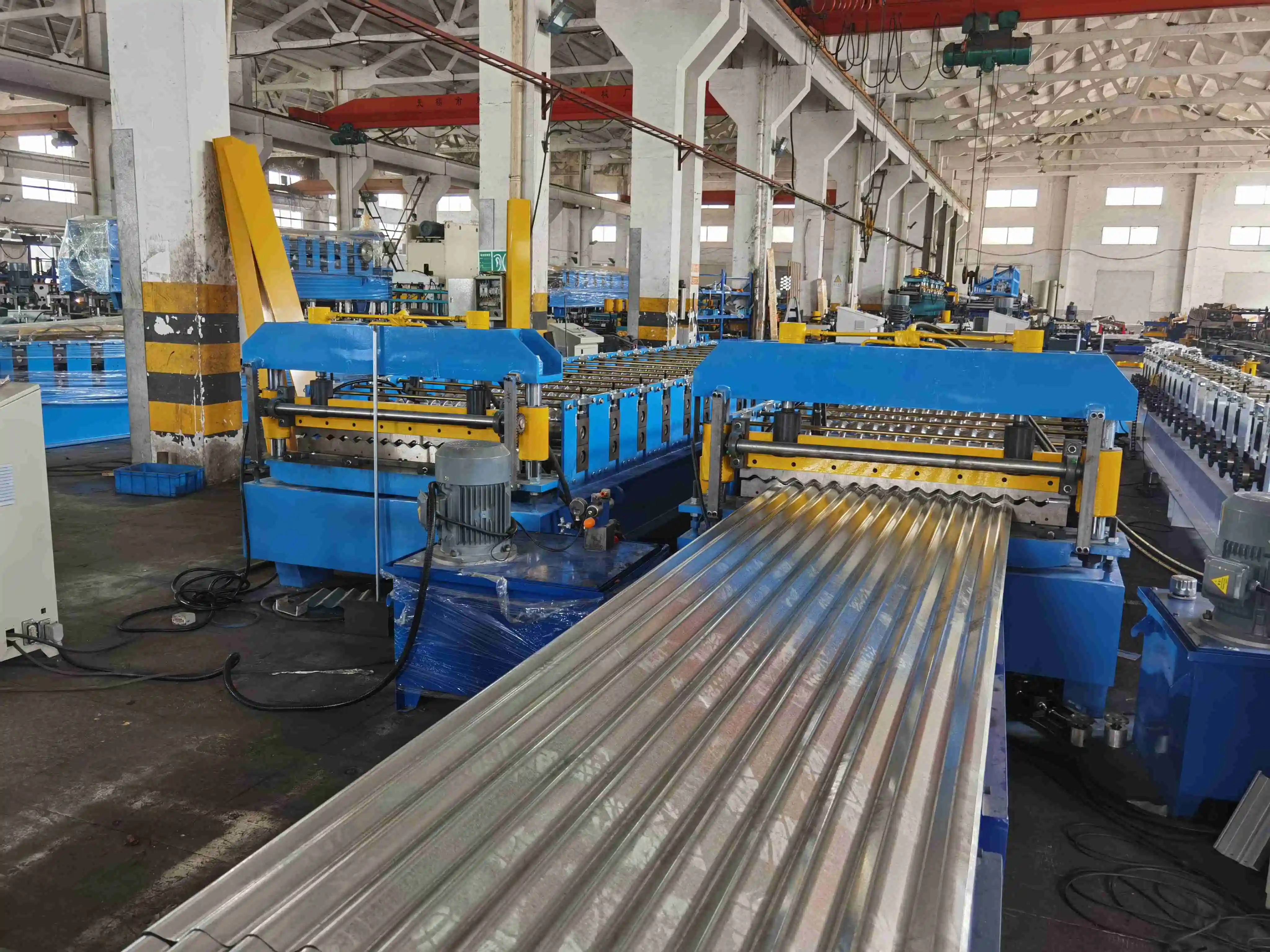
corrugated roofing sheet roll former

What a Corrugated Sheet Roll Forming Machine Does

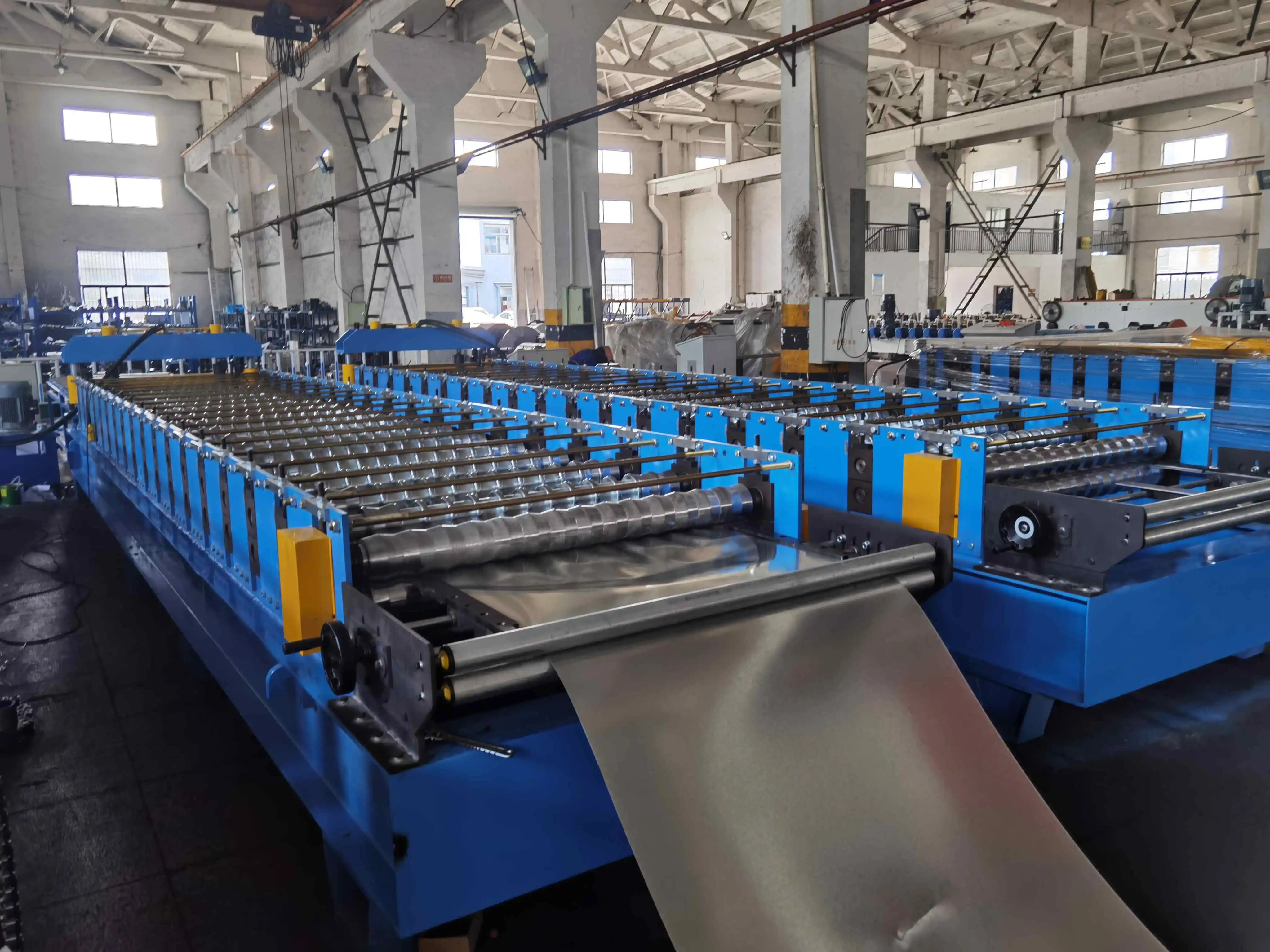
A corrugated sheet roll forming machine does one job. It bends a flat strip through a series of driven roll stands until the strip takes the wave section, then cuts it to length. Nothing is welded. Nothing is pressed. The wave comes from the roll gap in one continuous pass.
That is why a corrugated sheet roll forming machine is sized by the profile rather than by the sheet. Sheet length comes from the encoder and the cut signal. Sheet width comes from the roll set and the edge trim.
One property separates corrugated from most other roofing profiles. The roll set does not care how wide the incoming coil is. Change the coil, adjust the feeding guide by hand, and the same line produces a narrower sheet with the same pitch and the same wave depth. No mould change is needed, which is what lets one machine serve several markets.

The Profile Numbers That Set the Whole Line

Five dimensions appear on every corrugated drawing. They are also the five questions a builder has to answer before quoting.
ParameterStandard corrugatedWhat it controls
Pitch, wave to wave76.2 mm (3 inch)Roll diameter and stand count
Wave depth18 mmRoll gap, shaft stiffness
Feed width914 mm coilGuide setting, decoiler size
Cover width762 mm after lappingSheet count per roof area
Cover ratio83.4%Coil that ends up as sellable width
Two variants sit either side of the standard profile, and the same corrugated sheet roll forming machine runs both once the roll set is swapped. A mini corrugated profile uses a shorter pitch and a shallower wave, which suits residential roofing and the South African market where narrow sheets are still common. A deep corrugated profile pushes the wave past 25 mm for industrial walls and long spans that need stiffness from the section itself.
If your profile is none of these, the roll set is cut from your drawing. Send a section drawing with pitch, depth, cover width, and material thickness, and the corrugated sheet roll forming machine gets built around it. Our customized profiles page covers what that drawing needs to contain.

From Coil Width to Cover Width

On a corrugated sheet roll forming machine, cover width is always smaller than coil width. The difference is the steel consumed by the wave plus the edge trim, and it is fixed by the roll set, not by the operator.
Coil widthCover widthWidth taken by wave and trimTypical use
1250 mm1000 mm250 mmWide commercial roofing
1000 mm838 mm162 mmGeneral roofing and walling
914 mm762 mm152 mmClassic 3 inch corrugated, export markets
On the 914 mm coil the loss is 16.6 percent. That number belongs in your costing sheet, because it decides how much coil you buy per square metre of finished roof. The full method sits in our guide to coil width calculation. Confirm the cover width on a section drawing before ordering, since two profiles with the same pitch can trim differently at the edge, and a 5 mm error at the lap becomes a leak path on a finished roof.

What Sits on a Corrugated Sheet Roll Forming Machine

Every corrugated sheet roll forming machine we build follows the same sequence, whether it runs 10 m/min or 15 m/min.
  • Hydraulic decoiler, 5 tonne, for coil handling and mandrel expansion
  • Feeding and guiding unit with hand wheel edge adjustment
  • Roll forming mill, 24 stations on an H beam welded frame
  • Hydraulic cutting device with Cr12MoV blade and PLC length control
  • Control cabinet with touch screen, encoder, and inverter
  • Run out table, two pieces, angle steel frame
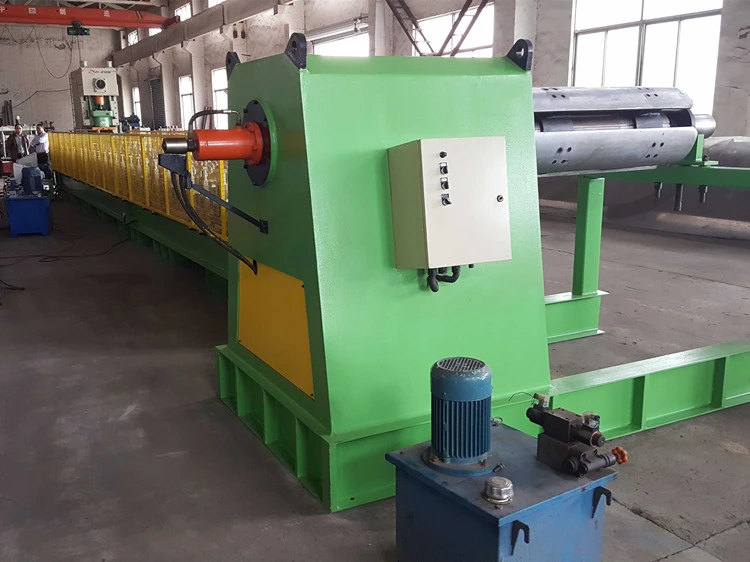
5 ton hydraulic uncoiler
The decoiler is where most problems on a corrugated sheet roll forming machine start. A coil that expands unevenly pulls the strip off centre, and the guide then has to correct a fault it did not create. Our guide to decoiler types explains when a hydraulic mandrel is worth the extra cost over a manual one.

Technical Specification

The table below is the configuration we build most often for 0.4 to 0.8 mm galvanized coil. Values change with material thickness and profile depth.
SectionItemSpecification
DecoilerType and capacity5 t hydraulic, welded steel plate and beam frame
DecoilerMandrel and coil sizeExpansion 480 to 560 mm, coil ID 508 mm, OD up to 1350 mm
DecoilerDecoiling speed0 to 15 m/min, Yaskawa inverter
FeedingFeeding width and guide600 to 1450 mm, manual side hand wheel
FormingStations and thickness24 forming steps, 0.4 to 1.6 mm
FormingShaft and roller40Cr shaft 80 mm, 45 steel roller with 0.05 mm chrome
FormingMain motor and speed5 kW chain drive, 10 to 15 m/min
CuttingBlade and toleranceCr12MoV, HRC 60 to 62, plus or minus 5 mm
CuttingLength controlPLC and Omron encoder, set on touch screen
CuttingHydraulic power4 kW, 12 MPa or above
ControlPLC and cabinetPanasonic PLC, 700 x 300 x 1000 mm cabinet
ControlPower supply380 V, 50 Hz, 3 phase
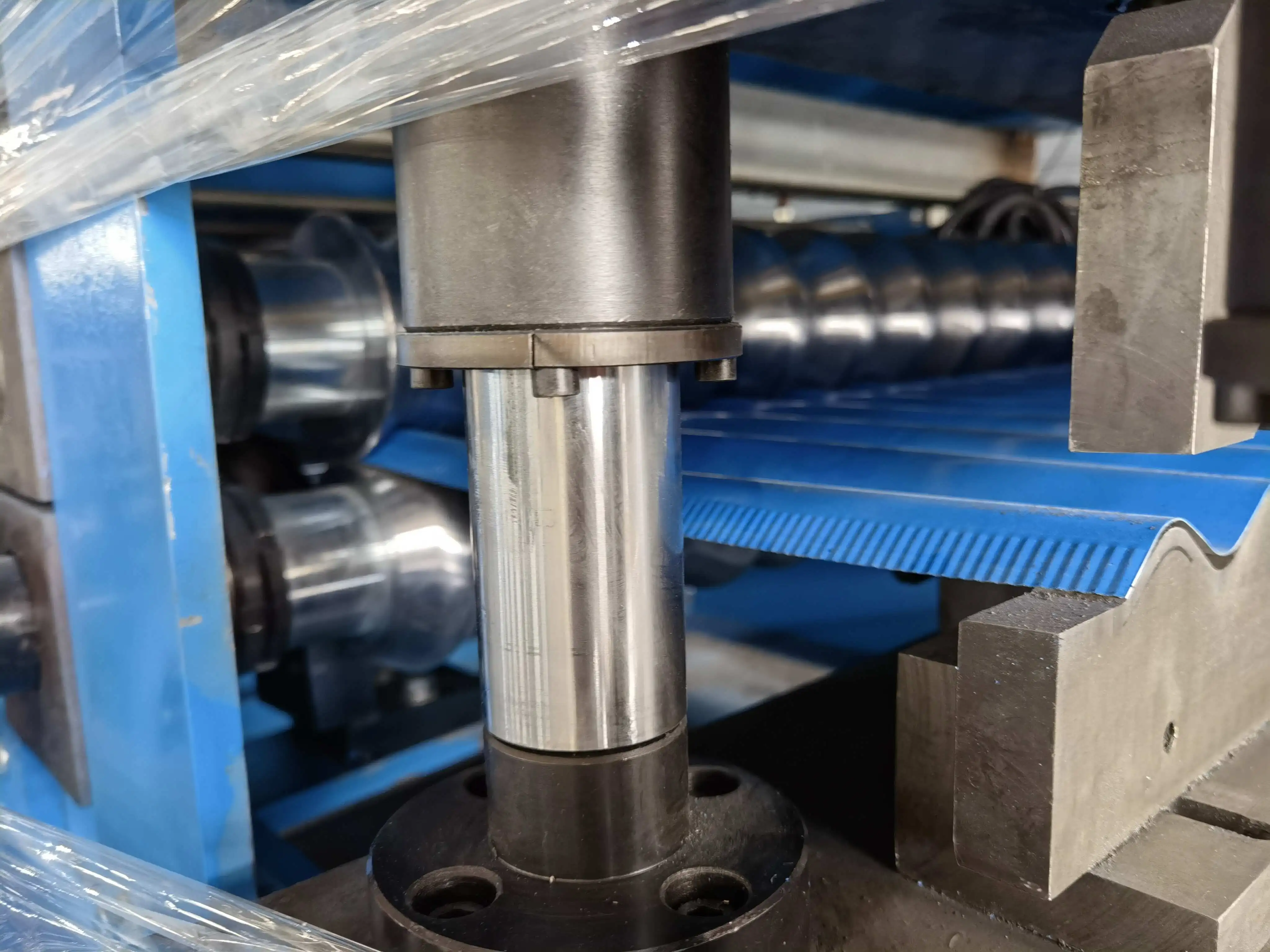
Corrugated Metal Panel Roll Forming Machine embossing rollers

Single Layer, Double Layer or Cassette

South African buyers often ask for a double layer line that runs IBR and corrugated on one frame. That choice saves floor space and one decoiler, and it is why the format sells well there. The trade off is changeover time and a heavier frame. The comparison sits in single layer vs double layer, and the IBR side has its own page on the IBR sheet roll forming machine.
Plants selling into several markets should look at cassette tooling instead. A cassette swap changes the profile on a corrugated sheet roll forming machine in roughly two to three hours without stripping the shaft, which suits a yard that runs corrugated one week and standing seam the next. Our page on the multi profile roll forming line covers the cost comparison.

Speed, Output and Labour

Speed on a corrugated sheet roll forming machine is quoted in metres per minute, but buyers plan in sheets per shift. At 12 m/min with 85 percent uptime, an 8 hour shift runs about 4,900 metres. Cut at 3.6 m, that is roughly 1,360 sheets. The same shift gives about 1,130 sheets at 10 m/min and 1,700 at 15 m/min.
The corrugated sheet roll forming machine itself rarely limits output at these speeds. Coil changes, packing, and crane time usually do. Two operators run a standard line: one at the decoiler and control cabinet, one at the run out table. An automatic stacker removes the second role on long runs and pays back fastest where sheets are cut to a fixed length all day.

Steel and Coating

A corrugated sheet roll forming machine runs coated coil, and that coil lives outdoors for decades, so the coating decision matters more than the frame paint on the machine. Hot dip galvanized coil at Z275 gives 275 g/m2 of zinc across both surfaces and covers most industrial and agricultural work. Aluzinc at AZ150 suits coastal and high humidity sites where zinc alone corrodes too fast. Pre-painted coil with a 25 micron polyester top coat goes on architectural work where colour matters, and it has to form without cracking the paint at the wave crest, which is a roll gap setting rather than a coating spec.
Standards worth quoting in a purchase order include EN 10346 for continuously hot dip coated steel and AS/NZS 2728 for coating selection by environment. The World Steel Association publishes background on coated steel in construction, and the galvanizing body covers coating mass testing at galvanizeit.org. Our wall cladding guide covers how coating choice shifts between roof and wall use.

What Drives the Price

Four things move the number on a corrugated sheet roll forming machine quote, and none of them is the paint colour.
Station count comes first. A 24 station mill handles 18 mm wave depth in mild steel comfortably. Deeper waves or high tensile G550 coil need more stands and larger roll diameters, because each stand has to bend less per pass. Shaft and frame size come second: an 80 mm shaft on an H beam frame covers the standard profile, while 1.6 mm at full width pushes both up a size.
Cutting method comes third. A stop cut hydraulic shear is standard. A flying shear that cuts on the move costs more and earns its money only above roughly 20 m/min, which a corrugated line rarely reaches. Options come last: automatic stacker, embossing rollers, double layer frame, cassette system. Ask for each as a separate line item so the comparison between suppliers stays honest.

How to Specify Your Line

Send these six items and a corrugated sheet roll forming machine builder can quote without a second round of questions.
  1. Profile drawing with pitch, depth, feed width, and cover width
  2. Steel type and thickness range, including the thinnest and thickest coil you will run
  3. Coil size: inner diameter, outer diameter, and maximum coil weight
  4. Required line speed and the sheet lengths you cut most often
  5. Power supply at the destination factory, including voltage and phase
  6. Site conditions: ambient temperature, humidity, and shifts per day
Believe Industry has built custom roll forming lines since 2005, with 15+ years of experience, 80+ engineers, and 500+ projects delivered to 50+ countries under ISO 9001 and CE. We size the frame, rolls, and cutoff to your profile, so the corrugated sheet roll forming machine you get matches the coil you can actually buy.
Send the profile drawing to enquiry@believeindustry.com or use the request a quote form. We reply with a layout drawing, the coil width to cover width conversion for your section, and a price within two working days.

Photo Gallery

Frequently Asked Questions of Corrugated Sheet Roll Forming Machine

Q: What is the standard size of a corrugated sheet roll forming machine?

A: A 24 station mill with an 80 mm shaft, a 5 kW main motor, and a 5 tonne hydraulic decoiler. It takes 914 mm coil and produces 762 mm cover at 18 mm wave depth, running 10 to 15 m/min.

Q: Can one corrugated sheet roll forming machine run different coil widths?

A: Yes. The roll set fixes pitch and depth, not width. Change from 1250 mm to 914 mm coil and adjust the side guide by hand. The sheet gets narrower and the wave stays the same.

Q: What steel thickness can the line form?

A: 0.4 to 1.6 mm on the standard build of this corrugated sheet roll forming machine. Roofing usually runs 0.5 mm galvanized and wall cladding 0.4 to 0.6 mm. Above 1.2 mm at full width, ask for the heavier frame and larger shaft.

Q: How fast does a corrugated line run?

A: 10 to 15 m/min, which equals roughly 1,130 to 1,700 sheets per 8 hour shift at 3.6 m lengths. Output is usually limited by coil changes and packing, not by the mill.

Q: Does the machine need a mould change for a new profile?

A: Not for a width change, and yes for a new section. Pitch, depth, and wave shape live in the roll set, so a different profile needs new rolls or a cassette. Width alone never does.

Q: Why do South African buyers order double layer lines?

A: One frame runs IBR and corrugated, which saves floor space, one decoiler, and one control cabinet. Yards selling both profiles to the same roofing contractor get more product mix from one investment.

Q: What is the difference between corrugated and IBR sheet?

A: Corrugated is a round sinus wave at 76.2 mm pitch. IBR is a square fluted profile with a trapezoid rib, normally 686 mm or 890 mm cover. Both form from coated coil, but they need different roll sets and guides.

Q: How long is delivery and installation?

A: Standard lines ship in 45 to 60 days after drawing approval, with a few weeks added for cassette tooling or a double layer frame. Installation and training take 7 to 10 days on site with an engineer for commissioning.
Last updated: 2026-11-01
Article Changelog
2026-11-01: Full rewrite of page 680. Replaced 2018 copy, moved the spec block into tables, corrected the thickness range, added coil to cover conversion, output math, coating guidance, FAQ and internal links.
Next Review Triggers
Corrugated profile standard changes in a major export market
Coil price shift above 15 percent
New cassette or double layer tooling released

Quick Inquiry

Send us your requirement — we'll reply within 24 hours.

Click or drag files here
PDF, DWG, DXF, STEP, PNG, JPG — Max 20MB

Inquiry Sent Successfully!

Thank you for your interest in Believe Industry.
Our engineering team will get back to you within 24 hours.

Need urgent response? Email enquiry@believeindustry.com

Table of Contents

Latest Posts Believe Industry

Buying Guider & Machinery Technology & Maintainence Tips