Alamat
No 1, Yd Road, Huishan District, Wuxi City, Jiangsu. 214183
Jam Kerja
Senin hingga Jumat: 9AM - 5PM
Sabtu: 9AM - 4PM
Alamat
No 1, Yd Road, Huishan District, Wuxi City, Jiangsu. 214183
Jam Kerja
Senin hingga Jumat: 9AM - 5PM
Sabtu: 9AM - 4PM

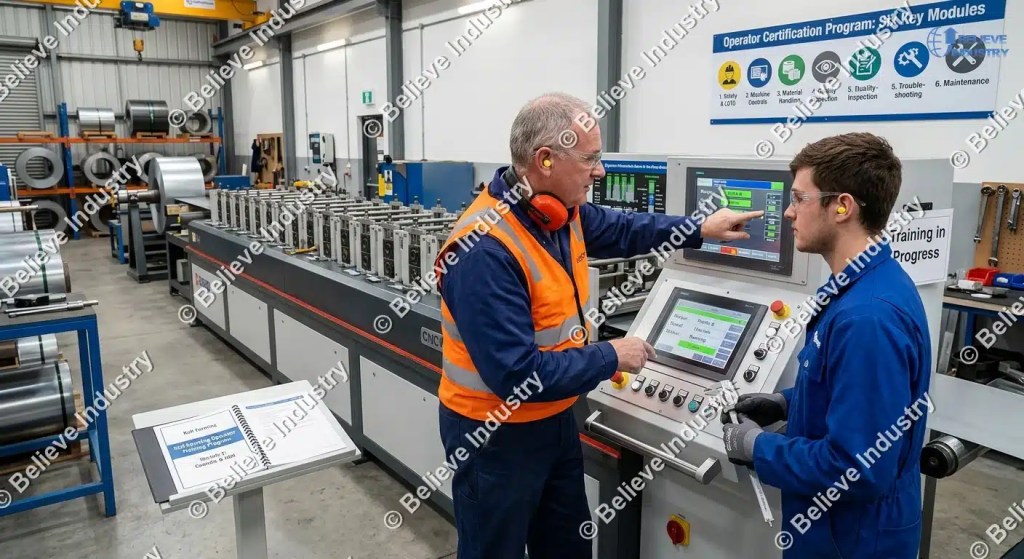
Cara melatih operator mesin pembentuk gulungan (roll forming) bergantung pada kurikulum terstruktur dan berjangka waktu yang akan membimbing karyawan baru dari nol hingga mampu mengoperasikan lini produksi sendirian. Kurikulum ini mencakup enam modul: keselamatan, kontrol mesin, penanganan material, inspeksi kualitas, pemecahan masalah, dan perawatan harian. Setiap modul diakhiri dengan penilaian praktik, dan program lengkapnya berlangsung selama enam hingga delapan minggu.
Definisi program pelatihan operator: Urutan instruksi, praktik, dan pengujian yang terdokumentasi dan diawasi yang membuktikan bahwa seorang pekerja dapat mengoperasikan jalur pembentukan gulungan dengan aman, mempertahankan toleransi profil, dan menanggapi kesalahan tanpa bantuan pengawas. Jika tidak ada standar tertulis dan tidak ada tes, itu hanya pengamatan langsung, bukan pelatihan.
Kami memberikan komisi lini mesin pembentuk rol di lebih dari 20 negara. Prediktor terbaik tentang bagaimana kinerja lini produksi di tahun kedua bukanlah merek mesin atau jenis baja. Melainkan seberapa baik operator dilatih pada bulan pertama. Lini produksi dengan program pelatihan operator formal akan mengalami lebih sedikit penghentian, lebih sedikit limbah, dan penggantian gulungan baja yang lebih cepat selama masa pakai peralatan.
Bolos latihan terlihat murah pada hari pertama, tetapi menjadi mahal pada bulan ketiga.
Sisa material muncul pertama kali. Mesin pembentuk gulungan yang menggunakan baja galvanis 0,5 mm dapat menghasilkan profil yang tidak sesuai spesifikasi sepanjang 2 hingga 3 km dalam satu jam pertama penggunaan kepala gulungan yang salah ulir. Itu berarti satu gulungan penuh rusak karena satu keputusan operator yang tidak terlatih.
Waktu henti menjadi hal kedua. Ketika operator tidak dapat membedakan kerusakan hidrolik dari kerusakan sensor, setiap penghentian menjadi panggilan bantuan. Jalur yang kami audit di tahun pertama menunjukkan 30 hingga 40 persen penghentian yang tidak direncanakan disebabkan oleh kesalahan operator.
Keselamatan adalah yang ketiga. Jalur pembentukan gulungan memiliki titik jepit pada pemandu masuk, perkakas yang berputar, dan pisau pemotong yang beterbangan. Peraturan OSHA tentang pengamanan mesin Di bawah 29 CFR 1910.212, masalah ini ada karena pekerja yang tidak terlatih terluka tepat di titik-titik ini. Keausan mesin adalah yang keempat. Tekanan celah rol yang salah atau pemandu masuk yang tidak sejajar mengikis tepi perkakas berbulan-bulan lebih awal. Baca cara kerja mesin pembentuk gulungan sebelum menyusun rencana pelatihan Anda, karena setiap modul di bawah ini dipetakan ke sebuah stasiun di jalur tersebut.
Modul | Topik | Jam | Penilaian langsung |
1 | Keselamatan dan penguncian/penandaan | 12 | Demonstrasikan LOTO secara penuh, sebutkan semua tombol berhenti darurat dengan mata tertutup. |
2 | Kontrol mesin dan HMI | 16 | Jalankan siklus perubahan resep dan mulai/berhenti yang aman. |
3 | Penanganan material dan gulungan | 20 | Muat, pusatkan, dan pasang gulungan dengan sisa material kurang dari 2 m. |
4 | Inspeksi kualitas | 16 | Ukur 8 titik profil, catat hasilnya, nilai lulus/gagal. |
5 | Penyelesaian Masalah | 20 | Mendiagnosis 5 kesalahan yang telah ditentukan dalam waktu 10 menit untuk setiap kesalahan. |
6 | Perawatan harian | 16 | Selesaikan seluruh daftar periksa shift secara mandiri dalam 25 menit. |
Total waktu kontak sekitar 100 jam selama enam minggu, kemudian dua hingga empat minggu produksi yang diawasi sebelum shift mandiri. Jika jangka waktunya dipersingkat, skor penilaian akan selalu turun. Pabrik yang mencoba menerapkannya dalam dua minggu selama pesanan mendesak akan menanggung biaya pengerjaan ulang di bulan kedua.
Operator baru menghabiskan dua hari pertama hanya untuk pelatihan keselamatan. Itu memang disengaja. Proses pembentukan gulungan baja (roll forming) menjalankan gulungan baja berat melalui rol berputar dengan kecepatan tinggi, dan titik-titik rawan cedera tidak memberi kesempatan kedua.
Konten inti untuk modul keselamatan:
Penilaiannya bersifat fisik, bukan tertulis. Peserta pelatihan harus mengunci jalur produksi dari ingatan, kemudian menemukan dan menekan semua tombol berhenti darurat (e-stop) dalam waktu 60 detik. Operator yang gagal dalam hal ini tidak akan melanjutkan ke pelatihan kontrol. Pabrik yang selaras dengan ISO 45001 akan mengenali strukturnya, karena pemeriksaan kompetensi yang terdokumentasi merupakan persyaratan inti dari standar tersebut.

Pelatihan pengoperasian kontrol mengajarkan operator untuk berkomunikasi dengan mesin. Lini produksi modern menggunakan HMI (Human-Machine Interface) dengan penyimpanan resep, kontrol kecepatan, input panjang potongan, dan riwayat kesalahan. A Mesin pembentuk rol CNC menambahkan program pengelompokan dan durasi di atasnya.
Peserta pelatihan harus menguasai lima operasi sebelum mereka dianggap memenuhi syarat untuk mengoperasikan kontrol:
Poin terakhir ini sangat penting. Operator yang mematikan alarm tanpa mencatatnya akan menciptakan masalah yang tidak terlihat, dan sebulan kemudian tidak ada yang dapat melacak mengapa dimensi bergeser. Tekankan pentingnya pencatatan kesalahan sejak hari pertama pelatihan pengendalian.
Penilaian ini dijalankan pada perubahan pekerjaan nyata: memuat resep baru, menyesuaikan tabel pengeluaran, menjalankan jalur produksi dari kondisi dingin ke kecepatan penuh dan kembali ke berhenti. Pada jalur produksi dengan pemutus yang digerakkan servo, sertakan hal-hal berikut: pembentukan gulungan servo Pemeriksaan titik nol, karena pemeriksaan titik nol yang dilewati akan terlihat sebagai bagian yang tidak sesuai panjang dalam hitungan menit.

Sebagian besar kesalahan operator di tahun pertama terjadi di bagian depan lini produksi. Pelatihan penanganan gulungan mencakup alat pembuka gulungan, pemasangan strip, dan identifikasi material.
Para peserta pelatihan mempelajari cara memuat kumparan pada Uncoiler Proses selanjutnya meliputi: sinyal derek atau forklift, ekspansi mandrel, pemusatan gulungan, dan pelepasan tali pengikat yang aman. Kemudian, pemasangan strip, tempat sisa material berada. Operator terlatih memasang strip berdiameter 0,5 mm melalui alat perata dan pemandu masuk dengan sisa material kurang dari 2 meter. Operator yang tidak terlatih akan menghabiskan 20 meter pada percobaan pertama.
Pengetahuan tentang material adalah bagian tersembunyi dari modul ini. Operator harus membaca sertifikat pabrik, memeriksa mutu dan ketebalan sesuai dengan kartu pekerjaan, dan mendeteksi kerusakan tepi sebelum gulungan dimasukkan ke dalam perkakas. Material yang salah menjadi penyebab banyak keluhan dimensi yang seringkali disalahkan pada mesin.
Modul ini sangat cocok dipadukan dengan cara mengurangi waktu penggantian koil, karena rutinitas pemasangan benang yang terlatih juga merupakan rutinitas yang cepat. Disiplin yang sama yang mengurangi limbah juga mengurangi waktu henti.
Penilaian: memuat gulungan 3 ton, memasangnya ke jalur produksi, dan mencapai kecepatan penuh dengan sisa material kurang dari 2 meter dan tanpa pelanggaran keselamatan.

Pelatihan mutu memberikan operator kemampuan untuk mendeteksi penyimpangan sebelum menjadi barang cacat. Ini dimulai dengan gambar profil dan penentuan toleransi.
Setiap peserta pelatihan belajar mengukur profil pada delapan titik tetap: lebar keseluruhan, dua tinggi, dua panjang kaki, lebar web, dan dua sudut, menggunakan jangka sorong dan busur derajat. Inspeksi artikel pertama dilakukan setelah setiap penggantian gulungan dan perubahan resep, tanpa pengecualian.
Kebiasaan mencatat adalah keterampilan yang sebenarnya. Peserta pelatihan mencatat pengukuran pada lembar periksa setiap jam, sehingga penyimpangan terlihat sebagai tren dan bukan kejutan. Ketika masalah dimensi muncul, operator memeriksa penyebab standar secara berurutan: penyelarasan pemandu masuk sebelum pemasangan perkakas, ketebalan material terhadap sertifikat pabrik sebelum celah rol, kemudian penyelarasan dudukan diperiksa terhadap laporan pengoperasian.
Metode mendalam di balik penyelarasan dan koreksi posisi berdiri terdapat dalam diri kami. Penyelarasan dan kalibrasi pembentukan gulungan Panduan ini. Berikan salinan cetaknya kepada setiap operator bersertifikat. Mereka yang membacanya adalah mereka yang dapat mendeteksi penyimpangan 0,3 mm sebelum merusak palet.

Penyelesaian masalah dilatih, bukan diwariskan. Metodenya sederhana: ajarkan urutan diagnostik tetap, lalu uji dengan kesalahan yang sengaja dibuat.
Para peserta pelatihan mempelajari peta hubungan gejala-ke-penyebab untuk enam masalah pembentukan gulungan yang paling umum:
Gejala | Pemeriksaan pertama | Pemeriksaan kedua |
Kerumunan penari telanjang di pintu masuk | Panduan penyelarasan, gerigi pada tepi strip | Pemusatan kumparan pada mandrel |
Perubahan profil | Panduan masuk ke bentuk persegi | Selisih putaran kiri vs kanan |
Tepi bergelombang | Ketebalan material vs kartu pekerjaan | Celah gulungan terlalu sempit |
Haluan atau lengkungan | Penyelarasan posisi | Set kumparan material |
Potongan rambut tidak panjang | Kontak roda encoder | Kalibrasi pemotongan sesuai panjang |
Genangan minyak | Fitting hidrolik, pengaturan jalur selang | Kondisi dan tekanan filter |
Teknik pelatihan yang digunakan adalah dengan memberikan contoh kesalahan. Seorang supervisor memberikan contoh masalah yang sudah diketahui, seperti pemandu masuk yang longgar atau celah rol yang salah atur, dan peserta pelatihan harus mendiagnosisnya dalam waktu 10 menit menggunakan urutan yang telah ditentukan. Lima contoh kesalahan yang diberikan, lima kali percobaan, dan modul selesai.
Lulusan modul ini mengubah suasana di lapangan. Kesalahan tidak lagi menjadi misteri. proses pembentukan gulungan berhenti menjadi kotak hitam, dan operator mulai membawa akar penyebab ke rapat pagi, bukan hanya gejalanya.

Modul terakhir melindungi semua yang telah dibangun oleh lima modul pertama. Pelatihan perawatan harian mengubah manual menjadi rutinitas 25 menit yang menjadi tanggung jawab operator.
Daftar periksa standar mencakup level dan suhu oli hidrolik, titik pelumasan pada dudukan rol dan pemutus, tekanan udara, ketegangan rantai dan sabuk, kebersihan roda encoder dan sensor fotolistrik, serta pembersihan konveyor sisa material. Peserta pelatihan juga mempelajari batasan: apa yang boleh mereka perbaiki sendiri, seperti sambungan yang longgar atau sensor yang kotor, dibandingkan dengan apa yang harus diserahkan kepada staf pemeliharaan, seperti apa pun yang ada di dalam kabinet listrik.
Kebiasaan lebih penting daripada daftar. Saluran yang dirawat setiap shift selama lima tahun akan berfungsi seperti saluran berusia tiga tahun. Saluran yang dirawat ketika seseorang mengingatnya akan berfungsi seperti saluran berusia sepuluh tahun. Cakupan dari perawatan jalur pembentukan rol Berbagai media perdagangan mengulang temuan yang sama: perawatan kecil yang konsisten lebih baik daripada perawatan mendalam secara berkala.
Penilaian: selesaikan seluruh daftar periksa secara mandiri, dengan pemilihan oli dan pelumas yang tepat, dalam waktu 25 menit, dengan setiap entri log terisi.

Sebarkan modul-modul tersebut selama enam minggu agar latihan dapat diulang. Program yang dipadatkan akan gagal karena keterampilan membutuhkan istirahat di antara sesi.
Pekan | Fokus | Tingkat pengawasan |
1 | Keamanan, LOTO, anatomi jalur | Tidak pernah sendirian |
2 | Kontrol, HMI, resep | Pengawas di panel |
3 | Penanganan kumparan, praktik penguliran | Pengawas di lapangan |
4 | Inspeksi kualitas, lembar periksa | Pemeriksaan mendadak, setiap jam |
5 | Penyelesaian masalah, identifikasi penyebab kesalahan | Pengawas menanam tanaman yang rusak setiap minggu. |
6 | Perawatan, pengoperasian solo penuh | Pengamatan jarak jauh saja |
Minggu ke-6 diakhiri dengan uji sertifikasi: dua shift penuh bekerja sendiri, tingkat kerusakan dan hasil produksi dicatat, dimensi sesuai toleransi di kedua shift. Lulus uji tersebut dan operator akan disertifikasi.
Sertifikasi memberikan landasan bagi program tersebut. Kami merekomendasikan tiga tingkatan dengan sertifikasi ulang setiap tahun.
Tingkat | Judul | Cakupan | Sertifikasi Ulang |
1 | Operator jalur | Berjalan satu jalur, satu keluarga profil. | Tahunan, tertulis dan praktik |
2 | Operator senior | Perubahan resep, pemulihan kesalahan, pelatihan karyawan baru | Setiap tahun, menambahkan uji pendeteksian kesalahan. |
3 | Pengawas sel | Penjadwalan multi-jalur, persetujuan kualitas, audit keselamatan | Setiap tahun, menambah tugas audit LOTO. |
Operator Level 2 adalah pengali pelatihan Anda. Setiap pabrik yang kami operasikan untuk mesin pembentuk rol khusus Sebaiknya kita menominasikan satu kandidat Level 2 selama minggu instalasi, saat teknisi komisioning berada di lokasi dan materi pelatihan masih segar. Keputusan tunggal itu akan menjaga pengetahuan tetap ada di gedung setelah kita pergi.


Mesin Pembuat Scaffold Sheet Siap Dikirim ke Pembeli di Amerika Serikat...
Baca selengkapnya
Marine Roll Forming Machines: 5 Profil Pembuatan Kapal Sebuah marine roll...
Baca selengkapnya
Mesin roll forming untuk rel kereta api: 5 profil infrastruktur. Sebuah rel...
Baca selengkapnya
Penyiapan mesin tiang rak: 12 langkah menuju profil pertama yang bagus...
Baca selengkapnya English English
  Español
 Português
 Русский
 العربية
 Bahasa Melayu
 Türkçe
 ไทย
ไทย
 Bahasa Indonesia