Address
No 1, Yd Road, Huishan District, Wuxi City, Jiangsu. 214183
Work Hours
Monday to Friday: 9AM - 5PM
Saturday: 9AM - 4PM

A roll forming machine price ranges from 20,000 for a basic stud and track line to over over 500,000 for a high-speed multi-profile system. That is a 25x spread between the cheapest and most expensive options. And if you are sourcing one for the first time, the pricing can feel opaque — different suppliers quote wildly different numbers for what looks like the same machine.
This guide covers what you actually pay for, what drives the cost up or down, and how to avoid overspending on features you do not need. If you are new to roll forming, start with our roll forming machine overview to understand the basics before diving into pricing. All data reflects 2026 market conditions.
| Machine Type | Price Range (USD) | Typical Application |
|---|---|---|
| Light Gauge Stud & Track | 20,000–60,000 | Drywall framing, interior partitions |
| Roof Panel Roll Former | 25,000–120,000 | Corrugated, trapezoidal, standing seam roofing |
| C/Z Purlin Roll Former | 60,000–150,000 | Structural steel purlins for large buildings |
| Deck Roll Forming Machine | 50,000–200,000 | Floor decking, composite slabs |
| High-Speed Metal Roofing Line | 120,000–250,000+ | Mass production with PLC and servo cutting |
| Tube & Pipe Mill | 140,000–300,000+ | Round, square, rectangular tubing |
| Custom Profile Roll Former | 10,000–300,000 | Specialized flashings, trims, solar channels |
Source: Industry pricing data compiled from manufacturer quotations and trade platforms, 2025–2026.
Most suppliers will tell you “it depends.” That is technically true but not helpful. Here are the five factors that actually move the number on a quotation.
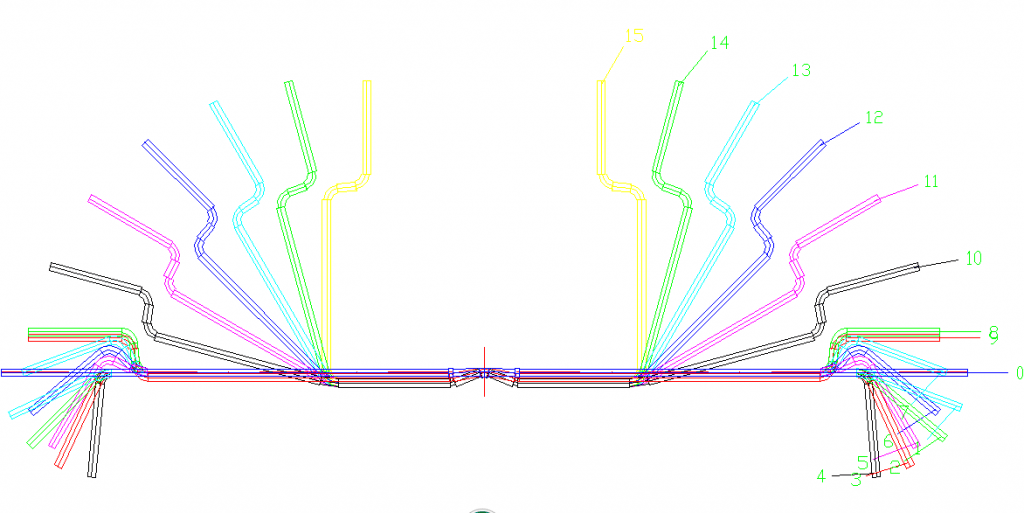
The shape you want to form and the thickness of the metal are the single biggest roll forming machine price drivers. For more on how material properties affect design choices, see our guide on material influence while designing the roll former.
But here is the nuance: a wider profile is not always more expensive than a narrow one. A simple wide corrugated roof panel needs fewer stations than a narrow C-purlin with tight radius bends. The profile drawing — not the width alone — determines the forming steps, and that is what moves the roll forming machine price up or down.
| Specification | Typical Range |
|---|---|
| Max product width | Up to 1,600 mm |
| Min product width | Below 10 mm |
| Max material thickness | Up to 6 mm |
| Min material thickness | As low as 0.25 mm |
Common applications and their thickness requirements:
The physical frame and stand design directly affects the roll forming machine price. Believe Industry builds five distinct mill structures, each suited to different production needs and budgets. For a detailed look at each structure type, see our page on cold roll forming mills.
| Mill Structure | Characteristics | Price Impact |
|---|---|---|
| Siding Panel Structure | Economic, compact, single-profile focus | Lower |
| Chromed Box Stands | Rigid, good for medium-gauge work | Mid-range |
| Cast Steel Arch | Heavy-duty, absorbs vibration well | Higher |
| Duplex Mill | Two profiles on one line, shared drive | Mid-to-high |
| Double High Mill | Two forming levels, high throughput | Highest |
A siding panel structure keeps the cost down for straightforward profiles. A duplex mill saves money if you need two profiles from one line — but the upfront engineering cost is higher. The right choice depends on your production volume and how often you switch profiles, and it will shape your final roll forming machine price significantly. If you produce two different profiles, a double layer roll forming machine can also cut equipment costs compared to buying two separate lines.
This is where the “brand tax” hits hard. A roll forming machine price can swing 15–25% depending on which component brands you select.
| Component | Standard Option | Premium Option | Price Difference |
|---|---|---|---|
| Main Motor | Chinese brand (e.g., QEED) | Siemens or Yaskawa | +10–15% |
| PLC System | Delta | Siemens, Panasonic, Mitsubishi | +5–10% |
| Encoder | Standard optical | Omron rotary encoder | +3–5% |
| Limit Switch | Standard mechanical | Omron proximity | +2–3% |
| HMI/Touchscreen | Chinese brand | Siemens or Weintek | +3–5% |
If your production runs 8 hours a day, 5 days a week, premium components pay for themselves in reduced downtime within 2–3 years. For intermittent production, standard components are a reasonable choice and will keep your roll forming machine price lower without sacrificing much. For a deeper comparison of motor brands and their impact on performance, see our guide on comparing different motor brands for your roll forming machine.
The global roll forming machine market was valued at USD 10.09 billion in 2026, with automatic machines holding a 46.8% market share, according to Coherent Market Insights. For high-volume producers, automation has shifted from nice-to-have to practical necessity.
| Automation Level | Features | Price Impact |
|---|---|---|
| Manual | Hand-wheel adjustments, manual length stops | Baseline |
| Semi-Automatic | PLC control, manual profile changeover | +20–40% |
| Fully Automatic | Servo-driven, auto stacker, coil car, flying shear | +60–100% |
Automation reduces production costs by up to 30% and cuts material waste significantly, per SW Forming’s price analysis. The trade-off is a higher roll forming machine price upfront — a fully automatic line at 200,000canproduce100+metersperminute,whileamanualmachineat200,000canproduce100+metersperminute,whileamanualmachineat30,000 manages 10–30 meters per minute with more operator involvement.
Where the machine is built changes the price more than most buyers expect.
| Region | Typical Price Range | Key Factors |
|---|---|---|
| China (Asia-Pacific) | 25,000–150,000 | Competitive labor, strong export infrastructure |
| Turkey / Eastern Europe | 40,000–200,000 | Mid-range pricing, CE marking available |
| Western Europe | €80,000 – €400,000+ | CE certified, strict quality standards |
| United States | 150,000–500,000 | Domestic service, fast spare parts |
Importing from China can reduce equipment costs by 30–40% compared to buying domestic in the US or Europe, which is why the Chinese roll forming machine price average sits well below Western levels. The trade-off is longer lead times for spare parts and potential communication gaps. Established Chinese manufacturers like Believe Industry, a cold roll forming machine manufacturer in China exporting to 40+ countries since 2005, bridge that gap with dedicated English-speaking support and video-assisted commissioning.
Here is what a typical C/Z purlin roll forming machine price quotation looks like when you break it down line by line. For a broader look at purlin machine options, see our C/Z purlin roll forming machine page.
| Component | Estimated Cost (USD) |
|---|---|
| Roll forming base machine (18 stations) | $80,000 |
| Hydraulic flying shear | $12,000 |
| PLC control system (Siemens S7) | $8,000 |
| 5-ton hydraulic decoiler | $8,000 |
| Hydraulic station | $3,000 |
| Spare roller set | $10,000 |
| Installation & training (on-site) | 5,000–10,000 |
| Total Estimated Price | 125,000–135,000 |
For a C purlin machine producing 100–300 mm profiles from 1.5–3.0 mm galvanized steel at 25 m/min, the quotation typically lands between 95,000 and 115,000 and 185,000 FOB, depending on component selections. For a deeper ROI analysis on the full cost of ownership, see our roll forming machine cost breakdown.
Budgeting rule of thumb: Your total project budget should be 20–30% higher than the roll forming machine price alone. This accounts for shipping, import duties, installation, spare parts, and operator training. Use our free metal coil calculator to estimate your raw material costs alongside the machine investment.
| Factor | New Machine | Used Machine |
|---|---|---|
| Upfront cost | Higher | 30–50% cheaper |
| Customization | Fully configurable | Limited to existing profiles |
| Warranty | 1–2 years standard | Often sold as-is |
| Expected lifespan | 15–25 years | 5–10 years remaining |
| Technical support | Full remote PLC support | Depends on seller |
| Spare parts availability | Guaranteed from manufacturer | May be discontinued |
Used machines make sense if you find one that matches your exact profile and the previous owner maintained it well. The risk is hidden wear — roller surfaces, bearing fatigue, and PLC obsolescence are not always visible during inspection. A used roll forming machine price might look attractive, but if you go this route, budget for a roller regrind (3,000–8,000) and a PLC upgrade (5,000–12,000) within the first year. For alignment and calibration tips after installation, see our guide on roll forming alignment and calibration.
The Asia-Pacific region accounts for 31.1% of the global roll forming machine market, followed by North America at 23.2%, per Coherent Market Insights data. This regional split directly shapes the roll forming machine price you pay — labor costs, certification requirements, and local supply chains all factor in.
Suppliers need specific information before they can give you a realistic number. Prepare these details before you reach out:
Without a profile drawing, any price you receive is an estimate — not a quotation. If you need help understanding the roll forming process before preparing your specs, our guide walks through the eight critical stages.
| Tier | Price Range | What You Get |
|---|---|---|
| Entry | 10,000–60,000 | Basic stud & track, manual operation, standard components |
| Mid-Range | 60,000–150,000 | Roof panels, purlin lines, PLC control, mid-tier components |
| High-End | 150,000–350,000 | Deck machines, duplex mills, premium components, flying shear |
| Premium | 350,000–600,000+ | High-speed lines, full automation, multi-profile capability |
The lowest roll forming machine price you will find is around $20,000 for a light gauge stud and track machine from Chinese manufacturers. These are manual or semi-automatic lines suitable for small workshops. Check our FAQs for more common questions about roll forming equipment.
A: The variation comes from component brands (Siemens vs. Delta PLC, for example), mill structure type, automation level, and the supplier’s overhead. Two machines that look similar on paper can have $10,000+ price differences based on what is inside the control cabinet.
:Add 20–30% to the machine cost for shipping, import duties, installation, spare parts, and operator training. For a 100,000 machine, your total project budget should be120,000–$130,000.
If your machine runs more than 6 hours per day, yes. Premium components reduce unplanned downtime and have faster spare-parts availability worldwide. For intermittent use, standard components are a reasonable cost saving.
You can get an estimate, but not a firm quotation. The profile drawing determines the number of forming stations, roller design, and motor size — all of which directly affect the price.
A well-maintained machine from a reputable manufacturer lasts 15–25 years. Budget machines with lighter frames and standard components typically last 5–10 years before major overhauls are needed. A higher roll forming machine price often correlates with longer service life. For maintenance best practices, see our guide on how to choose, operate, and maintain a roll forming machine.
Payment terms vary by order size and region. Contact the Believe Industry sales team directly for specific financing options and trade assurance details. Getting a roll forming machine price quote is free and typically takes 24–48 hours after submitting your profile drawing.
A roll forming machine price is not a single number — it is the result of five interlocking factors: profile design, mill structure, component brands, automation level, and region of manufacture. Understanding how each one moves the quote up or down puts you in control of the negotiation instead of reacting to whatever number a supplier puts in front of you.
The key takeaways from this guide:
Whether you are buying your first stud and track line at 20,000 or upgrading to a a 500,000+ high-speed automated system, the same principles apply: define your requirements precisely, compare apples to apples, and always factor in the hidden costs. Request a quote from Believe Industry to get a roll forming machine price tailored to your exact specifications — typically within 24–48 hours.
| Date | Phase | Changes |
|---|---|---|
| 2018-04-18 | — | Intinial Content |
| 2026-05-07 | Content Optimization | Expanded from ~500 words to ~3,600 words. Added 7-type price table, 5 key price factors, C/Z purlin cost breakdown, new vs. used comparison, regional pricing, 7 saving tips, 7 FAQs. |
| 2026-11-07 | — | Next Review |


Standing seam roll former machines produce standing seam roofing panels with...
Read MoreWhat Is a Solar Strut Channel Roll Forming Machine? A solar...
Read MoreA cable tray roll former machine shapes metal strips into cable trays....
Read MoreWall Cladding Roll Former: Complete Buyer’s Guide 2026 A wall cladding...
Read MoreSubscribe now to keep reading and get access to the full archive.