Address
No. 1 Yudong Road, Huishan District, Wuxi City, Jiangsu. 214103
Work Hours
Monday to Friday: 9AM - 5PM
Saturday: 9AM - 4PM
Short answer: A medium gauge slitting line cuts master steel coil between 2 mm and 8 mm thick into narrower strips, then rewinds those strips into tight baby coils. It carries a heavier arbor, a stronger leveler and a higher tension range than a thin strip line. Most medium gauge slitting line buyers run 2 mm to 6 mm hot rolled, cold rolled or galvanized coil at 60 m/min to 100 m/min and hold slit width to about ±0.2 mm. The strips feed tube mills, purlin roll formers, rack upright lines and cut to length work.
The 2 mm to 8 mm band is where coil slitting stops being a light duty precision job and becomes a structural one. Strip stiffness is high enough to hold its own shape, but shear force, coil weight and recoil tension are large enough to spring a light frame. Every medium gauge slitting line we build is sized around that load path, not around a catalogue speed.

Five stations do the work in one pass. A coil car lifts a 15 t to 30 t master coil onto a hydraulic expansion mandrel. A peeler and pinch roll open the coil head into a five or seven roll leveler that removes coil set. Side guides centre the strip before it reaches two powered arbors carrying circular knives. A loop pit separates slitting speed from recoiling speed. A tension bridle and a hydraulic recoiler build the finished mults.
Thick strip changes what each station has to survive. An 8 mm edge trim leaves the head as a rigid, springy ribbon, so the scrap winder needs its own drive and a guarded path. A 25 t coil needs a mandrel, coil car and foundation designed for that mass. A medium gauge slitting line that shares a light gauge frame will slit the coil, but the arbors will deflect and the outer strips will run wide.
For a plain language walk through of the process, see what is coil slitting. The equipment families sit under coil process equipment, with the full range on the slitting line page.
The industry splits coil slitting into three bands. A medium gauge slitting line sits in the middle. The borders are practical, not standards. They come from arbor diameter, knife loading and the tension a recoiler can hold without slipping.
| Item | Light gauge | Medium gauge | Heavy gauge |
|---|---|---|---|
| Thickness | 0.2-4.0 mm | 2-8 mm | 8-20 mm |
| Coil width | up to 2000 mm | 500-2600 mm | up to 2600 mm |
| Line speed | 120-180 m/min | 60-100 m/min | 20-60 m/min |
| Arbor diameter | 120-180 mm | 220-260 mm | 300-400 mm |
| Slits per pass | up to 30 | 6-20 | 3-10 |
| Width tolerance | ±0.05 to ±0.15 mm | ±0.15 to ±0.3 mm | ±0.5 mm |
The 2 mm to 4 mm overlap causes most buying mistakes. If your mix is mostly 0.5 mm to 2 mm with occasional 3 mm work, a light gauge slitting line is the honest choice. If you run 6 mm to 16 mm plate coil, go to the heavy gauge slitting line. A medium gauge slitting line earns its cost when 2 mm to 6 mm is the daily diet.
BELI builds the range in six frame sizes. The first number in the model name is the nominal top thickness class, the second is maximum coil width in millimetres. Thickness, width and coil weight move together, because all three load the same arbors and mandrel.
| Model | Thickness | Coil width | Slits | Speed | Coil weight |
|---|---|---|---|---|---|
| BELI-2×2000 | 2-5 mm | 500-2000 mm | 6-20 | 0-100 m/min | 15-25 t |
| BELI-2×2600 | 2-6 mm | 500-2600 mm | 6-20 | 0-100 m/min | 15-25 t |
| BELI-3×2000 | 3-6 mm | 600-2000 mm | 6-20 | 0-80 m/min | 15-25 t |
| BELI-3×2600 | 3-8 mm | 600-2600 mm | 6-20 | 0-80 m/min | 15-25 t |
| BELI-4×2000 | 4-6 mm | 600-2000 mm | 6-15 | 0-80 m/min | 15-30 t |
| BELI-4×2600 | 4-8 mm | 600-2600 mm | 6-15 | 0-60 m/min | 15-30 t |
Two numbers need a second read. Slit count falls as thickness rises, because the arbor can only carry a fixed bending load. At 8 mm, plan on 3 to 6 strips from a 1500 mm coil, not 20. Coil weight drives mandrel size, coil car capacity and foundation loading, and it is the item most often under-specified by buyers who later want 30 t coils on a 15 t frame.
A medium gauge slitting line is specified station by station. The table below is the layout we quote most often for 2 mm to 6 mm hot rolled and galvanized coil.
| Station | Job | Medium gauge build |
|---|---|---|
| Coil car and uncoiler | Load and pay off the master coil | Hydraulic expansion mandrel, 15-30 t, 508/610/760 mm ID |
| Peeler and pinch roll | Open the coil head and feed forward | Driven hold down arm, hydraulic snubber roll |
| Leveler | Remove coil set and crossbow | 5 or 7 rolls, 120-160 mm work roll diameter |
| Side guide | Centre the strip on the arbors | Vertical rolls, manual or servo width setting |
| Slitter head | Shear the strip into widths | 220-260 mm arbors, powered, cassette change on request |
| Loop pit | Decouple slitting from recoiling | 3-5 m deep, ultrasonic or photoelectric loop control |
| Scrap winder | Wind both edge trims | Twin driven spools, guarded feed chute |
| Tension bridle | Set recoil tension by strip group | Belt or roll bridle, 3-8 percent of yield load |
| Recoiler | Build the finished baby coils | Hydraulic drum, overarm separator, 610 mm ID |
| Coil unloading | Remove finished mults | Exit coil car, 15 t, with tipping or turnstile option |
Power for a 2600 mm line with 8 mm capability lands near 260 kW installed, with the slitter head and recoiler taking most of it. Supply is 380 V / 50 Hz / 3 phase as standard and is rebuilt to the local grid on export orders. World Steel Association data is a useful cross check when you plan coil supply by grade and region.
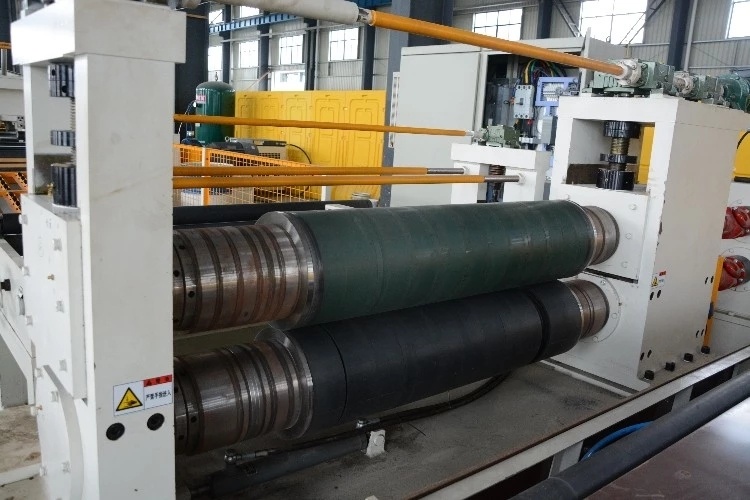
Knife setting is where a medium gauge slitting line differs most from a thin strip line. On 0.5 mm sheet the knives need a small positive vertical overlap and a clearance near 7 to 10 percent of thickness. Above 2 mm the overlap drops to zero or slightly negative, and horizontal clearance moves toward 5 to 8 percent of thickness. A 4 mm hot rolled strip typically runs 0.20 mm to 0.32 mm horizontal clearance.
Standard knives for this class are 360 mm outside diameter, 220 mm bore and 20 mm thick, in 6CrW2Si, H13 or SKD11 at HRC 58 to 61. Spacers and shims set the strip pattern. Shim stacks must be ground flat and matched across both arbors, or the outside strips drift by 0.2 mm while the centre strips stay in tolerance.
Expect burr height at 5 to 8 percent of strip thickness on a correctly set head, roughly 0.15 mm to 0.30 mm at 4 mm. A burr that grows on one edge only points to a worn knife or a mismatched shim, not to a tension problem. Roller type edge deburr heads are worth adding when the strip feeds a tube mill or a roll former with tight entry guides. Guidance from AIST on strip processing practice is a good reference when you write the acceptance test.
Hot rolled coil in this range arrives with coil set that a light leveler cannot remove. The leveler needs larger work rolls and more down force, and the entry pinch rolls need enough grip to push a stiff 8 mm head through. On pickled and oiled coil, add a brush or felt wipe so scale does not score the knives.
Recoil tension does the opposite job to thin strip work. Thin strip needs low, very finely resolved tension to avoid stretching. A medium gauge slitting line needs 3 to 8 percent of the strip yield load to build a coil that stays tight through handling and transport. A belt or roll bridle splits the strips into tension groups so wide and narrow mults wind at the same density. Taper tension reduces as the coil grows, which keeps the inner wraps from collapsing when the drum releases.
On a medium gauge slitting line the loop pit absorbs the speed difference between the head and the recoiler. On 2 mm to 8 mm stock the loop must be deeper than on a thin line, because the stiff strip forms a wide natural arc. A shallow pit pushes the strip into the side guides and produces camber that no knife setting can fix.

Specify the measurable items, not the word precision. These are the values we put in acceptance documents for a medium gauge slitting line, measured on a stable, pickled coil after threading.
| Check | 2-4 mm | 4-8 mm | How it is measured |
|---|---|---|---|
| Slit width | ±0.15 mm | ±0.30 mm | Caliper on three points per strip, head and tail included |
| Burr height | up to 0.15 mm | up to 0.30 mm | Dial indicator or burr gauge on both edges |
| Camber | 1 mm per 2 m | 1.5 mm per 2 m | Straightedge on a 2 m sample above 300 mm width |
| Telescoping | ±1 mm | ±2 mm | Face offset across the wound mult |
| Coil ID after release | 610 mm nominal | 610 mm nominal | Internal tape on the released coil |
Tolerances assume coil within standard dimensional limits and tensile strength at or below 450 MPa with yield at or below 260 MPa. Above that, or on high strength low alloy grades, the arbor load and knife life both change and the numbers are re-agreed before build. Metal Construction Association publications give useful downstream tolerance context for strip that ends up in structural profiles.
Take a 20 t coil, 4 mm thick and 1500 mm wide, cut into six strips at 60 m/min on a medium gauge slitting line. Steel at 7850 kg/m3 makes that coil about 47.1 kg per metre, so the coil holds roughly 425 m of strip. Pure cutting time is a little over 7 minutes.
The coil cycle is longer. Loading, threading, trim handling, coil change and a strip check take 15 to 25 minutes, so the line finishes two to three coils an hour, about 40 t/h to 60 t/h. At 75 percent uptime over eight hours that is 240 t to 360 t a shift. Thicker coil cuts fewer strips but the tonnage per metre rises, so throughput in tons stays fairly flat until knife changes start to dominate.
That last point matters more than peak speed. A medium gauge slitting line running many short patterns spends its day changing knives. If you cut ten patterns a shift, a second slitter head on a change cart pays back faster than a faster main drive.
A cassette type slitter head with two heads on a change cart is the first option to consider on a medium gauge slitting line. One head is set offline while the other runs, which cuts a pattern change from 40 minutes to about 15. Servo side guides and knife gap setting remove the shim guesswork on repeat orders.
The second group is handling. An exit coil car, a coil tipper and a mult packing station keep the recoiler from waiting on a forklift. For hot rolled coil, add a scale breaker or brush unit ahead of the leveler. For galvanized and prepainted stock, use polymer coated tension rolls and a belt bridle instead of a roll bridle so the surface stays clean.
Entry level buyers sometimes look at a simple slitting line to save capital. That works for low volume work below 3 mm. It does not replace a medium gauge slitting line on 20 t coils or 6 mm hot rolled strip. For very thin electrical steel, the silicon steel slitting line is the correct machine instead.
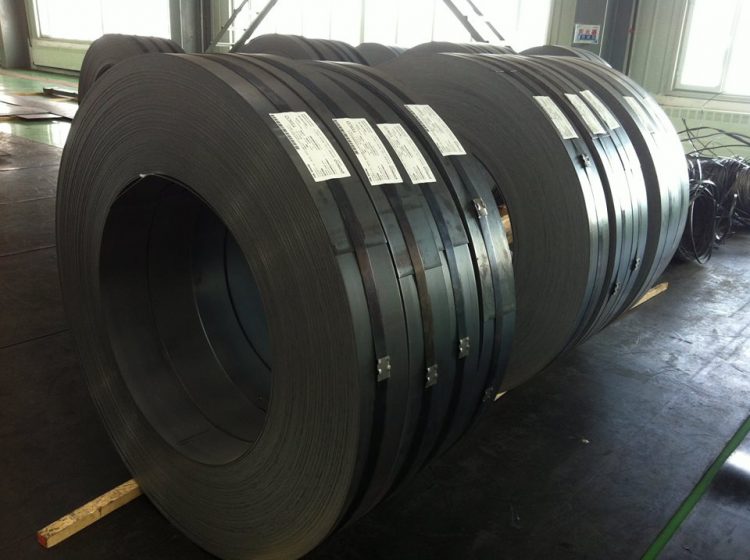
Send the material grade and tensile strength, the thickness range plus the one gauge you run most, mother coil width, coil ID and OD, maximum coil weight, and the strip pattern with minimum strip width and strips per pass. Add the power supply, available floor length, crane capacity and what the strips feed downstream. A line that feeds a cut to length line needs different flatness limits from one feeding a tube mill.
Ask for the arbor deflection calculation at your heaviest gauge, the knife and shim list for your patterns, and a sample acceptance sheet before you sign. If a supplier quotes 20 strips at 8 mm without asking about minimum strip width, the number is a catalogue figure rather than a build specification.
Layout and foundation drawings arrive within two weeks of order. A medium gauge slitting line takes about 120 to 150 days to build after deposit, longer than a thin strip line because the arbors, mandrel and gearbox are heavier. Installation, commissioning and operator training take three to four weeks on site. We ship with a full knife and shim set, spare wear parts and CE documentation under ISO 9001 control.
BELI has built roll forming and coil processing equipment since 2005. 80+ engineers and technicians support 500+ machines in 50+ countries. If you want a medium gauge slitting line sized to your own coil list, contact our engineers with the data above and we will return a layout and a station by station quote.
Eight questions come up on nearly every medium gauge slitting line enquiry.
Q: What thickness does a medium gauge slitting line cover?
A: A medium gauge slitting line covers 2 mm to 8 mm as standard. Below 2 mm a light gauge line holds tighter width tolerance and protects the surface better. Above 8 mm the arbor load, knife size and coil handling move into heavy gauge equipment.
Q: Can one medium gauge slitting line run 0.5 mm and 8 mm?
A: No. One machine can physically pass both, but knife clearance, vertical overlap and tension resolution are opposite at the two ends of that range. Buy for the gauge you run most, or buy two slitters if both ranges are core business.
Q: How fast does a medium gauge slitting line run?
A: 0 to 100 m/min on 2000 mm models for 2-6 mm stock, 0 to 80 m/min on the 3 mm and 4 mm classes, and 0 to 60 m/min at 8 mm on a 2600 mm line. Real speed follows thickness and slit count, not the nameplate maximum.
Q: How many strips can it cut in one pass?
A: About 6 to 20 strips at 2 mm to 4 mm, and 3 to 6 strips at 8 mm. Minimum strip width is usually 25 mm to 30 mm in this class, and usable arbor length sets the rest.
Q: What width tolerance should I expect?
A: ±0.15 mm on 2 mm to 4 mm cold rolled or pickled coil, and ±0.30 mm on 4 mm to 8 mm hot rolled coil. Camber should stay within 1 mm per 2 m below 4 mm and 1.5 mm per 2 m above it.
Q: What coil sizes does a medium gauge slitting line accept?
A: Coil ID 508 mm, 610 mm or 760 mm, maximum OD 2000 mm, width 500 mm to 2600 mm, and coil weight 15 t to 30 t depending on model. Tell us the heaviest coil you plan to run, not the current average.
Q: How long does a knife change take?
A: 30 to 45 minutes for an offline pattern on a conventional head, including shims and a strip check. With a second cassette head pre-set on a change cart, 12 to 18 minutes is realistic.
Q: What do you need from me to quote?
A: Material grade and tensile strength, thickness range and most used gauge, mother coil width, coil ID and OD, maximum coil weight, the strip pattern with minimum width and strips per pass, plus power supply and floor plan.
Last updated: 2026-11-09
Article Changelog
2026-11-09: Full rewrite. Removed the duplicated H1, the broken Jetpack contact form shortcode and the contradictory line speed and slit count figures. Rebuilt the six model table around 2-8 mm, added the gauge comparison, the station configuration, arbor and knife settings, tension and loop control, contract tolerances, output math, options, a specification checklist and 8 FAQs. All inline images now match the content column width.
Next Review Triggers
A new frame size is added to the medium gauge range, or a standard coil weight changes.
Customer acceptance data shows burr, camber or width limits need tightening.
EN 10051 or CE machinery documentation requirements are revised.

Short answer Cable tray cut off is the step that...
Read More
Short answer Upright punch die life is the number of...
Read More
Cable Tray Auto Stacking: Bundle, Nest and Container Loading Short...
Read More
Old Upright Line Retrofit: Servo Punching and Double-Side Dies Short...
Read More English English
 Español
 Português
 Русский
 العربية
 Bahasa Melayu
 Türkçe
 ไทย
 Bahasa Indonesia