Address
No 1, Yd Road, Huishan District, Wuxi City, Jiangsu. 214183
Work Hours
Monday to Friday: 9AM - 5PM
Saturday: 9AM - 4PM
Address
No 1, Yd Road, Huishan District, Wuxi City, Jiangsu. 214183
Work Hours
Monday to Friday: 9AM - 5PM
Saturday: 9AM - 4PM
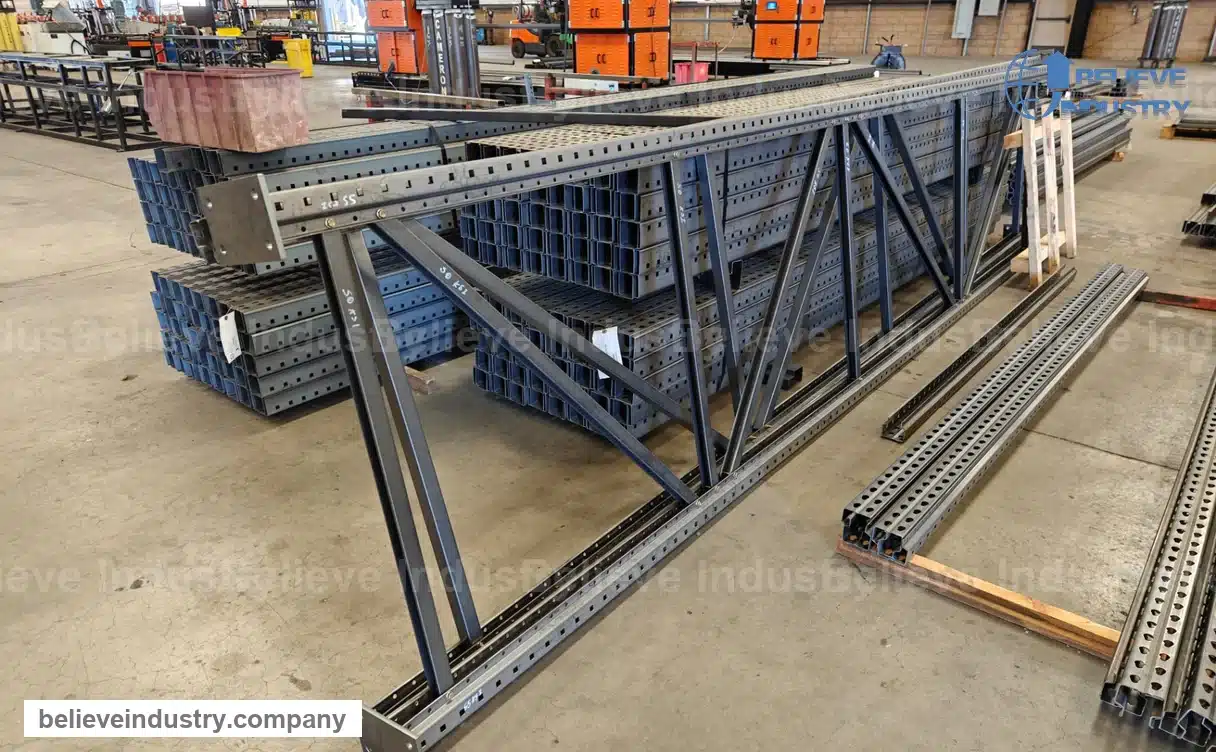
Six CO2 welding heads close the longitudinal seam on P beams and box beams in one automatic pass. The beam is clamped on the bed, a ball screw carriage runs the full length, and a three side tracing system keeps every torch on the real joint instead of a fixed line.
This is the welding station of a pallet racking line. It sits after the roll former and cut off, before the stacker, and it is the step that turns two roll formed pressings into one closed hollow section that carries the load the rack design assumes.
| Machine type | Automatic longitudinal seam welder |
| Beam types | P beam, box beam |
| Beam width | 50 to 220 mm |
| Beam height | 40 to 70 mm |
| Sheet thickness | 0.8 to 5 mm |
| Seam gap | 0.5 to 1.8 mm |
| Welding heads | 6 x NBC300 CO2 |
| Welding speed | up to 15 mm/s (0.9 m/min) |
| Beam length | 3.5 m standard, custom on request |
| Control | Delta PLC + touch screen |
A roll formed box beam starts life as two open sections. Until the longitudinal seam is closed, they behave as two separate pressings. Under a point load the halves slide against each other, the section twists, and the beam carries far less than the load table for that section promises.
Welding changes the mechanics. Once the seam is closed, the two pressings act as a single hollow section with a much higher torsional stiffness, which is what the beam load table assumes in the first place.
A P beam is the same argument in a simpler shape. The formed seam is the only thing holding the section together. An open seam lets the flange unwind at the ends, exactly where the beam hooks into the connector and where the bending moment is highest.

Hand welding a rack beam is not difficult. Doing it 300 times a shift at the same weld size is the hard part.
| Item | Hand welding | Automatic station |
|---|---|---|
| Arc time, 3.5 m seam | 12 to 18 min | 3.9 min |
| Weld size | Varies by shift | Same recipe every cycle |
| Distortion | Heat input follows the operator | Steady travel speed |
| Skill needed | Coded welder | Line operator |
| Fume and spatter | At the face | Extracted at the torch |
| Section changeover | Re-set by eye | Recall the recipe by section |
The 3.9 minute figure is arithmetic, not a claim. At 15 mm/s the torch covers 0.9 m per minute, so a 3.5 m seam takes 3 min 53 s of arc time. A hand welder laying a continuous 3 to 4 mm fillet runs at roughly 3 to 5 mm/s, which puts the same seam at 12 to 18 minutes.
| Beam types | P beam, box beam |
| Beam width | 50 to 220 mm |
| Beam height | 40 to 70 mm |
| Beam material thickness | 0.8 to 5 mm |
| Seam gap | 0.5 to 1.8 mm |
| Welding wire | 0.8 to 1.0 mm |
| Shielding gas | CO2 or 80/20 argon CO2 mix |
| Welding speed | up to 15 mm/s |
| Welding heads | 6 x NBC300 |
| Beam length | 3.5 m standard, longer on request |
| Travel drive | Stepper motor, ball screw, linear guide |
| Control | Delta PLC and touch screen |
| Cooling | Circulation system |
| Power requirement | 380 V, 3 phase, 50 Hz, other voltages on request |
Arc time is only part of the cycle. Load, clamp, weld and unload are what the operator feels. The table below adds two minutes of handling to the arc time and assumes both seams of a box beam close in the same pass.
| Beam length | Arc time | Cycle | Beams / 8 h |
|---|---|---|---|
| 1.0 m | 1.1 min | 3.1 min | about 120 |
| 2.0 m | 2.2 min | 4.2 min | about 90 |
| 3.5 m | 3.9 min | 5.9 min | about 65 |
The right hand column is 80 percent utilisation on an eight hour shift. Real output drops on short runs, on frequent section changes, and whenever the beam arrives at the station with a seam gap outside 0.5 to 1.8 mm and has to be reworked.
The welder is rarely the machine a buyer researches first, and it is often the one that sets the ceiling on the whole line. These are the four points worth settling before the order.
Believe Industry has built roll forming equipment since 2005, with 500+ machines in 50+ countries and an ISO 9001 quality system behind the CE marking on the machines we export.
Beam welding is one station in a sequence. If you are specifying the whole line, start from the pallet racking roll forming machine overview, then look at the sections that feed this welder: the box beam roll forming machine and the P beam roll forming machine. Uprights come from the upright rack roll forming machine, and the horizontal members from the step beam roll forming machine.
Two related reads on the same production problem: the step beam production process from coil to finished beam, and the comparison of step beam versus box beam roll forming machines. Beam to connector welding is a different station, covered on our box beam welding machine page.
Q: What is an upright rack beam automatic welding machine?
A: It is a fixed station that welds the longitudinal seam of roll formed rack beams. Six CO2 torches run along the beam on a ball screw carriage while a tracing system follows the profile, closing the seam on P beams and box beams without a hand welder.
Q: Can one machine weld both P beams and box beams?
A: Yes. Both sections fall inside the same 50 to 220 mm width and 40 to 70 mm height window, so one machine covers a mixed racking catalogue. The program changes with the section, and the torch angle is micro adjusted between runs.
Q: How fast is it compared with manual welding?
A: A 3.5 m seam takes 3.9 minutes of arc time at 15 mm/s, against 12 to 18 minutes by hand. The gap widens on long beams and on thin sheet, where a hand welder has to slow down to avoid burn through.
Q: What beam length can it handle?
A: 3.5 m is standard and covers most pallet racking beams. Longer beds are built to order, so specify the maximum cut off length of your mill when you ask for a quote rather than after the machine arrives.
Q: Does it weld the beam to the connector as well?
A: No. This machine closes the beam seam along its length. Welding the beam ends into the connector or frame is done on a separate four head station, the box beam welding machine, at 15 to 25 seconds per piece.
Q: What gas and wire does it use?
A: 0.8 to 1.0 mm copper coated wire with CO2, or an 80/20 argon CO2 mix if you want a smoother bead and less spatter. The mix costs more per hour but usually pays back on clean up time.
Q: What power and floor space does it need?
A: 380 V three phase is the standard build, with other voltages on request. The bed is about 3.5 m of beam plus the carriage travel, and the footprint depends on the beam length, so we confirm it on the layout drawing before shipment.
Q: Can it run inline with a roll forming line?
A: Yes, it normally runs after the cut off and before the stacker. If the mill is faster than the welder, put a buffer table between them so the mill does not stop every cycle.
Send a section drawing with width, height, sheet thickness and seam position, plus the beam length you cut and the output you need per shift. We will come back with the head count, the cycle time and a layout that fits your line. Email darren@believeindustry.com or message us on WhatsApp.
If your project is specified to RMI, the Rack Manufacturers Institute publishes the tolerance tables we measure against. European projects usually cite EN 15512 instead.
Last updated: 2026-11-06
Page changelog
2026-11-06: Rebuilt the page from 188 words, added the specification, comparison and cycle time tables, eight FAQs with FAQPage schema, and Rank Math title and description.
Next review dates
New beam section outside the 50 to 220 mm width or 40 to 70 mm height range
Change in head count, PLC platform or wire diameter
A customer project that requires a racking standard not yet covered on this page

A roll forming machine price ranges from 20,000 for a basic stud and...
Read More
Cable Tray Roll Forming Machine: Ladder vs Perforated Tray Lines...
Read More
Billboard & Signage Roll Forming: Advertising Structure Profiles Short answer:...
Read More
Heavy Duty Step Beam Roll Forming: Thick Coil and High-Strength...
Read More English English
 Español
 Português
 Русский
 العربية
 Bahasa Melayu
 Türkçe
 ไทย
 Bahasa Indonesia



